. 2012 Oct;343(1):214-24.
doi: 10.1124/jpet.112.196295. Epub 2012 Jul 18.

Antagonism of metabotropic glutamate 1 receptors attenuates behavioral effects of cocaine and methamphetamine in squirrel monkeys

Affiliations

Antagonism of metabotropic glutamate 1 receptors attenuates behavioral effects of cocaine and methamphetamine in squirrel monkeys

Cindy Achat-Mendes et al. J Pharmacol Exp Ther. 2012 Oct.

Abstract

Within the group I family of metabotropic glutamate receptors (mGluRs), substantial evidence points to a role for mGluR5 mechanisms in cocaine's abuse-related behavioral effects, but less is understood about the contribution of mGluR1, which also belongs to the group I mGluR family. The selective mGluR1 antagonist JNJ16259685 [(3,4-dihydro-2H-pyrano-[2,3-b]quinolin-7-yl)-(cis-4-methoxycyclohexyl)-methanone] was used to investigate the role of mGluR1 in the behavioral effects of cocaine and methamphetamine. In drug discrimination experiments, squirrel monkeys were trained to discriminate cocaine from saline by using a two-lever, food-reinforced operant procedure. JNJ16259685 (0.56 mg/kg) pretreatments significantly attenuated cocaine's discriminative stimulus effects and the cocaine-like discriminative stimulus effects of methamphetamine. In monkeys trained to self-administer cocaine or methamphetamine under a second-order schedule of intravenous drug injection, JNJ16259685 (0.56 mg/kg) significantly reduced drug-reinforced responding, resulting in a downward displacement of dose-response functions. In reinstatement studies, intravenous priming with cocaine accompanied by restoration of a cocaine-paired stimulus reinstated extinguished cocaine-seeking behavior, which was significantly attenuated by JNJ16259685 (0.56 mg/kg). Finally, in experiments involving food rather than drug self-administration, cocaine and methamphetamine increased the rate of responding, and the rate-increasing effects of both psychostimulants were significantly attenuated by JNJ16259685 (0.3 mg/kg). At the doses tested, JNJ16259685 did not significantly suppress food-reinforced behavior (drug discrimination or fixed-interval schedule of food delivery), but did significantly reduce species-typical locomotor activity in observational studies. To the extent that the psychostimulant-antagonist effects of JNJ16259685 are independent of motor function suppression, further research is warranted to investigate other mGluR1 antagonists for potential therapeutic value in psychostimulant abuse.


Figures
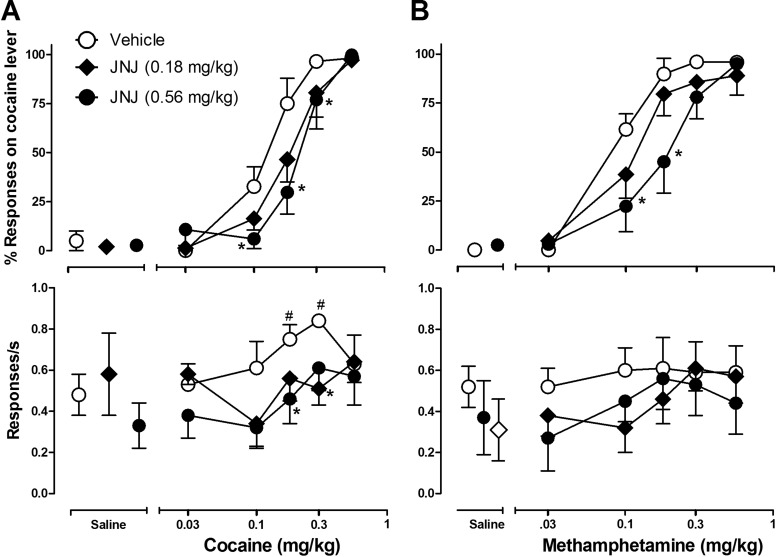
Fig. 1.
Fig. 1.
Effects of pretreatment with JNJ16259685 and vehicle on the discriminative stimulus effects of cocaine (A) and the cocaine-like discriminative stimulus effects of methamphetamine (B) in monkeys trained to discriminate cocaine from saline. Top, percentage of responses on the cocaine-associated lever. Bottom, rate of responding. Data are mean ± S.E.M. Points above the Saline column show the effects of pretreatment with vehicle or JNJ16259685 before saline. #, p < 0.05, effects of cocaine or methamphetamine compared with saline. *, p < 0.05, effects of pretreatment with JNJ16259685 compared with its vehicle; Bonferroni t test.
Fig. 2.
Fig. 2.
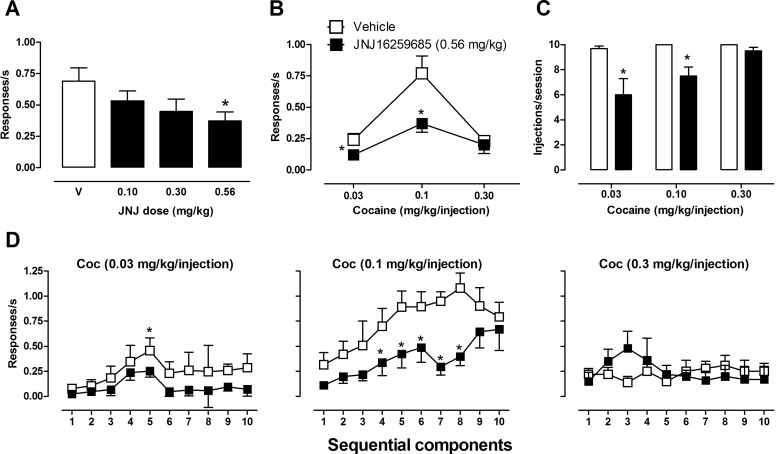
Effects of pretreatment with JNJ16259685 and vehicle on cocaine self-administration under a second-order schedule of intravenous drug delivery. A, JNJ16259685 dose-response curve; the empty bar shows the effects of the JNJ16259685 vehicle. B, cocaine dose-response function after pretreatment with JNJ16259685 or vehicle. C, number of injections/session self-administered during cocaine availability. D, within-session analyses showing the effects of pretreatment with JNJ16259685 or vehicle on the rate of responding during sequential components of cocaine self-administration sessions. *, p < 0.05, effects of pretreatment with JNJ16259685 compared with vehicle, Bonferroni t test.
Fig. 3.
Fig. 3.
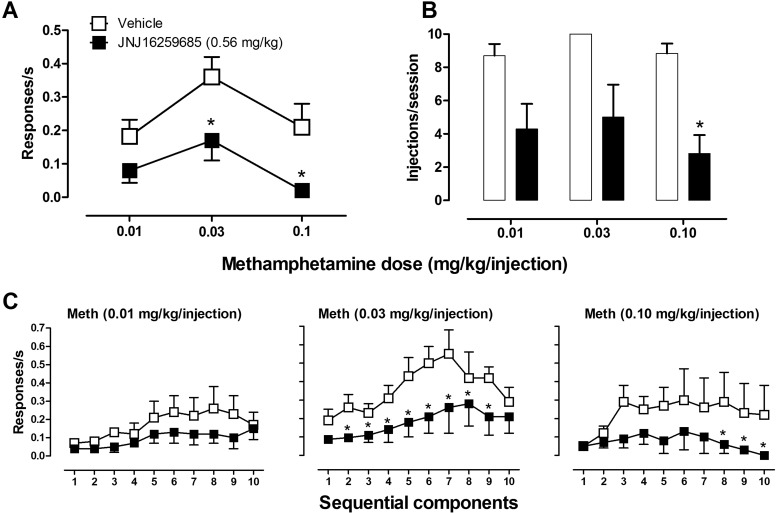
Effects of pretreatment with JNJ16259685 and vehicle on methamphetamine self-administration under a second-order schedule of intravenous drug delivery. A, methamphetamine dose-response curve after pretreatment with JNJ16259685 or vehicle. B, number of injections/session self-administered during methamphetamine availability. C, within-session analyses showing effects of pretreatment with JNJ16259685 or vehicle on the rate of responding during sequential components of methamphetamine self-administration sessions. *, p < 0.05, effects of pretreatment with JNJ16259685 compared with vehicle, Bonferroni t test.
Fig. 4.
Fig. 4.
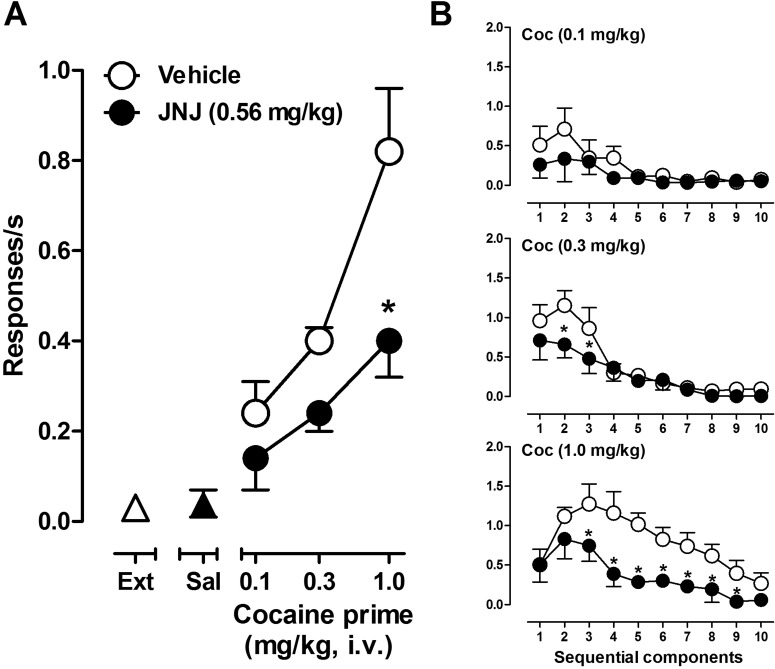
Effects of pretreatment with JNJ16259685 and vehicle on reinstatement of drug seeking induced by cocaine priming and restoration of the cocaine-paired stimulus. A, cocaine priming dose-response curve after pretreatment with JNJ16259685 or vehicle. ▵ shows the baseline response rate under extinction conditions. ▴ shows the response rate after priming with a saline injection. B, within-session analyses showing the effects of pretreatment with JNJ16259685 or vehicle on the rate of responding during sequential components of reinstatement test sessions. *, p < 0.05, effects of pretreatment with JNJ16259685 compared with vehicle, Bonferroni t test.
Fig. 5.
Fig. 5.
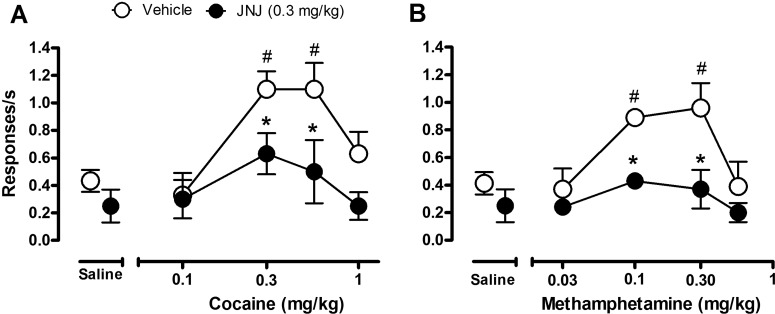
Effects of pretreatment with JNJ16259685 and vehicle on the behavioral stimulant effects of cocaine and methamphetamine under a second-order schedule of food delivery. A, cocaine dose-response curve after pretreatment with JNJ16259685 or vehicle. B, methamphetamine dose-response curve after pretreatment with JNJ16259685 or vehicle (right). Points above the Saline column show effects of pretreatment with JNJ16259685 or its vehicle before saline. #, p < 0.05, effects of cocaine or methamphetamine compared with saline. *, p < 0.05, effects of pretreatment with JNJ16259685 compared with pretreatment with vehicle; Bonferroni t test.

References

    1. Achat-Mendes C, Grundt P, Cao J, Platt DM, Newman AH, Spealman RD. (2010) Dopamine D3 and D2 receptor mechanisms in the abuse-related behavioral effects of cocaine: studies with preferential antagonists in squirrel monkeys. J Pharmacol Exp Ther 334:556–565 - PMC - PubMed
    1. Bellone C, Lüscher C. (2006) Cocaine triggered AMPA receptor redistribution is reversed in vivo by mGluR-dependent long-term depression. Nat Neurosci 9:636–641 - PubMed
    1. Besheer J, Faccidomo S, Grondin JJ, Hodge CW. (2008) Effects of mGlu1-receptor blockade on ethanol self-administration in inbred alcohol-preferring rats. Alcohol 42:13–20 - PMC - PubMed
    1. Bird MK, Lawrence AJ. (2009) Group I metabotropic glutamate receptors: involvement in drug-seeking and drug-induced plasticity. Curr Mol Pharmacol 2: 83–94 - PubMed
    1. Bruton RK, Ge J, Barnes NM. (1999) Group I mGlu receptor modulation of dopamine release in the rat striatum in vivo. Eur J Pharmacol 369:175–181 - PubMed

Publication types

MeSH terms

Substances