


Coevolution of white matter hyperintensities and cognition in the elderly
- PMID: 22815562
- PMCID: PMC3405254
- DOI: 10.1212/WNL.0b013e3182617136
Coevolution of white matter hyperintensities and cognition in the elderly
Abstract
Objective: To investigate the effects of baseline white matter hyperintensity (WMH) and rates of WMH extension and emergence on rate of change in cognition (episodic memory and executive function).
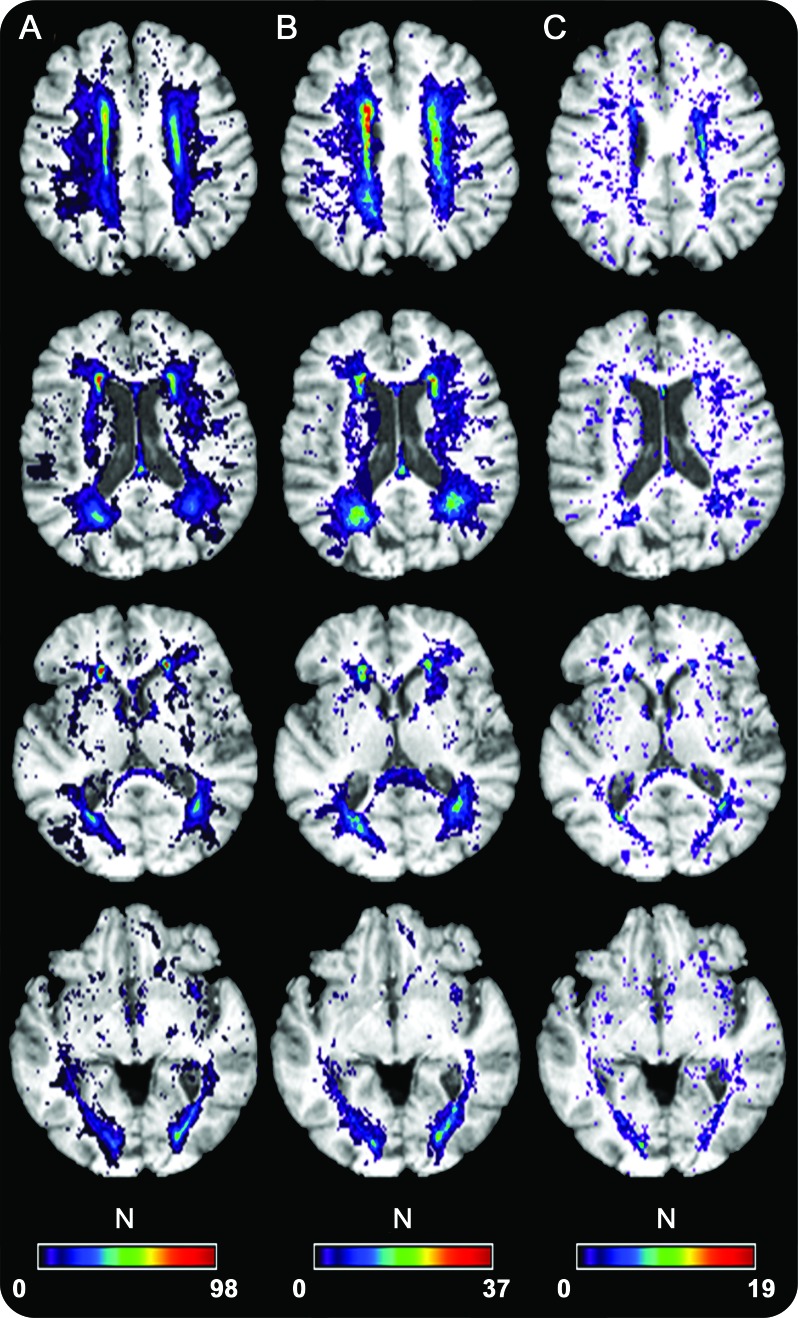
Methods: A total of 150 individuals including cognitively normal elderly individuals and those with Alzheimer disease and mild cognitive impairment completed serial episodic memory and executive function evaluations and serial MRI scans sufficient for longitudinal measurement of WMH (mean delay 4.0 years). Incident WMH voxels were categorized as extended (baseline WMH that grew larger) or emergent (newly formed WMH). We used a stepwise regression approach to investigate the effects of baseline WMH and rates of WMH extension and emergence on rate of change in cognition (episodic memory and executive function).
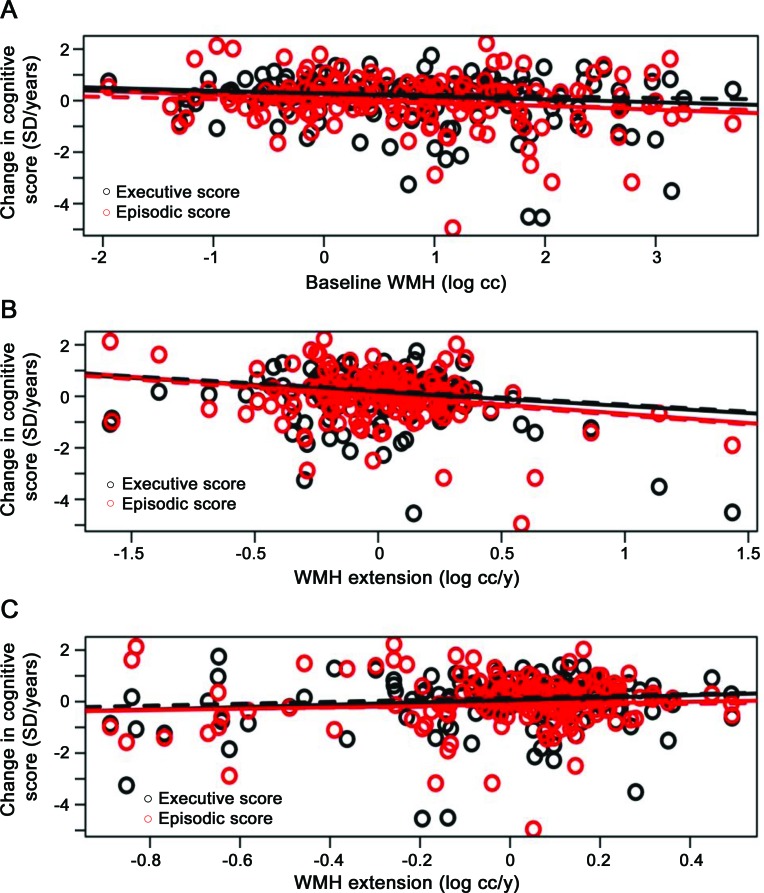
Results: WMH burden significantly increased over time, and approximately 80% of incident WMH voxels represented extensions of existing lesions. Each 1 mL/y increase in WMH extension was associated with an additional 0.70 SD/y of subsequent episodic memory decrease (p = 0.0053) and an additional 0.55 SD/y of subsequent executive function decrease (p = 0.022). Emergent WMHs were not found to be associated with a change in cognitive measures.
Conclusions: Aging-associated WMHs evolve significantly over a 4-year period. Most of this evolution represents worsening injury to the already compromised surround of existing lesions. Increasing WMH was also significantly associated with declining episodic memory and executive function. This finding supports the view that white matter disease is an insidious and continuously evolving process whose progression has clinically relevant cognitive consequences.
Figures
References
-
- DeCarli C, Murphy DG, Tranh M, et al. The effect of white matter hyperintensity volume on brain structure, cognitive performance, and cerebral metabolism of glucose in 51 healthy adults. Neurology 1995; 45: 2077– 2084 - PubMed
-
- O'Brien J, Desmond P, Ames D, Schweitzer I, Harrigan S, Tress B. A magnetic resonance imaging study of white matter lesions in depression and Alzheimer's disease. Br J Psychiatry 1996; 168: 477– 485 - PubMed
-
- Buckner RL. Memory and executive function in aging and AD: multiple factors that cause decline and reserve factors that compensate. Neuron 2004; 44: 195– 208 - PubMed
-
- DeCarli C, Miller BL, Swan GE, Reed T, Wolf PA, Carmelli D. Cerebrovascular and brain morphologic correlates of mild cognitive impairment in the National Heart, Lung, and Blood Institute Twin Study. Arch Neurol 2001; 58: 643– 647 - PubMed
Publication types
MeSH terms
Grants and funding
LinkOut - more resources
Full Text Sources
Medical
