


Cyberbullying definition among adolescents: a comparison across six European countries
- PMID: 22817693
- PMCID: PMC3443335
- DOI: 10.1089/cyber.2012.0040
Cyberbullying definition among adolescents: a comparison across six European countries
Abstract
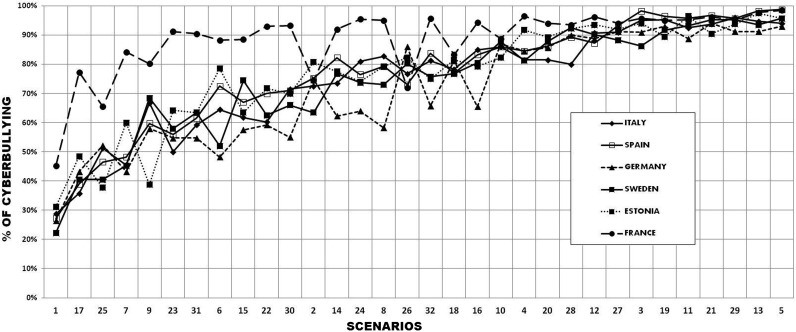
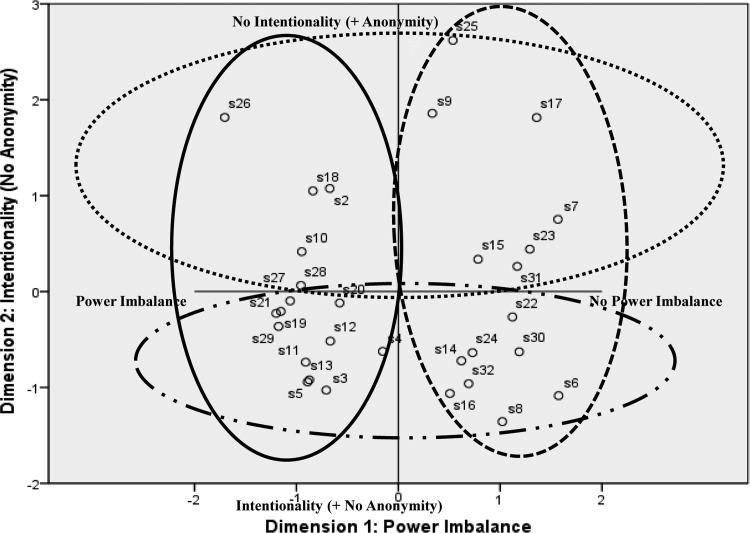
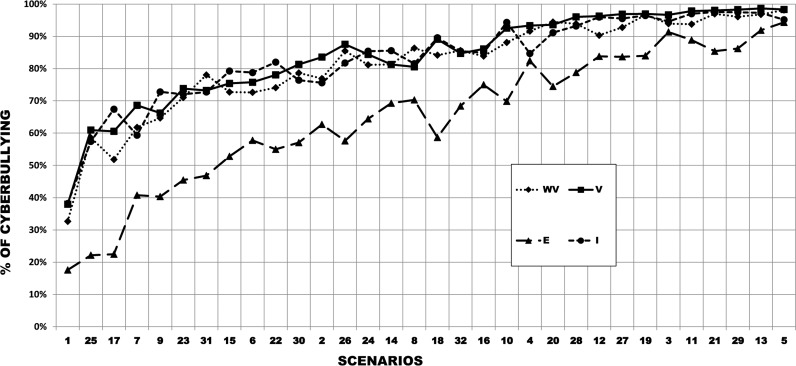
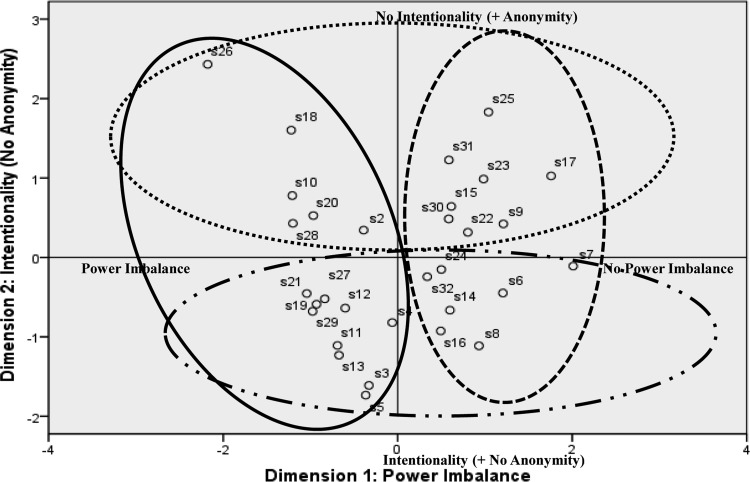
Several criteria have been proposed for defining cyberbullying to young people, but no studies have proved their relevance. There are also variations across different countries in the meaning and the definition of this behavior. We systematically investigated the role of five definitional criteria for cyberbullying, in six European countries. These criteria (intentionality, imbalance of power, repetition, anonymity, and public vs. private) were combined through a set of 32 scenarios, covering a range of four types of behaviors (written-verbal, visual, exclusion, and impersonation). For each scenario, participants were asked whether it was cyberbullying or not. A randomized version of the questionnaire was shown to 295 Italian, 610 Spanish, 365 German, 320 Sweden, 336 Estonian, and 331 French adolescents aged 11-17 years. Results from multidimensional scaling across country and type of behavior suggested a clear first dimension characterized by imbalance of power and a clear second dimension characterized by intentionality and, at a lower level, by anonymity. In terms of differences across types of behaviors, descriptive frequencies showed a more ambiguous role for exclusion as a form of cyberbullying, but general support was given to the relevance of the two dimensions across all the types of behavior. In terms of country differences, French participants more often perceived the scenarios as cyberbullying as compared with those in other countries, but general support was found for the relevance of the two dimensions across countries.
Figures
References
-
- Menesini E. Nocentini A. Cyberbullying definition and measurement: some critical considerations. Zeitschrift fur Psychologie/Journal of Psychology. 2009;217:230–232.
-
- Nocentini A. Calmaestra J. Schultze-Krumbholz A, et al. Cyberbullying: labels, behaviours and definition in three European countries. Australian Journal of Guidance and Counselling. 2010;20:129–142.
-
- Tokunaga SR. Following you home from school: a critcal review and synthesis of research on cyberbullying victimization. Computers in Human Behavior. 2009;26:277–287.
-
- Smith PK. Cyberbullying and cyber aggression. In: Jimerson RS, editor; Nickerson BA, editor; Mayer JM, editor; Furlong JM, editor. Handbook of school violence and school safety: international research and practice. New York: NY: Routledge; 2011.
-
- Smith PK. Cowie H. Olafsson FR, et al. Definitions of bullying: a comparison of terms used, and age and gender differences, in a fourteen-country international comparison. Child Development. 2002;73:1119–1133. - PubMed
Publication types
MeSH terms
LinkOut - more resources
Full Text Sources
Medical
