


Results of a phase II open-label, non-randomized trial of cisplatin chemotherapy in patients with BRCA1-positive metastatic breast cancer
- PMID: 22817698
- PMCID: PMC3680929
- DOI: 10.1186/bcr3231
Results of a phase II open-label, non-randomized trial of cisplatin chemotherapy in patients with BRCA1-positive metastatic breast cancer
Abstract
Introduction: The purpose of this investigation was to evaluate the efficacy of cisplatin chemotherapy in BRCA1 mutation carriers with metastatic breast cancer.
Methods: In a phase II, open-label study, 20 patients with metastatic breast cancer who carried a mutation in BRCA1 were treated with cisplatin 75 mg/m2 intravenously every 3 weeks as part of a 21-day cycle for 6 cycles. Restaging studies to assess response were performed after cycles 2 and 6, and every three months thereafter.
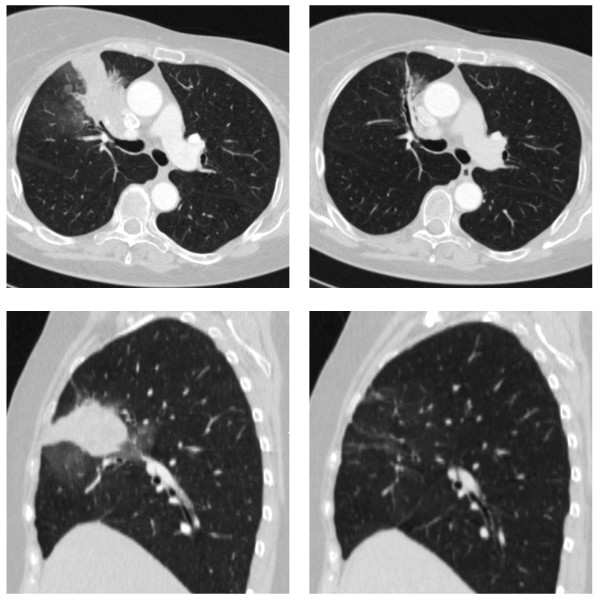
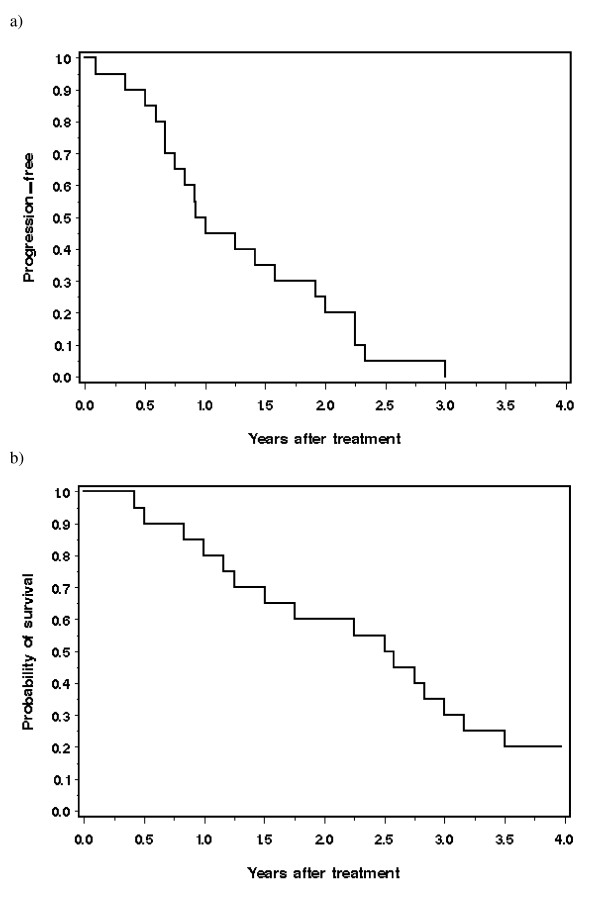
Results: Between July 2007 and January 2009, 20 patients were enrolled. Baseline characteristics were as follows: 65% had prior adjuvant chemotherapy, 55% had prior chemotherapy for metastatic breast cancer; mean age was 48 years (ranges 32 to 70); 30% estrogen receptor (ER) or progesterone receptor (PR)+, 70% ER/PR/Human Epidermal Growth Factor Receptor 2 (HER2)- and 0% HER2+. Overall response rate was 80%; nine patients experienced a complete clinical response (45%) and seven experienced a partial response (35%). Overall survival was 80% at one year, 60% at two years and 25% at three years. Four of the 20 patients are alive four years after initiating treatment. The median time to progression was 12 months. The median survival from the start of cisplatinum treatment was 30 months. Cisplatin-related adverse events, including nausea (50%), anemia (5%) and neutropenia (35%) were mostly mild to moderate in severity.
Conclusions: This phase II study demonstrates that cisplatin chemotherapy has high activity in women with a BRCA1 mutation and metastatic breast cancer and is generally well tolerated.
Trial registration: This trial is registered retrospectively on the clinical trials website ClinicalTrials.gov. The identifier is NCT01611727.
Figures
Comment in
-
Platinum chemotherapy for BRCA1-related breast cancer: do we need more evidence?Breast Cancer Res. 2012 Nov 13;14(6):115. doi: 10.1186/bcr3332. Breast Cancer Res. 2012. PMID: 23146216 Free PMC article.
References
-
- Byrski T, Gronwald J, Huzarski T, Grzybowska E, Budryk M, Stawicka M, Mierzwa T, Szwiec M, Wiśniowski R, Siolek M, Narod SA, Lubinski J. Response to neoadjuvant chemotherapy in women with BRCA1-positive breast cancers. Breast Cancer Res Treat. 2008;14:289–296. doi: 10.1007/s10549-007-9600-1. - DOI - PubMed
-
- Fong PC, Boss DS, Yap TA, Tutt A, Wu P, Mergui-Roelvink M, Mortimer P, Swaisland H, Lau A, O'Connor MJ, Ashworth A, Carmichael J, Kaye SB, Schellens JH, de Bono JS. Inhibition of poly(ADP-ribose) polymerase in tumors from BRCA mutation carriers. N Engl J Med. 2009;14:123–134. doi: 10.1056/NEJMoa0900212. - DOI - PubMed
-
- Lakhani SR, Jacquemier J, Sloane JP, Gusterson BA, Anderson TJ, van de Vijver MJ, Farid LM, Venter D, Antoniou A, Storger-Isser A, Smyth E, Steel CM, Haites N, Scott RJ, Goldgar D, Neuhausen S, Daly PA, Ormiston W, McManus R, Scherneck S, Ponder BA, Ford D, Peto J, Stoppa-Lyonnet D, Bignon YJ, Struewing JP, Spurr NK, Bishop DT, Klijn JG, Devilee P. et al. Multifactorial analysis of differences between sporadic breast cancers and cancers involving BRCA1 and BRCA2 mutations. J Natl Cancer Inst. 1998;14:1138–1145. doi: 10.1093/jnci/90.15.1138. - DOI - PubMed
Publication types
MeSH terms
Substances
Associated data
LinkOut - more resources
Full Text Sources
Other Literature Sources
Medical
Research Materials
Miscellaneous
