


Contemporary evidence about hospital strategies for reducing 30-day readmissions: a national study
- PMID: 22818070
- PMCID: PMC3537181
- DOI: 10.1016/j.jacc.2012.03.067
Contemporary evidence about hospital strategies for reducing 30-day readmissions: a national study
Abstract
Objectives: This study sought to determine the range and prevalence of practices being implemented by hospitals to reduce 30-day readmissions of patients with heart failure or acute myocardial infarction (AMI).
Background: Readmissions of patients with heart failure or AMI are both common and costly; however, evidence on strategies adopted by hospitals to reduce readmission rates is limited.
Methods: We used a Web-based survey to conduct a cross-sectional study of hospitals' reported use of specific practices to reduce readmissions for patients with heart failure or AMI. We contacted all hospitals enrolled in the Hospital to Home (H2H) quality improvement initiative as of July 2010. Of 594 hospitals, 537 completed the survey (response rate of 90.4%). We used standard frequency analysis to describe the prevalence of key hospital practices in the areas of: 1) quality improvement resources and performance monitoring; 2) medication management efforts; and 3) discharge and follow-up processes.
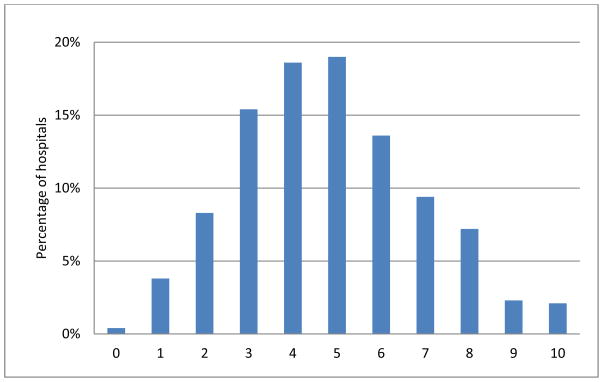
Results: Nearly 90% of hospitals agreed or strongly agreed that they had a written objective of reducing preventable readmission for patients with heart failure or AMI. More hospitals reported having quality improvement teams to reduce preventable readmissions for patients with heart failure (87%) than for patients with AMI (54%). Less than one-half (49.3%) of hospitals had partnered with community physicians and only 23.5% had partnered with local hospitals to manage patients at high risk for readmissions. Inpatient and outpatient prescription records were electronically linked usually or always in 28.9% of hospitals, and the discharge summary was always sent directly to the patient's primary medical doctor in only 25.5% of hospitals. On average, hospitals used 4.8 of 10 key practices; <3% of hospitals utilized all 10 practices.
Conclusions: Although most hospitals have a written objective of reducing preventable readmissions of patients with heart failure or AMI, the implementation of recommended practices varied widely. More evidence establishing the effectiveness of various practices is needed.
Copyright © 2012 American College of Cardiology Foundation. Published by Elsevier Inc. All rights reserved.
Figures
Comment in
-
Hospital strategies to reduce heart failure readmissions: where is the evidence?J Am Coll Cardiol. 2012 Aug 14;60(7):615-7. doi: 10.1016/j.jacc.2012.03.066. Epub 2012 Jul 18. J Am Coll Cardiol. 2012. PMID: 22818073 No abstract available.
References
-
- Krumholz HM, Merrill AR, Schone EM, et al. Patterns of hospital performance in acute myocardial infarction and heart failure 30-day mortality and readmission. Circ Cardiovasc Qual Outcomes. 2009;2(5):407–13. - PubMed
-
- Keenan PS, Normand SL, Lin Z, et al. An administrative claims measure suitable for profiling hospital performance on the basis of 30-day all-cause readmission rates among patients with heart failure. Circ Cardiovasc Qual Outcomes. 2008;1(1):29–37. - PubMed
Publication types
MeSH terms
Grants and funding
LinkOut - more resources
Full Text Sources
Medical
