


Atomoxetine modulates spontaneous and sensory-evoked discharge of locus coeruleus noradrenergic neurons
- PMID: 22820275
- PMCID: PMC3445720
- DOI: 10.1016/j.neuropharm.2012.07.020
Atomoxetine modulates spontaneous and sensory-evoked discharge of locus coeruleus noradrenergic neurons
Abstract
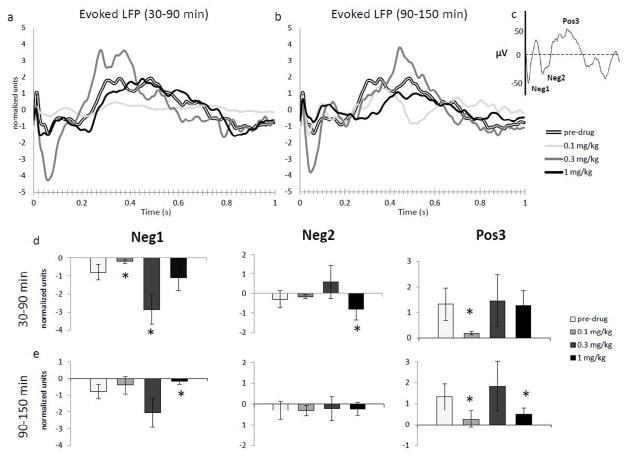
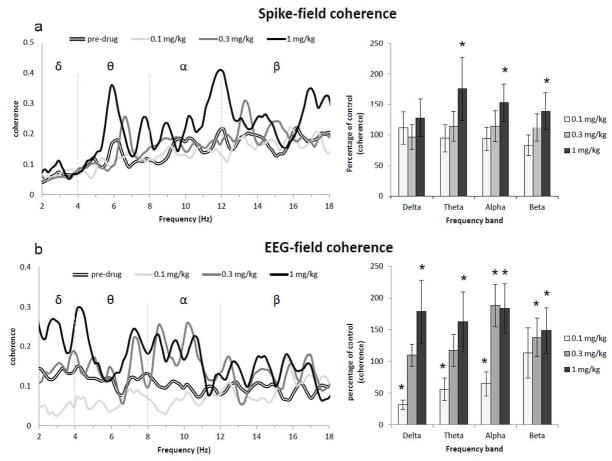
Atomoxetine (ATM) is a potent norepinephrine (NE) uptake inhibitor and increases both NE and dopamine synaptic levels in prefrontal cortex, where it is thought to exert its beneficial effects on attention and impulsivity. At the behavioral level, ATM has been shown to cause improvements on the measures of executive functions, such as response inhibition, working memory and attentional set shifting across different species. However, the exact mechanism of action for ATM's effects on cognition is still not clear. One possible target for the cognitive enhancing effects of ATM is the noradrenergic locus coeruleus (LC), the only source of NE to key forebrain areas such as cerebral cortex and hippocampus. Although it is known that ATM increases NE availability overall by blocking reuptake of NE, the effects of this agent on impulse activity of LC neurons have not been reported. Here, the effect of ATM (0.1-1 mg/kg, ip) on NE-LC neurons was investigated by recording extracellular activity of LC neurons in isoflurane-anesthetized rats. ATM caused a significant decrease of the tonic activity of LC single-units, although leaving intact the sensory-evoked excitatory component of LC phasic response. Moreover, the magnitude of the inhibitory component of LC response to paw stimulation was increased after 1 mg/kg of ATM and its duration was prolonged at 0.3 mg/kg. Together, these effects of ATM produced an increase in the phasic-to-tonic ratio of LC phasic response to sensory stimulation. ATM also modulated the average sensory-evoked local field potential (LFP) and spike-field coherence in LC depending on the dose tested. The lower dose (0.1 mg/kg) significantly decreased early positive and negative components of the sensory-evoked LFP response. Higher doses (0.3-1 mg/kg) initially increased and then decreased the amplitude of components of the evoked fields, whereas the spike-field coherence was enhanced by 1 mg/kg ATM across frequency bands. Finally, coherence between LC fields and EEG signals was generally increased by 1 mg/kg ATM, whereas 0.1 and 0.3 mg/kg respectively decreased and increased coherence values in specific frequency bands. Taken together these results suggest that ATM effects on LC neuronal activity are dose-dependent, with different doses affecting different aspects of LC firing. This modulation of activity of LC-NE neurons may play a role in the cognitive effects of ATM. This article is part of a Special Issue entitled 'Cognitive Enhancers'.
Copyright © 2012 Elsevier Ltd. All rights reserved.
Figures


Similar articles
-
Atomoxetine reverses attentional deficits produced by noradrenergic deafferentation of medial prefrontal cortex.Psychopharmacology (Berl). 2008 Sep;200(1):39-50. doi: 10.1007/s00213-008-1097-8. Epub 2008 Jun 22. Psychopharmacology (Berl). 2008. PMID: 18568443 Free PMC article.
-
The effects of tonic locus ceruleus output on sensory-evoked responses of ventral posterior medial thalamic and barrel field cortical neurons in the awake rat.J Neurosci. 2004 Dec 1;24(48):10773-85. doi: 10.1523/JNEUROSCI.1573-04.2004. J Neurosci. 2004. PMID: 15574728 Free PMC article.
-
Corticotropin-releasing hormone increases tonic but not sensory-evoked activity of noradrenergic locus coeruleus neurons in unanesthetized rats.J Neurosci. 1988 Mar;8(3):1016-25. doi: 10.1523/JNEUROSCI.08-03-01016.1988. J Neurosci. 1988. PMID: 3258021 Free PMC article.
-
Noradrenergic and locus coeruleus modulation of the perforant path-evoked potential in rat dentate gyrus supports a role for the locus coeruleus in attentional and memorial processes.Prog Brain Res. 1991;88:307-21. doi: 10.1016/s0079-6123(08)63818-2. Prog Brain Res. 1991. PMID: 1687619 Review.
-
Discharge of noradrenergic locus coeruleus neurons in behaving rats and monkeys suggests a role in vigilance.Prog Brain Res. 1991;88:501-20. doi: 10.1016/s0079-6123(08)63830-3. Prog Brain Res. 1991. PMID: 1813931 Review.
Cited by
-
Interactions of nitric oxide with α2 -adrenoceptors within the locus coeruleus underlie the facilitation of inhibitory avoidance memory by agmatine.Br J Pharmacol. 2016 Sep;173(17):2589-99. doi: 10.1111/bph.13531. Epub 2016 Aug 1. Br J Pharmacol. 2016. PMID: 27273730 Free PMC article.
-
Atomoxetine accelerates attentional set shifting without affecting learning rate in the rat.Psychopharmacology (Berl). 2015 Oct;232(20):3697-707. doi: 10.1007/s00213-015-4028-5. Epub 2015 Jul 24. Psychopharmacology (Berl). 2015. PMID: 26202614
-
Dextroamphetamine (but Not Atomoxetine) Induces Reanimation from General Anesthesia: Implications for the Roles of Dopamine and Norepinephrine in Active Emergence.PLoS One. 2015 Jul 6;10(7):e0131914. doi: 10.1371/journal.pone.0131914. eCollection 2015. PLoS One. 2015. PMID: 26148114 Free PMC article.
-
Methylphenidate and atomoxetine enhance sensory-evoked neuronal activity in the visual thalamus of male rats.Exp Clin Psychopharmacol. 2013 Oct;21(5):363-74. doi: 10.1037/a0033563. Exp Clin Psychopharmacol. 2013. PMID: 24099357 Free PMC article.
-
Pupil diameter reflects uncertainty in attentional selection during visual search.Front Hum Neurosci. 2015 Aug 4;9:435. doi: 10.3389/fnhum.2015.00435. eCollection 2015. Front Hum Neurosci. 2015. PMID: 26300759 Free PMC article.
References
-
- Aghajanian GK. Mescaline and LSD facilitate the activation of locus coeruleus neurons by peripheral stimuli. Brain Res. 1980;186:492–498. - PubMed
-
- Aghajanian GK, Cedarbaum JM, Wang RY. Evidence for norepinephrine-mediated collateral inhibition of locus coeruleus neurons. Brain Res. 1977;136:570–577. - PubMed
-
- Akaoka H, Roussel B, Lin JS, Chouvet G, Jouvet M. Effect of modafinil and amphetamine on the rat catecholaminergic neuron activity. Neurosci Lett. 1991;123:20–22. - PubMed
-
- Arnsten AF. Modulation of prefrontal cortical-striatal circuits: relevance to therapeutic treatments for Tourette syndrome and attention-deficit hyperactivity disorder. Adv Neurol. 2001;85:333–341. - PubMed
Publication types
MeSH terms
Substances
Grants and funding
LinkOut - more resources
Full Text Sources
Other Literature Sources
Research Materials
Miscellaneous
