


Characterization of peripheral and mucosal immune responses in rhesus macaques on long-term tenofovir and emtricitabine combination antiretroviral therapy
- PMID: 22820802
- PMCID: PMC3494791
- DOI: 10.1097/QAI.0b013e318266be53
Characterization of peripheral and mucosal immune responses in rhesus macaques on long-term tenofovir and emtricitabine combination antiretroviral therapy
Abstract
Background: The goal of antiretroviral therapy (ART) is to suppress virus replication to limit immune system damage. Some have proposed combining ART with immune therapies to boost antiviral immunity. For this to be successful, ART must not impair physiological immune function.
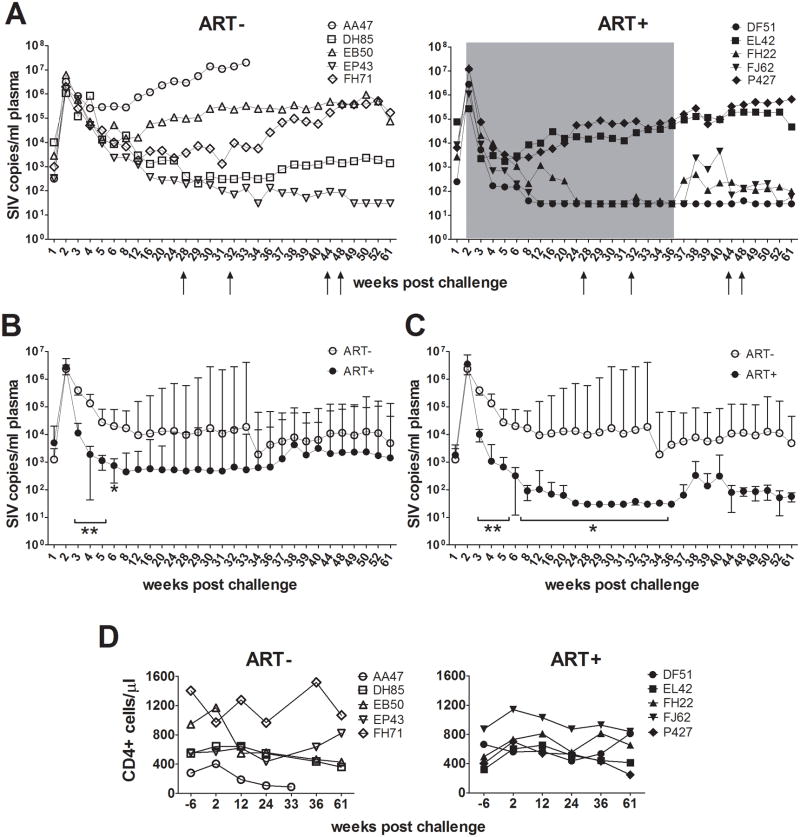
Methods: We studied the impact of ART (tenofovir and emtricitabine) on systemic and mucosal immunity in uninfected and simian immunodeficiency (SIV)-infected Chinese rhesus macaques. Subcutaneous ART was initiated 2 weeks after tonsillar inoculation with SIVmac239.
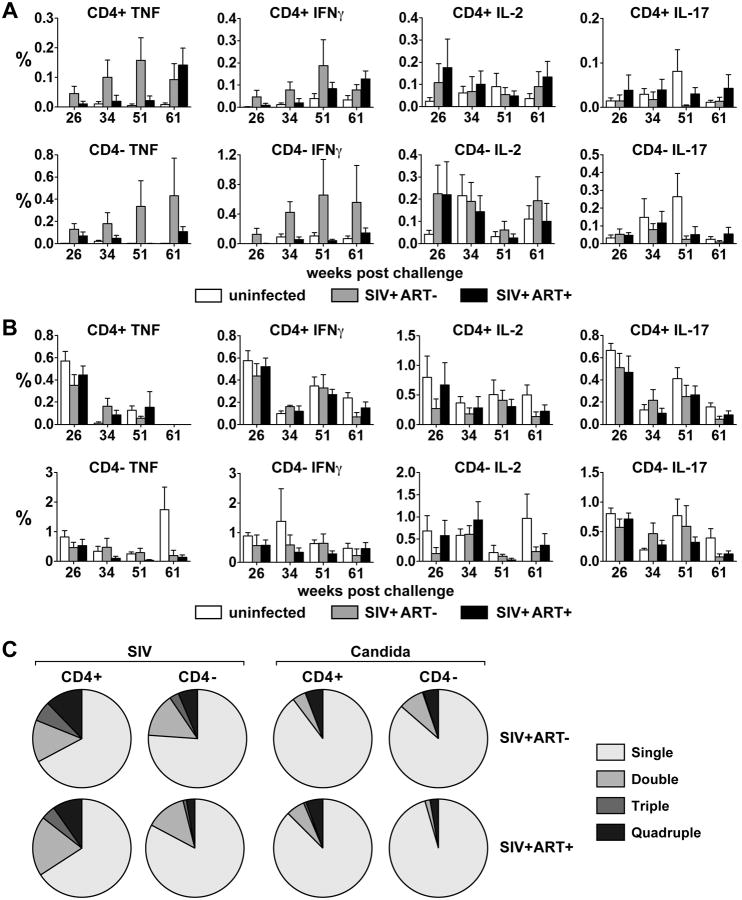
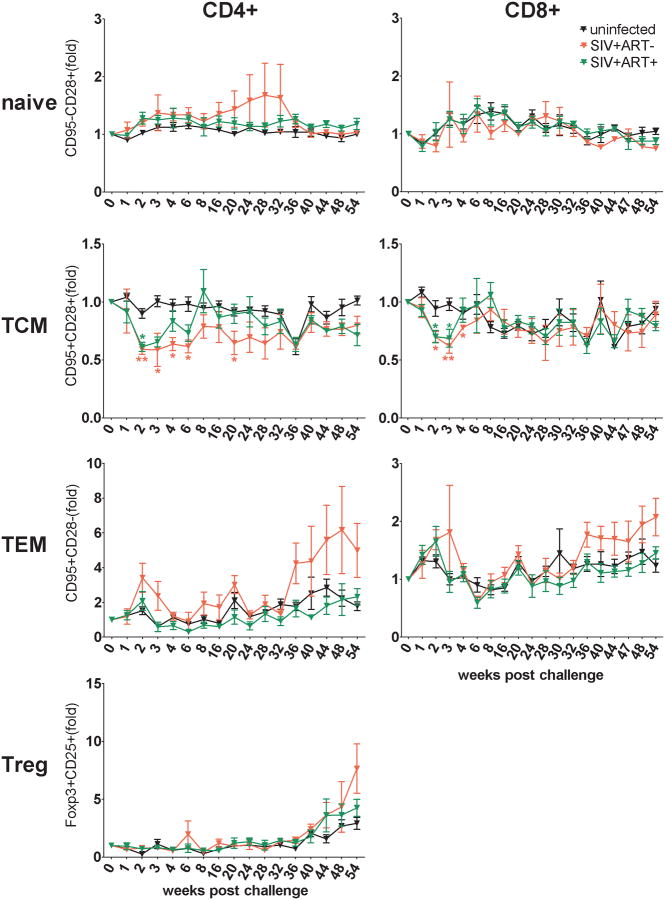
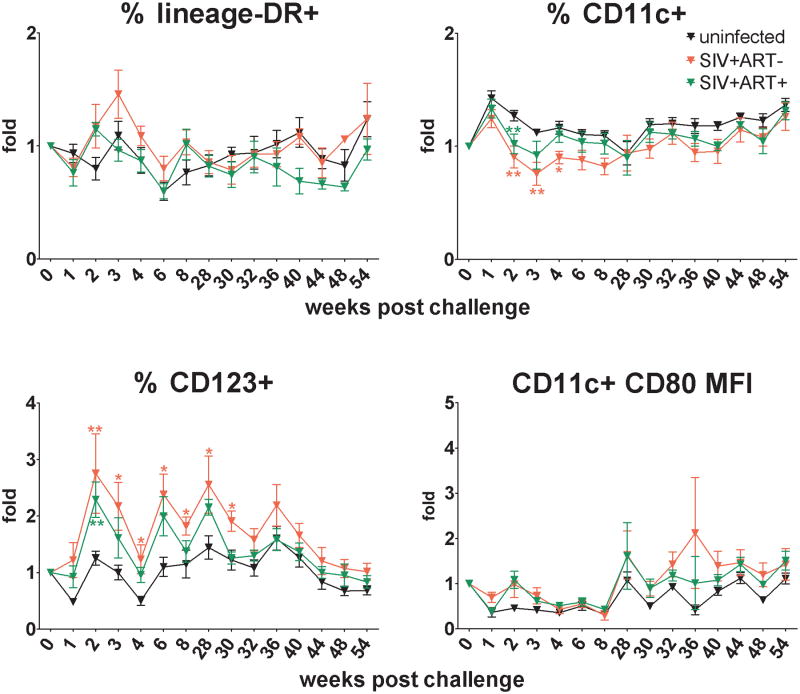
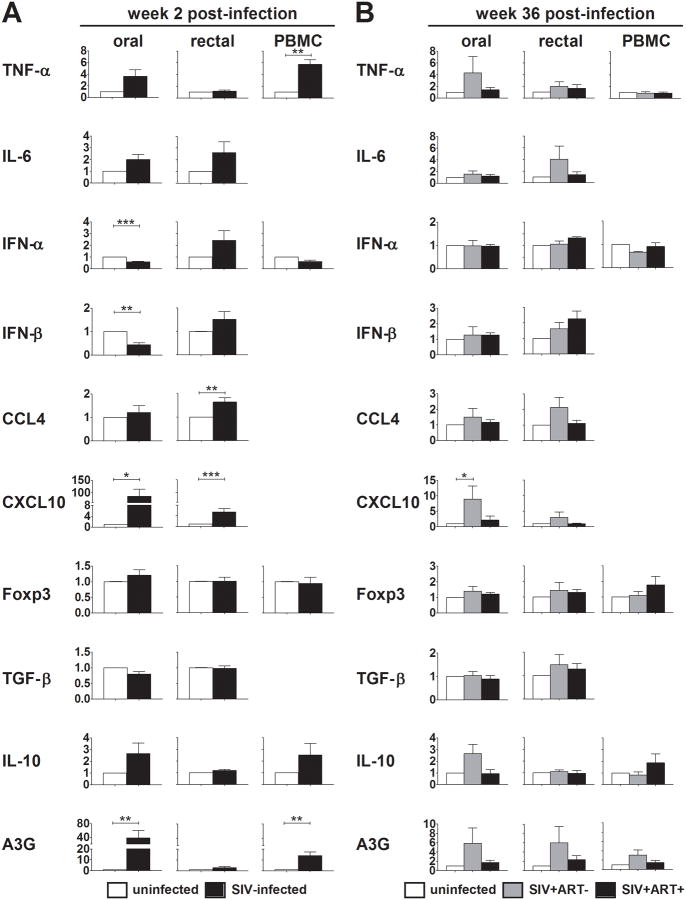
Results: There was no evidence of immune dysregulation as a result of ART in either infected or uninfected animals. Early virus-induced alterations in circulating immune cell populations (decreased central memory T cells and myeloid dendritic cells) were detected, but normalized shortly after ART initiation. ART-treated animals showed marginal SIV-specific T-cell responses during treatment, which increased after ART discontinuation. Elevated expression of CXCL10 in oral, rectal, and blood samples and APOBEC3G mRNA in oral and rectal tissues was observed during acute infection and was down regulated after starting ART. ART did not impact the ability of the animals to respond to tonsillar application of polyICLC with increased CXCL10 expression in oral fluids and CD80 expression on blood myeloid dendritic cells.
Conclusion: Early initiation of ART prevented virus-induced damage and did not impede mucosal or systemic immune functions.
Conflict of interest statement
None of the authors has a conflict of interest with this research. None of the material in this manuscript has been published or is under consideration elsewhere.
Figures
References
-
- Desrosiers RC. The simian immunodeficiency viruses. Ann Rev Immunol. 1990;8:557–578. - PubMed
-
- Desrosiers RC. Non-human primate models for AIDS vaccines. Aids. 1995;9(Suppl A):S137–141. - PubMed
-
- Van Rompay KK. Evaluation of antiretrovirals in animal models of HIV infection. Antiviral Res. 2010 Jan;85(1):159–175. - PubMed
-
- Van Rompay KK. Antiretroviral drug studies in nonhuman primates: a valid animal model for innovative drug efficacy and pathogenesis experiments. AIDS Rev. 2005 Apr-Jun;7(2):67–83. - PubMed
-
- Franchini G, Nacsa J, Hel Z, Tryniszewska E. Immune intervention strategies for HIV-1 infection of humans in the SIV macaque model. Vaccine. 2002 Dec 19;20(Suppl 4):A52–60. - PubMed
Publication types
MeSH terms
Substances
Grants and funding
- G20 RR019607/RR/NCRR NIH HHS/United States
- G20 RR018397/RR/NCRR NIH HHS/United States
- G20 RR021381/RR/NCRR NIH HHS/United States
- 1G20RR21381/RR/NCRR NIH HHS/United States
- DE018293/DE/NIDCR NIH HHS/United States
- 1CO6RR012112-01/CO/NCI NIH HHS/United States
- R01 DE018293/DE/NIDCR NIH HHS/United States
- RR000164/RR/NCRR NIH HHS/United States
- 1G20RR013466-01/RR/NCRR NIH HHS/United States
- HHSN261200800001C/RC/CCR NIH HHS/United States
- HHSN261200800001E/CA/NCI NIH HHS/United States
- G20 RR022760/RR/NCRR NIH HHS/United States
- G20 RR013466/RR/NCRR NIH HHS/United States
- 1G20RR016930-01/RR/NCRR NIH HHS/United States
- G20 RR019628/RR/NCRR NIH HHS/United States
- 1G20RR22760/RR/NCRR NIH HHS/United States
- G20 RR016930/RR/NCRR NIH HHS/United States
- 1G20RR018397-01/RR/NCRR NIH HHS/United States
- P51 RR000164/RR/NCRR NIH HHS/United States
- 1G20RR019607-01/RR/NCRR NIH HHS/United States
- 1G20RR019628-01/RR/NCRR NIH HHS/United States
- P51 OD011104/OD/NIH HHS/United States
LinkOut - more resources
Full Text Sources
Medical
Molecular Biology Databases
