


Bidirectional relations between parenting practices and child externalizing behavior: a cross-lagged panel analysis in the context of a psychosocial treatment and 3-year follow-up
- PMID: 22821450
- PMCID: PMC3626089
- DOI: 10.1007/s10802-012-9670-3
Bidirectional relations between parenting practices and child externalizing behavior: a cross-lagged panel analysis in the context of a psychosocial treatment and 3-year follow-up
Abstract
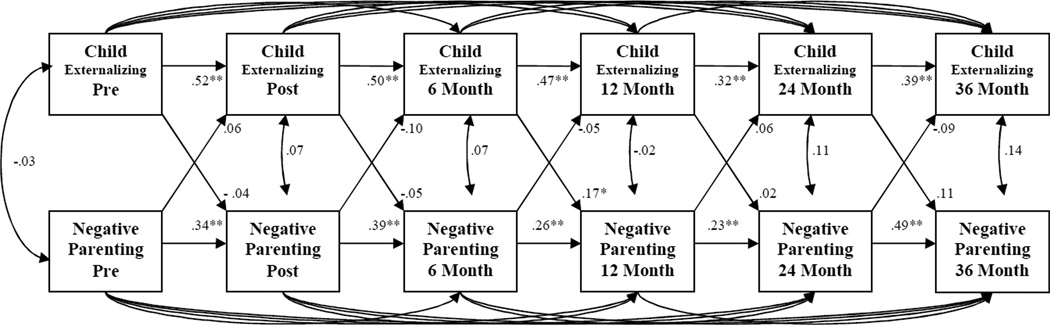
In the current study, we examined longitudinal changes in, and bidirectional effects between, parenting practices and child behavior problems in the context of a psychosocial treatment and 3-year follow-up period. The sample comprised 139 parent-child dyads (child ages 6-11) who participated in a modular treatment protocol for early-onset ODD or CD. Parenting practices and child behavior problems were assessed at six time-points using multiple measures and multiple reporters. The data were analyzed using cross-lagged panel analyses. Results indicated robust temporal stabilities of parenting practices and child behavior problems, in the context of treatment-related improvements, but bidirectional effects between parenting practices and child behavior were less frequently detected. Our findings suggest that bidirectional effects are relatively smaller than the temporal stability of each construct for school-age children with ODD/CD and their parents, following a multi-modal clinical intervention that is directed at both parents and children. Implications for treatment and intervention are discussed.
Figures
References
-
- Achenbach TM. Integrative guide for the 1991 CBCL/4-18, YSR, and TRF profiles. Burlington, VT: University of Vermont, Department of Psychiatry; 1991.
-
- Albrecht AK, Galambos NL, Jansson SM. Adolescents’ internalizing and aggressive behaviors and perceptions of parents’ psychological control: A panel study examining direction of effects. Journal of Youth and Adolescence. 2007;36:673–684.
-
- Baron RM, Kenny DA. The moderator-mediator variable distinction in social psychological research: conceptual, strategic, and statistical considerations. Journal of Social and Personality Psychology. 1986;51:1173–1182. - PubMed
-
- Beauchaine TS, Webster-Stratton C, Reid MJ. Mediators, moderators, and predictors of 1-year outcomes among children treated for early-onset conduct problems: a latent growth curve analysis. Journal of Consulting and Clinical Psychology. 2005;73:371–388. - PubMed
-
- Bell RQ. A reinterpretation of the direction of effects in studies of socialization. Psychological Review. 1968;75:81–95. - PubMed
Publication types
MeSH terms
Grants and funding
LinkOut - more resources
Full Text Sources
Medical
