doi: 10.1007/978-1-4614-3704-8_26.
Mass spectrometry tools for analysis of intermolecular interactions
Affiliations
- PMID: 22821539
- PMCID: PMC4638115
- DOI: 10.1007/978-1-4614-3704-8_26
Item in Clipboard
Mass spectrometry tools for analysis of intermolecular interactions
Methods Mol Biol.
2012.
Abstract
The small quantities of protein required for mass spectrometry (MS) make it a powerful tool to detect binding (protein-protein, protein-small molecule, etc.) of proteins that are difficult to express in large quantities, as is the case for many intrinsically disordered proteins. Chemical cross-linking, proteolysis, and MS analysis, combined, are a powerful tool for the identification of binding domains. Here, we present a traditional approach to determine protein-protein interaction binding sites using heavy water ((18)O) as a label. This technique is relatively inexpensive and can be performed on any mass spectrometer without specialized software.
Figures
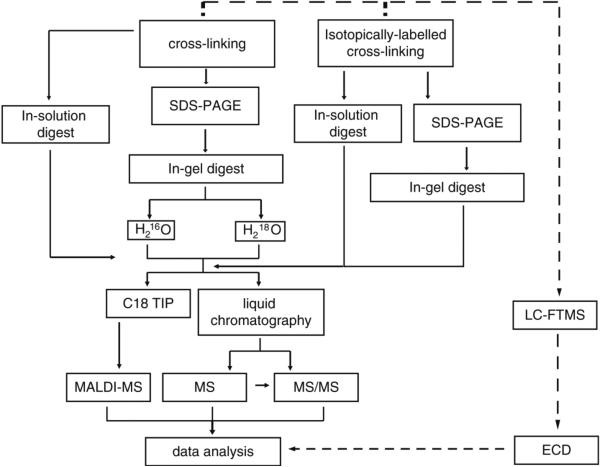
Mass spectrometry analysis of protein binding work-flow.

Heavy water labeled peptides and cross-linked peptides. (a) Mass spectra of a peptide; box zoomed in (b). (b) An unlabelled m/z at 1,380.7 and its labeled counterpart at 1,384.7; the shift in mass of four indicates a non-cross-linked peptide. (c) Mass Spectra of a cross-linked peptide (box; zoomed in (d)). Analyzing the spectra by hand allows for the majority of cross-linked pairs to be identified. (d) An unlabelled m/z at 2,156.1 and its labeled counterpart at 2,164.5; the shift in mass of eight indicates a cross-linked peptide. The cross-linking complicates the spectral analysis; however, it is still possible to distinguish the pair of related m/z values based on the isotopic label.

Noncovalent Interactions using the FTICR. (Top) Spectra of protein alone. (Bottom) Protein incubated with a panel of small molecules. The addition of a new peak indicates protein–compound complex (noncovalent interaction).
References
-
- Dunker AK, et al. Intrinsically disordered protein. (Translated from eng). J Mol Graph Model. 2001;19(1):26–59. (in eng) - PubMed
-
- Yates JR, Ruse CI, Nakorchevsky A. Proteomics by mass spectrometry: approaches, advances, and applications. (Translated from eng). Annu Rev Biomed Eng. 2009;11:49–79. (in eng) - PubMed
-
- Back JW, de Jong L, Muijsers AO, de Koster CG. Chemical cross-linking and mass spectrometry for protein structural modeling. (Translated from eng). J Mol Biol. 2003;331(2):303–313. (in eng) - PubMed
-
- Eyles SJ, Kaltashov IA. Methods to study protein dynamics and folding by mass spectrometry. (Translated from eng). Methods. 2004;34(1):88–99. (in eng) - PubMed
-
- Farmer TB, Caprioli RM. Determination of protein-protein interactions by matrix-assisted laser desorption/ionization mass spectrometry. (Translated from eng). J Mass Spectrom. 1998;33(8):697–704. (in eng) - PubMed
Publication types
MeSH terms
Substances
Grants and funding
LinkOut - more resources
Full Text Sources