A randomized trial comparing buttonhole with rope ladder needling in conventional hemodialysis patients
- PMID: 22822010
- PMCID: PMC3463206
- DOI: 10.2215/CJN.02730312
A randomized trial comparing buttonhole with rope ladder needling in conventional hemodialysis patients
Abstract
Background and objectives: Buttonhole needling is reported to be associated with less pain than standard needling. The purpose of this study was to compare patient perceived pain and fistula complications in buttonhole and standard needling.
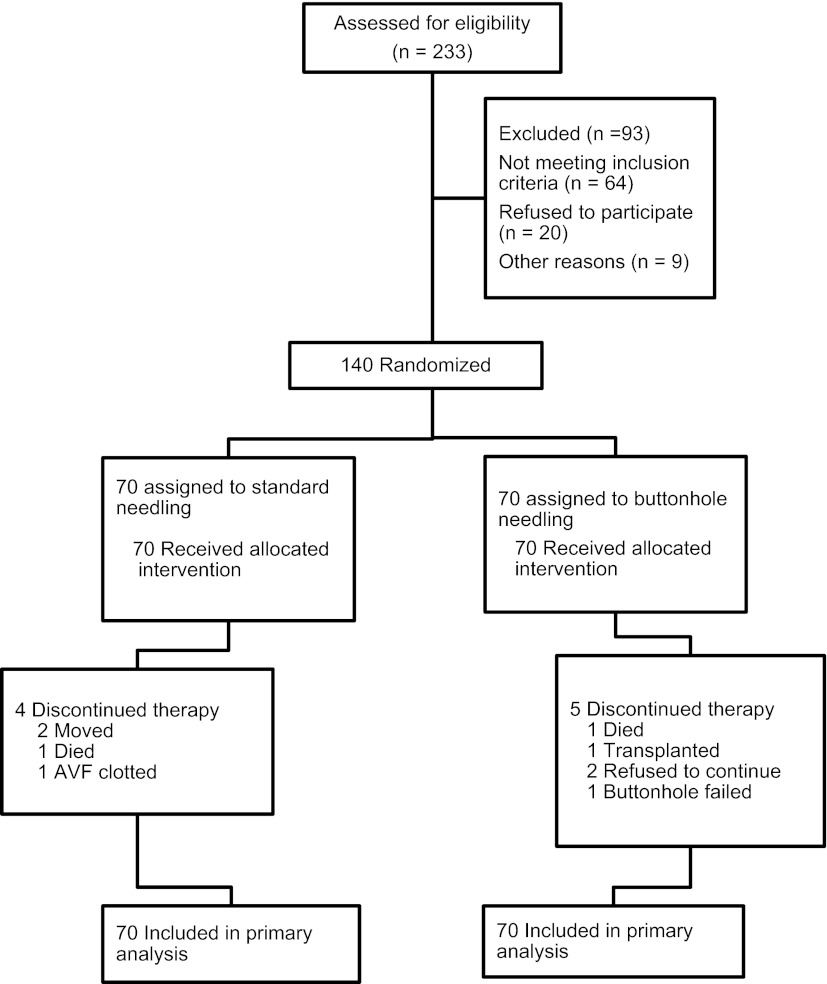
Design, setting, participants, & measurements: In this study, 140 conventional hemodialysis patients were randomly assigned to buttonhole or standard needling. The primary outcome was patient perceived pain with needling at 8 weeks. Fistula complications of hematoma, bleeding postdialysis, and infection were tracked.
Results: Median pain score at 8 weeks using a visual analog scale from 0 to 10 cm was similar for standard and buttonhole needling (1.2 [0.4-2.4] versus 1.5 [0.5-3.4]; P=0.57). Rate of hematoma formation in standard needling was higher (436 versus 295 of 1000 hemodialysis sessions; P=0.03). Rate of no bleeding postdialysis was 23.6 and 28.3 per 1000 in standard and buttonhole needling, respectively (P=0.40). Rate of localized signs of infection in standard versus buttonhole needling was 22.4 versus 50 per 1000 (P=0.003). There was one episode of Staphylococcal aureus bacteremia during the 8 weeks with buttonhole needling and no episodes with standard needling (P=1.00). Within 12 months of follow-up, another two buttonhole needling episodes developed S. aureus bacteremia, and nine buttonhole needling episodes had needling site abscesses requiring intravenous antibiotics versus zero standard needling episodes (P=0.003).
Conclusions: Patients had no difference in pain between buttonhole and standard needling. Although fewer buttonhole needling patients developed a hematoma, there was an increased risk of bacteremia and localized signs of infection. Routine use of buttonhole needling is associated with increased infection risk.
Figures
Comment in
-
Accessing the access.Clin J Am Soc Nephrol. 2012 Oct;7(10):1548-50. doi: 10.2215/CJN.08670812. Epub 2012 Sep 13. Clin J Am Soc Nephrol. 2012. PMID: 22977211 No abstract available.
References
-
- Allon M: Current management of vascular access. Clin J Am Soc Nephrol 2: 786–800, 2007 - PubMed
-
- Polkinghorne KR, McDonald SP, Marshall MR, Atkins RC, Kerr PG: Vascular access practice patterns in the New Zealand hemodialysis population. Am J Kidney Dis 43: 696–704, 2004 - PubMed
-
- Lee T, Barker J, Allon M: Needle infiltration of arteriovenous fistulae in hemodialysis: Risk factors and consequences. Am J Kidney Dis 47: 1020–1026, 2006 - PubMed
-
- Twardowski Z, Kubar H: Different sites versus constant sites of needle insertion into arteriovenou fistulas for treatment by repeated dialysis. Dial Transplant 8: 978–980, 1979
Publication types
MeSH terms
Substances
Associated data
LinkOut - more resources
Full Text Sources
Medical