Sex differences in the association of childhood socioeconomic status with adult blood pressure change: the CARDIA study
- PMID: 22822232
- PMCID: PMC3434230
- DOI: 10.1097/PSY.0b013e31825e32e8
Sex differences in the association of childhood socioeconomic status with adult blood pressure change: the CARDIA study
Abstract
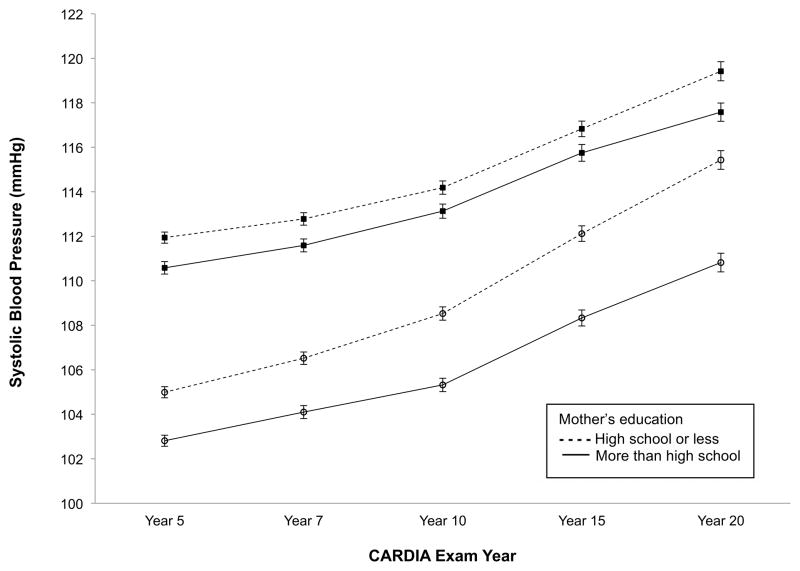
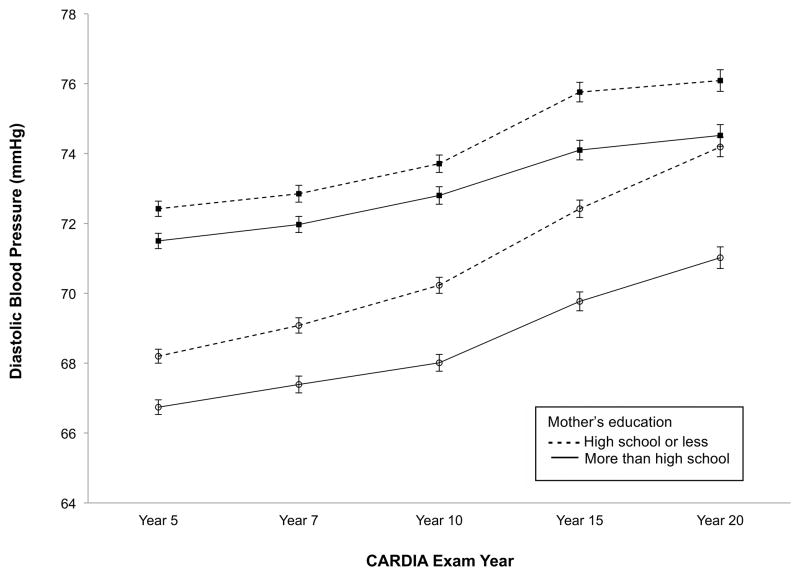
Objective: To examine sex differences in the relation of childhood socioeconomic status (CSES) to systolic (SBP) and diastolic blood pressure (DBP) trajectories during 15 years, spanning young (mean [M] [standard deviation {SD}] = 30 [3] years) and middle (M [SD] = 45 [3] years) adulthood, independent of adult SES.
Methods: A total of 4077 adult participants reported father's and mother's educational attainments at study enrollment (Year 0) and own educational attainment at enrollment and at all follow-up examinations. Resting BP also was measured at all examinations. Data from examination Years 5 (when participant M [SD] age = 30 [3] years), 7, 10, 15, and 20 are examined here. Associations of own adult (Year 5), mother's, and father's educations with 15-year BP trajectories were examined in separate multilevel models. Fully controlled models included time-invariant covariates (age, sex, race, recruitment center) and time-varying covariates that were measured at each examination (marital status, body mass, cholesterol, oral contraceptives/hormones, and antihypertensive drugs). Analyses of parental education controlled for own education.
Results: When examined without covariates, higher education - own (SBP γ = -0.03, DBP γ = -0.03), mother's (SBP γ = -0.02, DBP γ = -0.02), and father's (SBP γ = -0.02, DBP γ = -0.01) - were associated with attenuated 15-year increases in BP (p < .001). Associations of own (but not either parent's) education with BP trajectories remained independent of standard controls. Sex moderated the apparent null effects of parental education, such that higher parental education-especially mother's, predicted attenuated BP trajectories independent of standard covariates among women (SBP γ = -0.02, p = .02; DBP γ = -0.01, p = .04) but not men (SBP γ = 0.02, p = .06; DBP γ = 0.005, p = .47; p interaction SBP < .001, p interaction DBP = .01).
Conclusions: Childhood socioeconomic status may influence women's health independent of their own adult status.
Figures
References
-
- Cohen S, Janicki-Deverts D, Chen E, Matthews KA. Childhood socioeconomic status and adult health. The Biology of Disadvantage. In: Adler N, Stewart J, editors. Ann NY Acad Sci. Vol. 1186. 2010. pp. 37–55. - PubMed
-
- Galobardes B, Lynch JW, Davey Smith G. Childhood socioeconomic circumstances and cause-specific mortality in adulthood: Systematic review and interpretation. Epidemiol Rev. 2004;26:7–21. - PubMed
-
- Hamil-Luker J, O’Rand AM. Gender differences in the link between childhood socioeconomic conditions and heart attack risk in adulthood. Demography. 2007;44(1):137–158. - PubMed
Publication types
MeSH terms
Grants and funding
- N01 HC048048/HL/NHLBI NIH HHS/United States
- N01-HC-48047/HC/NHLBI NIH HHS/United States
- N01 HC048049/HL/NHLBI NIH HHS/United States
- N01-HC-48050/HC/NHLBI NIH HHS/United States
- N01-HC-48049/HC/NHLBI NIH HHS/United States
- N01 HC048047/HL/NHLBI NIH HHS/United States
- R24HL076858/HL/NHLBI NIH HHS/United States
- N01 HC048050/HL/NHLBI NIH HHS/United States
- R01-HL095296-01/HL/NHLBI NIH HHS/United States
- N01-HC-48048/HC/NHLBI NIH HHS/United States
- N01 HC095095/HL/NHLBI NIH HHS/United States
- R24 HL076858/HL/NHLBI NIH HHS/United States
- N01-HC-95095/HC/NHLBI NIH HHS/United States
- R24 HL076852/HL/NHLBI NIH HHS/United States
- HL076852/HL/NHLBI NIH HHS/United States
- R01 HL095296/HL/NHLBI NIH HHS/United States
LinkOut - more resources
Full Text Sources
Medical