


Exercise for people in early- or mid-stage Parkinson disease: a 16-month randomized controlled trial
- PMID: 22822237
- PMCID: PMC3488266
- DOI: 10.2522/ptj.20110472
Exercise for people in early- or mid-stage Parkinson disease: a 16-month randomized controlled trial
Abstract
Background: Exercise confers short-term benefits for individuals with Parkinson disease (PD).
Objective: The purpose of the study was to compare short- and long-term responses among 2 supervised exercise programs and a home-based control exercise program.
Design: The 16-month randomized controlled exercise intervention investigated 3 exercise approaches: flexibility/balance/function exercise (FBF), supervised aerobic exercise (AE), and home-based exercise (control).
Setting: This study was conducted in outpatient clinics.
Patients: The participants were 121 individuals with PD (Hoehn & Yahr stages 1-3).
Interventions: The FBF program (individualized spinal and extremity flexibility exercises followed by group balance/functional training) was supervised by a physical therapist. The AE program (using a treadmill, bike, or elliptical trainer) was supervised by an exercise trainer. Supervision was provided 3 days per week for 4 months, and then monthly (16 months total). The control group participants exercised at home using the National Parkinson Foundation Fitness Counts program, with 1 supervised, clinic-based group session per month.
Measurements: Outcomes, obtained by blinded assessors, were determined at 4, 10, and 16 months. The primary outcome measures were overall physical function (Continuous Scale-Physical Functional Performance [CS-PFP]), balance (Functional Reach Test [FRT]), and walking economy (oxygen uptake [mL/kg/min]). Secondary outcome measures were symptom severity (Unified Parkinson's Disease Rating Scale [UPDRS] activities of daily living [ADL] and motor subscales) and quality of life (39-item Parkinson's Disease Quality of Life Scale [PDQ-39]).
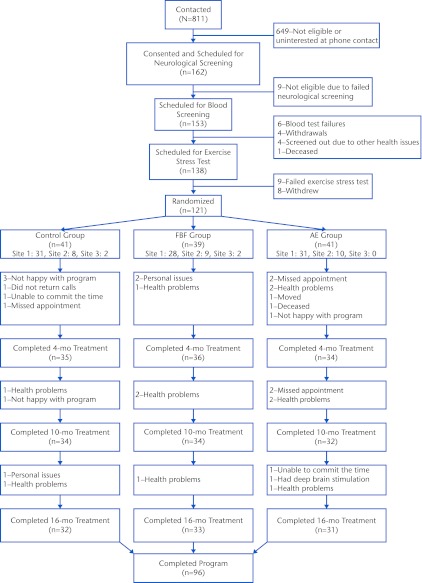
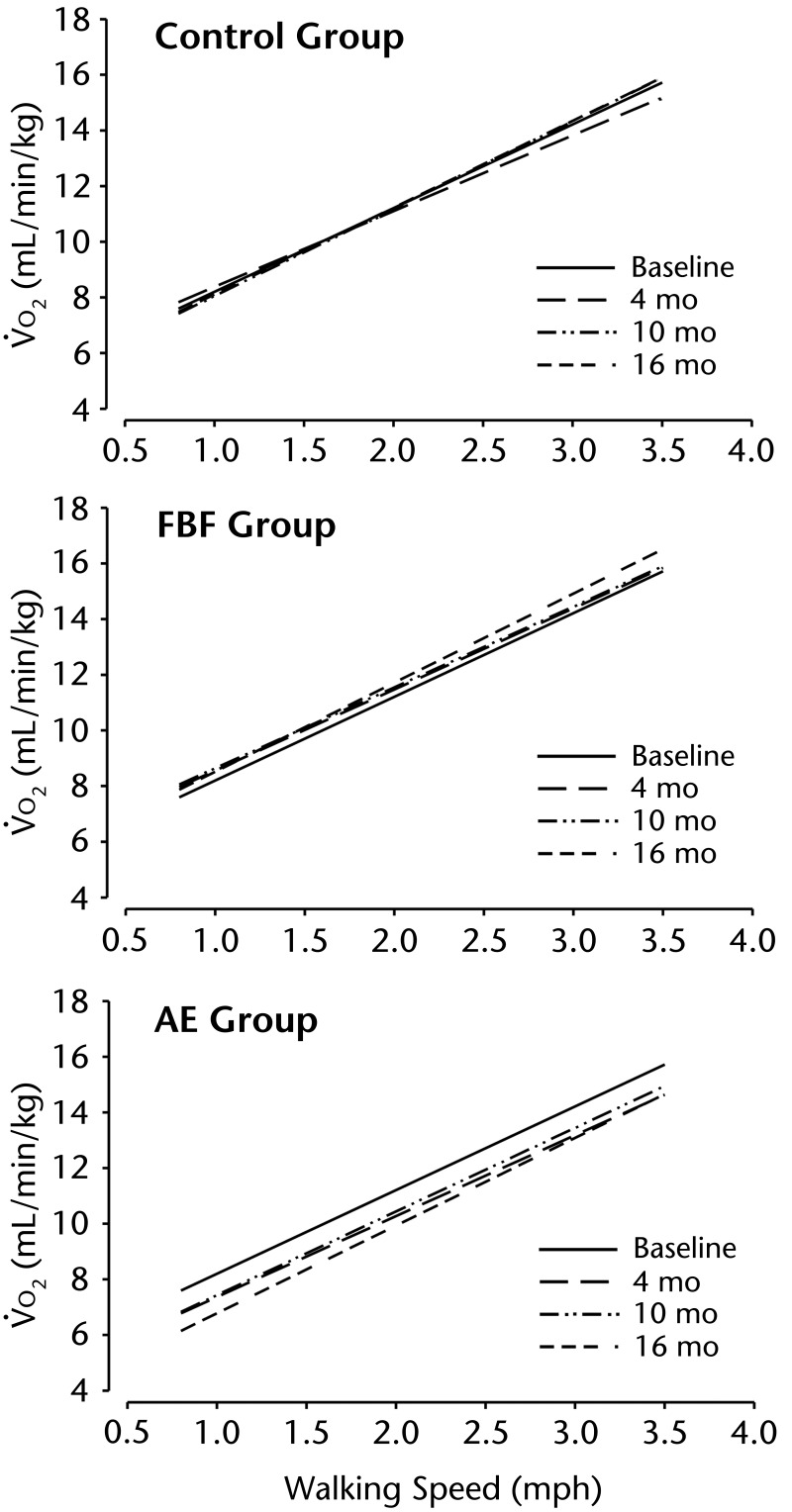
Results: Of the 121 participants, 86.8%, 82.6%, and 79.3% completed 4, 10, and 16 months, respectively, of the intervention. At 4 months, improvement in CS-PFP scores was greater in the FBF group than in the control group (mean difference=4.3, 95% confidence interval [CI]=1.2 to 7.3) and the AE group (mean difference=3.1, 95% CI=0.0 to 6.2). Balance was not different among groups at any time point. Walking economy improved in the AE group compared with the FBF group at 4 months (mean difference=-1.2, 95% CI=-1.9 to -0.5), 10 months (mean difference=-1.2, 95% CI=-1.9 to -0.5), and 16 months (mean difference=-1.7, 95% CI=-2.5 to -1.0). The only secondary outcome that showed significant differences was UPDRS ADL subscale scores: the FBF group performed better than the control group at 4 months (mean difference=-1.47, 95% CI=-2.79 to -0.15) and 16 months (mean difference=-1.95, 95% CI=-3.84 to -0.08).
Limitations: Absence of a non-exercise control group was a limitation of the study.
Conclusions: Findings demonstrated overall functional benefits at 4 months in the FBF group and improved walking economy (up to 16 months) in the AE group.
Trial registration: ClinicalTrials.gov NCT01257945.
Figures
References
-
- De Lau LM, Breteler MM. Epidemiology of Parkinson's disease. Lancet Neurol. 2006;5:525–535 - PubMed
-
- Dorsey ER, Constantinescu R, Thompson JP, et al. Projected number of people with Parkinson disease in the most populous nations, 2005 through 2030. Neurology. 2007;68:384–386 - PubMed
-
- Dibble LE, Hale T, Marcus RL, et al. The safety and feasibility of high-force eccentric resistance exercise in persons with Parkinson's disease. Arch Phys Med Rehabil. 2006;87:1280–1282 - PubMed
-
- Dibble LE, Addison O, Papa E. The effects of exercise on balance in persons with Parkinson's disease: a systematic review across the disability spectrum. J Neurol Phys Ther. 2009;33:14–26 - PubMed
Publication types
MeSH terms
Associated data
Grants and funding
LinkOut - more resources
Full Text Sources
Other Literature Sources
Medical
