. 2012;1(1):75-87.

Lowering of amyloid beta peptide production with a small molecule inhibitor of amyloid-β precursor protein dimerization

Affiliations

Lowering of amyloid beta peptide production with a small molecule inhibitor of amyloid-β precursor protein dimerization

Pauline Pl So et al. Am J Neurodegener Dis. 2012.

Abstract

The amyloid β precursor protein (APP) is a single-pass transmembrane glycoprotein that is ubiquitously expressed in many cell types, including neurons. Amyloidogenic processing of APP by β- and γ-secretases leads to the production of amyloid-β (Aβ) peptides that can oligomerize and aggregate into amyloid plaques, a characteristic hallmark of Alzheimer's disease (AD) brains. Multiple reports suggest that dimerization of APP may play a role in Aβ production; however, it is not yet clear whether APP dimers increase or decrease Aβ and the mechanism is not fully understood. To better understand the relationship between APP dimerization and production of Aβ, a high throughput screen for small molecule modulators of APP dimerization was conducted using APP-Firefly luciferase enzyme complementation to detect APP dimerization. Selected modulators identified from a compound library of 77,440 compounds were tested for their effects on Aβ generation. Two molecules that inhibited APP dimerization produced a reduction in Aβ levels as measured by ELISA. The inhibitors did not change sAPPα or γ-CTF levels, but lowered sAPPβ levels, suggesting that blocking the dimerization is preventing the cleavage by β-secretase in the amyloidogenic processing of APP. To our knowledge, this is the first High Throughput Screen (HTS) effort to identify small molecule modulators of APP dimerization. Inhibition of APP dimerization has previously been suggested as a therapeutic target in AD. The findings reported here further support that modulation of APP dimerization may be a viable means of reducing the production of Aβ.

Keywords: Alzheimer disease; amyloid beta-peptides; amyloid-β precursor protein; firefly luciferase complementation; high-throughput screening; protein dimerization.


Figures
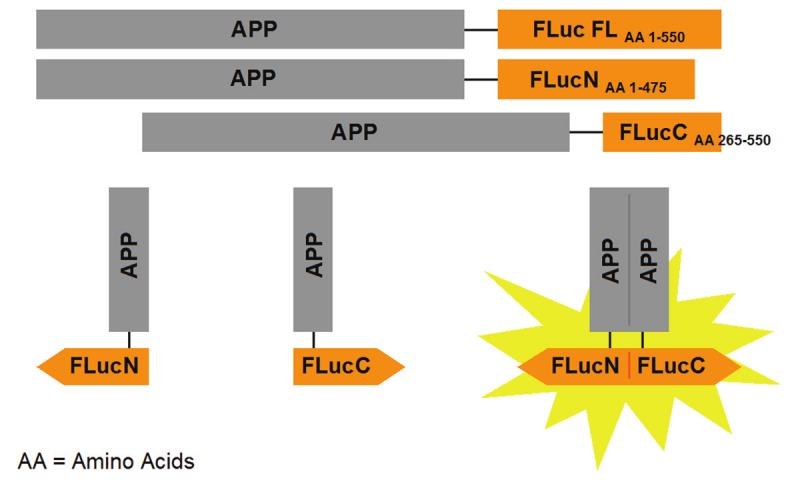
Figure 1
Figure 1
Schematic diagram of the APP-Firefly luciferase enzyme fragment complementation (APP FLuc EFC) system. Deletion mutants of the overlapping Firefly luciferase fragments were generated, where FLucN corresponds to the N-terminal fragment of luciferase with amino acids 1-475, and FLucC corresponds to the C-terminal fragment of luciferase with amino acids 265-550. APP tagged to full-length Firefly luciferase (APP FLuc FL) was constructed as a positive control for luminescence-inducing activity.
Figure 2
Figure 2
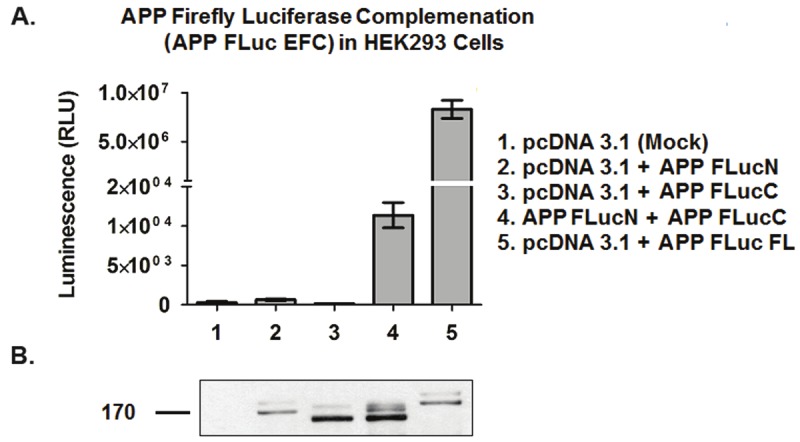
Validation of APP-Firefly luciferase system. A. Quantification of APP dimerization by measurement of luminescence. No luminescence is detected from HEK293 cells transfected with pcDNA1, or cells transfected with the APP FLucN or APP FLucC fragments alone. Luminescence is detected only in cells transfected with the APP FLuc FL control or cells cotransfected with both the APP FLucN and APP FLucC fragments (APP FLuc EFC). APP FLuc EFC activity is correlated to APP dimerization. Results shown are mean ± standard error, n = 3. B. Protein expression of APP Firefly luciferase constructs. HEK293 cell lysates were ran on 8% Tris-Glycine gel. Protein samples in each lane correspond to the luminescence samples in Figure 2A. 6E10 antibody was used at 1:1000 dilution.
Figure 3
Figure 3
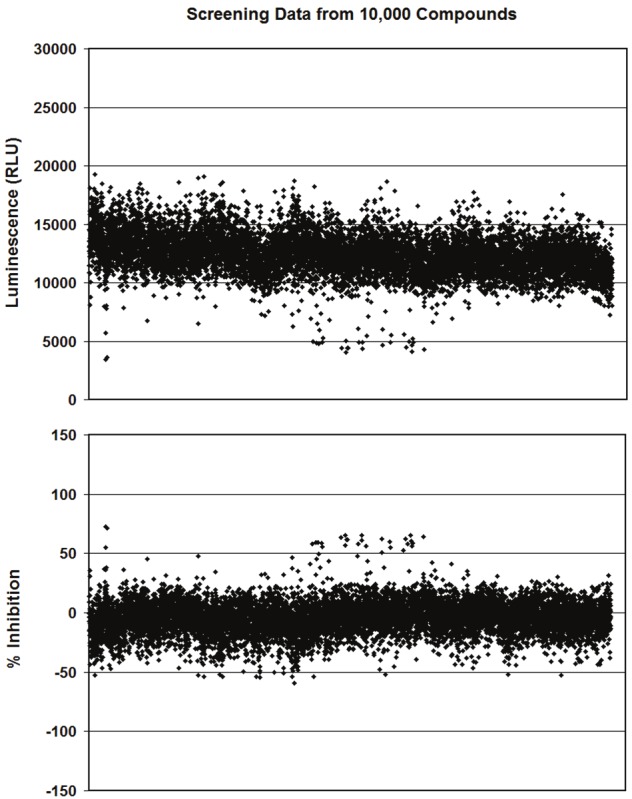
Representative results from HTS. Effects of ~10,000 compounds on stably transfected APP FLuc EFC cells are shown, which represent ~1/7 of the total compounds screened. Each data point represents a single compound. A. Luminescence results. The mean luciferase signal is about 12,000 RLU. Data points that fall lower than the mean represent potential APP dimerization inhibitors. B. Percent (%) inhibition as calculated for each compound as compared to DMSO control. % inhibition is calculated as [(Average DMSO signal - Compound Signal)/ Average DMSO Signal] x 100. Only data points that fall over the 50% or higher cutoff point are considered as potential hits.
Figure 4
Figure 4
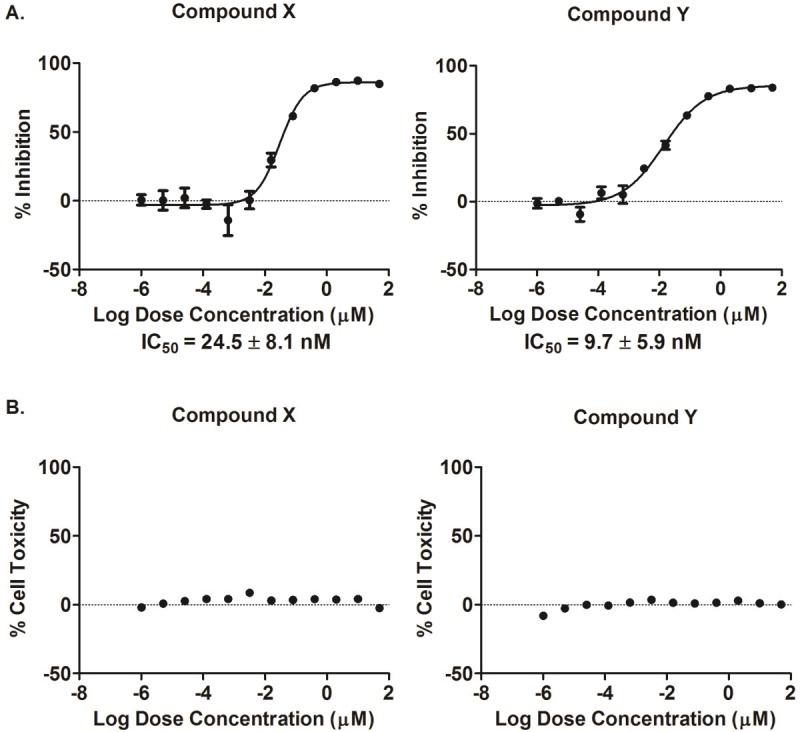
12-Point dose response and toxicity curves. Representative 12-point dose response and toxicity curves for compounds X and Y are shown. A. The dose-response curves demonstrate that increasing compound concentration increased inhibition of assay signal, which can be correlated to inhibition of APP dimerization. B. In the accompanying toxicity curves, the 12 compound doses are shown to be non-toxic to cells. IC50 values are mean ± standard deviation, n = 2, in quadruplicates.
Figure 5
Figure 5
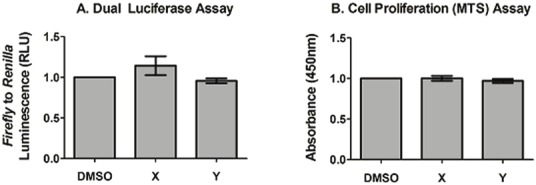
Effect of compounds on luciferase signal. A. Dual Luciferase assay. Compounds X and Y did not significantly affect luciferase signal in transfected HEK293 cells as compared to DMSO. B. Cell proliferation assay. Compounds X and Y did not affect cell number in transfected HEK293 cells as measured by MTS viability assay . Results are fold changes over DMSO control, mean ± standard error, n = 4.
Figure 6
Figure 6
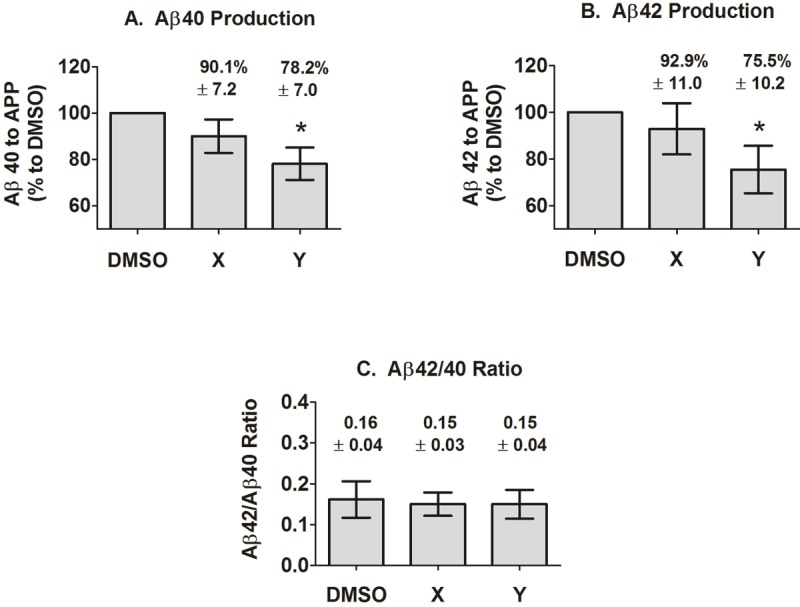
Effects of compounds on Aβ40 and 42 production. Aβ was measured from the media of stably transfected WT APP cells treated with DMSO or with 1 μM of compound X or Y by ELISA. Aβ levels are then normalized to APP protein expression via densitometry of western blots. A. Compound X did not significantly affect Aβ40 level as compared to DMSO vehicle control, but there is a trend towards a decrease. Compound Y significantly reduced Aβ40 with p<0.05. B. Similarly, compound X did not significantly affect Aβ42 as compared to DMSO vehicle control, but there is a trend towards a decrease. Compound Y significantly reduced Aβ42 with p<0.05. C. Both compounds X and Y did not affect Aβ42 to Aβ40 ratio. Results are mean ± standard error, n = 7.
Figure 7
Figure 7
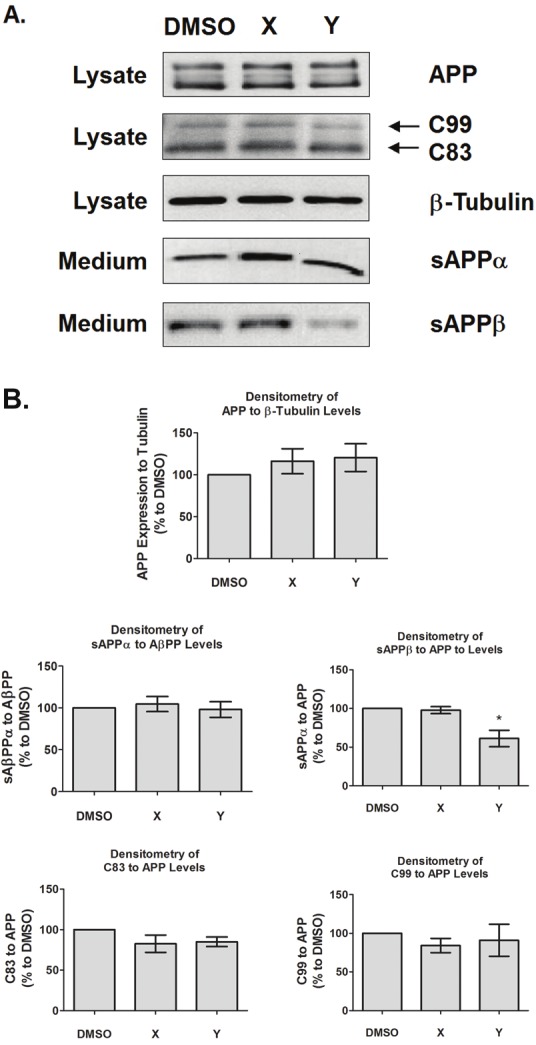
Effect of compounds on APP processing. A. Cell lysates and media from stably transfected WT APP cells treated with DMSO or with 1 μM of compound X or Y were collected and ran on 8% SDS-PAGE Tris-Glycine gel followed by western blot. The representative blots indicate the effects of compounds X and Y on APP protein expression and the APP processing products sAPPα, sAPPβ, and the γ-CTFs, C99 ad C83. B. Upon quantification, densitometric plots indicate that compound X does not affect APP expression and its processing products as compared to DMSO control. However, compound Y significantly reduced the sAPPβ at p<0.05. Results are mean ± standard error, n = 7.

References

    1. Selkoe D, Mandelkow E, Holtzman D. Deciphering Alzheimer disease. Cold Spring Harbor perspectives in medicine. 2012;2:a011460. - PMC - PubMed
    1. Huang Y, Mucke L. Alzheimer mechanisms and therapeutic strategies. Cell. 2012;148:1204–1222. - PMC - PubMed
    1. Vassar R, Bennett BD, Babu-Khan S, Kahn S, Mendiaz EA, Denis P, Teplow DB, Ross S, Amarante P, Loeloff R, Luo Y, Fisher S, Fuller J, Edenson S, Lile J, Jarosinski MA, Biere AL, Curran E, Burgess T, Louis JC, Collins F, Treanor J, Rogers G, Citron M. Beta-secretase cleavage of Alzheimer's amyloid precursor protein by the transmembrane aspartic protease BACE. Science. 1999;286:735–741. - PubMed
    1. Lin X, Koelsch G, Wu S, Downs D, Dashti A, Tang J. Human aspartic protease memapsin 2 cleaves the beta-secretase site of beta-amyloid precursor protein. Proc Natl Acad Sci U S A. 2000;97:1456–1460. - PMC - PubMed
    1. De Strooper B. Aph-1, Pen-2, and Nicastrin with Presenilin generate an active gamma-Secretase complex. Neuron. 2003;38:9–12. - PubMed

LinkOut - more resources