


Does the home environment and the sex of the child modify the adverse effects of prenatal exposure to chlorpyrifos on child working memory?
- PMID: 22824009
- PMCID: PMC3901426
- DOI: 10.1016/j.ntt.2012.07.004
Does the home environment and the sex of the child modify the adverse effects of prenatal exposure to chlorpyrifos on child working memory?
Abstract
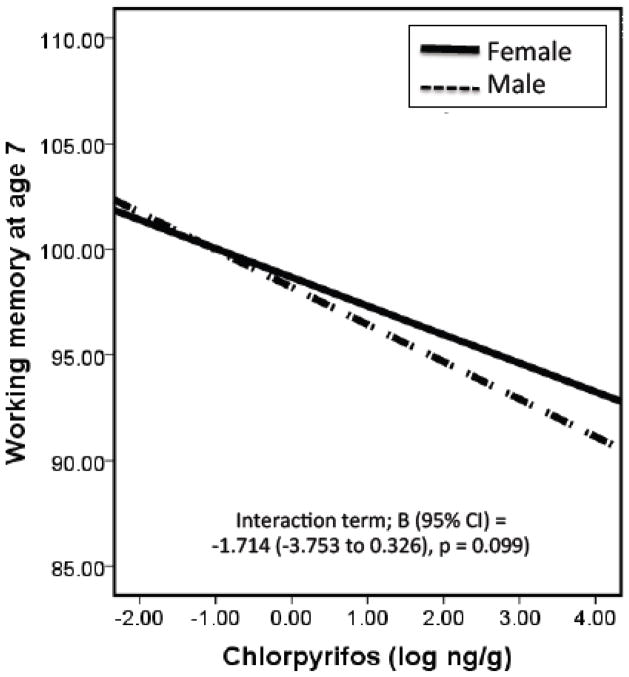
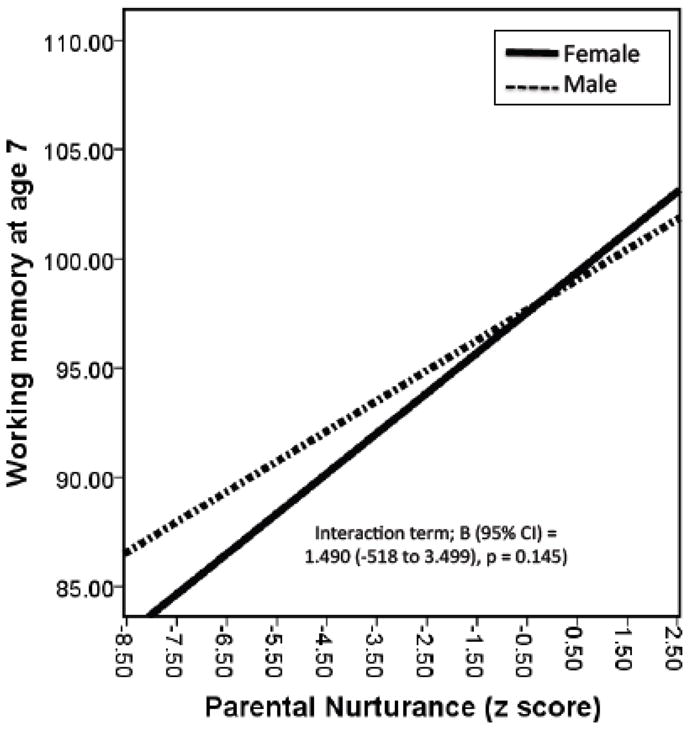
Prenatal exposure to chlorpyrifos (CPF), an organophosphorus insecticide, has long been associated with delayed neurocognitive development and most recently with decrements in working memory at age 7. In the current paper, we expanded the previous work on CPF to investigate how additional biological and social environmental factors might create or explain differential neurodevelopmental susceptibility, focusing on main and moderating effects of the quality of the home environment (HOME) and child sex. We evaluate how the quality of the home environment (specifically, parental nurturance and environmental stimulation) and child sex interact with the adverse effects of prenatal CPF exposure on working memory at child age 7years. We did not observe a remediating effect of a high quality home environment (either parental nurturance or environmental stimulation) on the adverse effects of prenatal CPF exposure on working memory. However, we detected a borderline significant interaction between prenatal exposure to CPF and child sex (B (95% CI) for interaction term=-1.714 (-3.753 to 0.326)) suggesting males experience a greater decrement in working memory than females following prenatal CPF exposure. In addition, we detected a borderline interaction between parental nurturance and child sex (B (95% CI) for interaction term=1.490 (-0.518 to 3.499)) suggesting that, in terms of working memory, males benefit more from a nurturing environment than females. To our knowledge, this is the first investigation into factors that may inform an intervention strategy to reduce or reverse the cognitive deficits resulting from prenatal CPF exposure.
Copyright © 2012 Elsevier Inc. All rights reserved.
Figures
References
-
- U.S. EPA. US EPA: Chlorpyrifos Revised Risk Assessment and Agreement with Registrants. Washington, D.C: 2000.
-
- Arunajadai S, Rauh V. Handling covariates subject to limits of detection in regression. Environmental and Ecological Statistics. 2012 Apr 1;:1–23.
-
- Baddeley A, Logie R. Working memory: the multi-component model. In: AM, PS, editors. Models of Working Memory: Mechanisms of Active Maintenance and Executive Control. Cambridge University Press; New York: 1999. pp. 28–61.
-
- Barr DB, Barr JR, Maggio VL, Whitehead RD, Jr, Sadowski MA, Whyatt RM, et al. A multi-analyte method for the quantification of contemporary pesticides in human serum and plasma using high-resolution mass spectrometry. J Chromatogr B Analyt Technol Biomed Life Sci. 2002;778(1–2):99–111. - PubMed
-
- Bellinger DC. Effect modification in epidemiologic studies of low-level neurotoxicant exposures and health outcomes. Neurotoxicology and teratology. 2000;22(1):133–140. - PubMed
MeSH terms
Substances
Grants and funding
LinkOut - more resources
Full Text Sources
Medical
