


Antitumor activity of zoledronic acid in primary breast cancer cells determined by the ATP tumor chemosensitivity assay
- PMID: 22824103
- PMCID: PMC3416722
- DOI: 10.1186/1471-2407-12-308
Antitumor activity of zoledronic acid in primary breast cancer cells determined by the ATP tumor chemosensitivity assay
Abstract
Background: The NeoAzure study has demonstrated that the use of the bisphosphonate zoledronic acid (Zol) in the neoadjuvant setting increases the rate of complete response in primary breast cancer and therefore indicates direct antitumor activity. The purpose of this study was to compare the antitumor effect of Zol with standard chemotherapy in primary breast cancer cells using ATP-tumor chemosensitivity assay (ATP-TCA).
Methods: Breast cancer specimens were obtained from patients with breast cancer who underwent primary breast cancer surgery at the Department of Obstetrics and Gynecology, Tübingen, Germany, between 2006 through 2009. Antitumor effects of Zol, TAC (Docetaxel, Adriamycin, Cyclophosphamide) and FEC (5-Fluorouracil, Epirubicin, Cyclophosphamide) were tested in 116 fresh human primary breast cancer specimens using ATP-TCA. ATP-TCA results were analyzed with different cut-off levels for the half maximal inhibitory concentration (IC50), for IC90 and for the sensitivity index (IndexSUM). Each single agent or combination was tested at six doubling dilutions from 6.25, 12.5, 25, 50, 100, and 200% of test drug concentrations (TDC) derived from the plasma peak concentrations determined by pharmacokinetic data. The assay was carried out in duplicate wells with positive and negative controls.
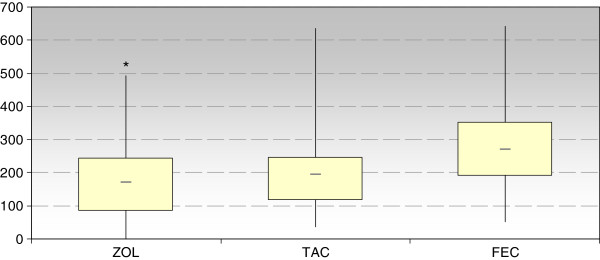
Results: The median IndexSUM value was lower for Zol than for the combined regimen FEC (36.8%) and TAC (12.9%), respectively, indicating increased antitumor activity of Zol in primary breast cancer cells. The difference regarding Zol and FEC was significant (p < 0.05). The median IC50 value for Zol (8.03% TDC) was significantly lower than the IC50 values for FEC (33.5% TDC) and TAC (19.3% TDC) treatment (p < 0.05). However, the median IC90 value for Zol (152.5% TDC) was significantly higher than the IC90 value obtained with TAC (49.5% TDC; p < 0.05), but similar to the IC90 value for FEC (180.9% TDC). In addition a significant positive correlation was observed for the IndexSum of Zol and the ER status (p < 0.01).
Conclusion: Zoledronic acid has a strong antitumor effect on primary breast cancer cells in vitro which is equal or superior to commonly used chemotherapeutic regimens for treating breast cancer.
Figures
References
-
- Lipton A, Theriault RL, Hortobagyi GN, Simeone J, Knight RD, Mellars K, Reitsma DJ, Heffernan M, Seaman JJ. Pamidronate prevents skeletal complications and is effective palliative treatment in women with breast carcinoma and osteolytic bone metastases: long term follow-up of two randomized, placebo-controlled trials. Cancer. 2000;88:1082–1090. doi: 10.1002/(SICI)1097-0142(20000301)88:5<1082::AID-CNCR20>3.0.CO;2-Z. - DOI - PubMed
-
- Gnant M, Mlineritsch B, Luschin-Ebengreuth G, Kainberger F, Kässmann H, Piswanger-Sölkner JC, Seifert M, Ploner F, Menzel C, Dubsky P, Fitzal F, Bjelic-Radisic V, Steger G, Greil R, Marth C, Kubista E, Samonigg H, Wohlmuth P, Mittlböck M, Jakesz R. Austrian Breast and Colorectal Cancer Study Group (ABCSG) Adjuvant endocrine therapy plus zoledronic acid in premenopausal women with earlystage breast cancer: 5-year follow-up of the ABCSG-12 bone-mineral density substudy. Lancet Oncol. 2008;9:840–849. doi: 10.1016/S1470-2045(08)70204-3. - DOI - PubMed
-
- Aapro M, Abrahamsson PA, Body JJ, Coleman RE, Colomer R, Costa L, Crinò L, Dirix L, Gnant M, Gralow J, Hadji P, Hortobagyi GN, Jonat W, Lipton A, Monnier A, Paterson AH, Rizzoli R, Saad F, Thürlimann B. Guidance on the use of bisphosphonates in solid tumours: recommendations of an international expert panel. Ann Oncol. 2008;19(3):420–432. - PubMed
MeSH terms
Substances
LinkOut - more resources
Full Text Sources
Medical
