


Regional variations in early and late survival after out-of-hospital cardiac arrest
- PMID: 22824170
- PMCID: PMC3470746
- DOI: 10.1016/j.resuscitation.2012.07.013
Regional variations in early and late survival after out-of-hospital cardiac arrest
Abstract
Background: While prior studies highlight regional variations in out-of-hospital cardiac arrest (OHCA) survival, the underlying reasons remain unknown. We sought to characterize regional variations early and later survival to hospital discharge after OHCA.
Methods: We studied adult, non-traumatic OHCA treated by 10 regional sites of the Resuscitation Outcomes Consortium (ROC) during 12/01/2005-6/30/2007. We compared (1) early survival (up to one calendar day after arrest) and (2) later conditional survival to hospital discharge (early survivors progressing to eventual hospital discharge) between ROC regional sites.
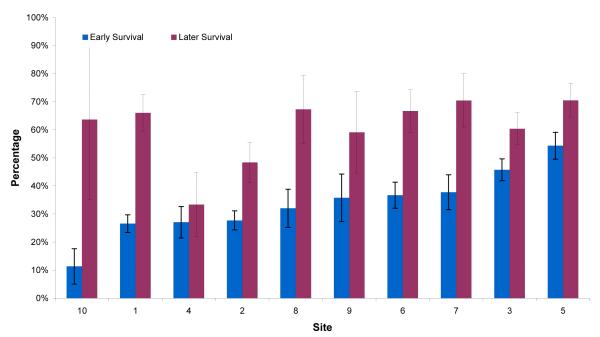
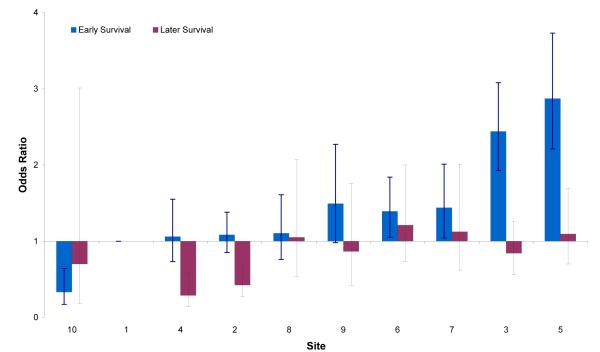
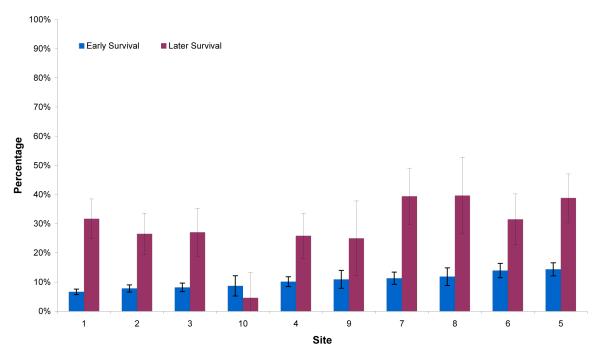
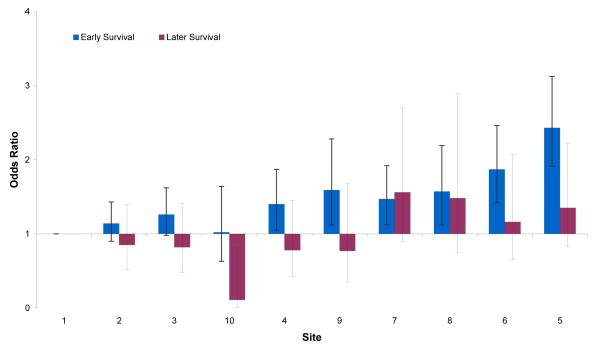
Results: Among 3763 VF/VT with complete covariates, site unadjusted early survival varied from 11.3 to 54.3%, and site unadjusted later survival varied from 33.3 to 70.5%. Compared with the largest site, adjusted VF/VT survival varied across sites: early survival OR 0.33 (95% CI: 0.17, 0.65) to 2.87 (2.20, 3.73), overall site variation p<0.001; later survival OR 0.29 (0.14, 0.59) to 1.21 (0.73, 2.00), p<0.001. Among 10,879 non-VF/VT with complete covariates, site unadjusted early survival varied from 6.6 to 14.3%, and site unadjusted later survival varied from 4.5 to 39.6%. Compared with the largest site, adjusted non-VF/VT survival varied across sites: early survival OR 1.02 (0.63, 1.64) to 2.43 (1.91, 3.12), p<0.001; later survival OR 0.11 (0.01, 0.82) to 1.56 (0.90, 2.70), p=0.02.
Conclusions: In this prospective multicenter North American series, there were regional disparities in early and later survival after OHCA, suggesting that there are underlying regional differences in out-of-hospital and post-arrest care beyond traditional Utstein predictors. Community efforts to improve OHCA survival must address both out-of-hospital and in-hospital care.
Copyright © 2012 Elsevier Ireland Ltd. All rights reserved.
Figures
Comment in
-
Death to discharge--devil in the details--or not?Resuscitation. 2012 Nov;83(11):1313-4. doi: 10.1016/j.resuscitation.2012.09.001. Epub 2012 Sep 7. Resuscitation. 2012. PMID: 22960568 No abstract available.
References
-
- Howard G. Why do we have a stroke belt in the southeastern united states? A review of unlikely and uninvestigated potential causes. Am J Med Sci. 1999;317:160–167. - PubMed
-
- Ford ES, Mokdad AH, Giles WH, Galuska DA, Serdula MK. Geographic variation in the prevalence of obesity, diabetes, and obesity-related behaviors. Obesity Research. 2005;13:118–122. - PubMed
-
- Pickle LW, Mungiole M, Gillum RF. Geographic variation in stroke mortality in blacks and whites in the united states. Stroke. 1997;28:1639–1647. - PubMed
Publication types
MeSH terms
Grants and funding
- U01 HL077866/HL/NHLBI NIH HHS/United States
- U01 HL077871/HL/NHLBI NIH HHS/United States
- CAPMC/ CIHR/Canada
- HL077867/HL/NHLBI NIH HHS/United States
- 5U01 HL077863/HL/NHLBI NIH HHS/United States
- HL077887/HL/NHLBI NIH HHS/United States
- U01 HL077881/HL/NHLBI NIH HHS/United States
- HL077873/HL/NHLBI NIH HHS/United States
- U01 HL077872/HL/NHLBI NIH HHS/United States
- HL077871/HL/NHLBI NIH HHS/United States
- HL077881/HL/NHLBI NIH HHS/United States
- HL077908/HL/NHLBI NIH HHS/United States
- U01 HL077887/HL/NHLBI NIH HHS/United States
- U01 HL077885/HL/NHLBI NIH HHS/United States
- U01 HL077863/HL/NHLBI NIH HHS/United States
- U01 HL077908/HL/NHLBI NIH HHS/United States
- HL077872/HL/NHLBI NIH HHS/United States
- HL077866/HL/NHLBI NIH HHS/United States
- U01 HL077873/HL/NHLBI NIH HHS/United States
- U01 HL077867/HL/NHLBI NIH HHS/United States
- HL077885/HL/NHLBI NIH HHS/United States
LinkOut - more resources
Full Text Sources
