


Lifetime risk for cancer death by sex and smoking status: the lifetime risk pooling project
- PMID: 22825072
- PMCID: PMC3542389
- DOI: 10.1007/s10552-012-9959-0
Lifetime risk for cancer death by sex and smoking status: the lifetime risk pooling project
Abstract
Background: Understanding how sex and tobacco exposure may modify lifetime risks for cancer mortality is important for effective communication of risk in targeted public health messages.
Objective: To determine lifetime risk estimates for cancer death associated with sex and smoking status in the United States.
Methods: A pooled cohort design using ten well-defined epidemiologic cohorts including middle-aged and older individuals was used to estimate the lifetime risk for cancer death at selected index ages, with death from non-cancer causes as the competing risk, by sex and smoking status.
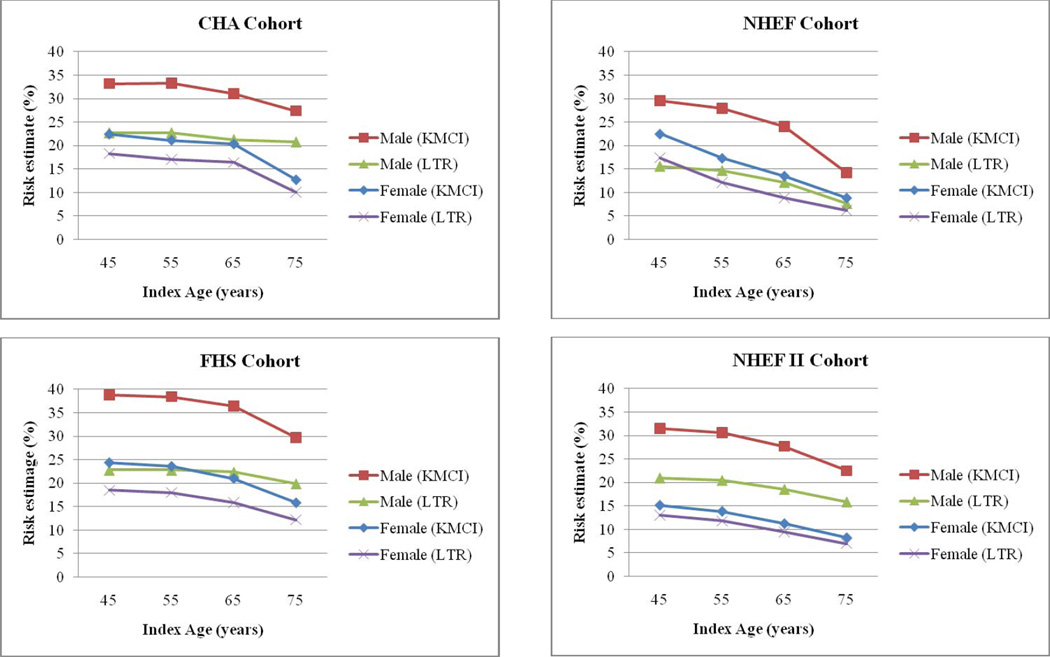
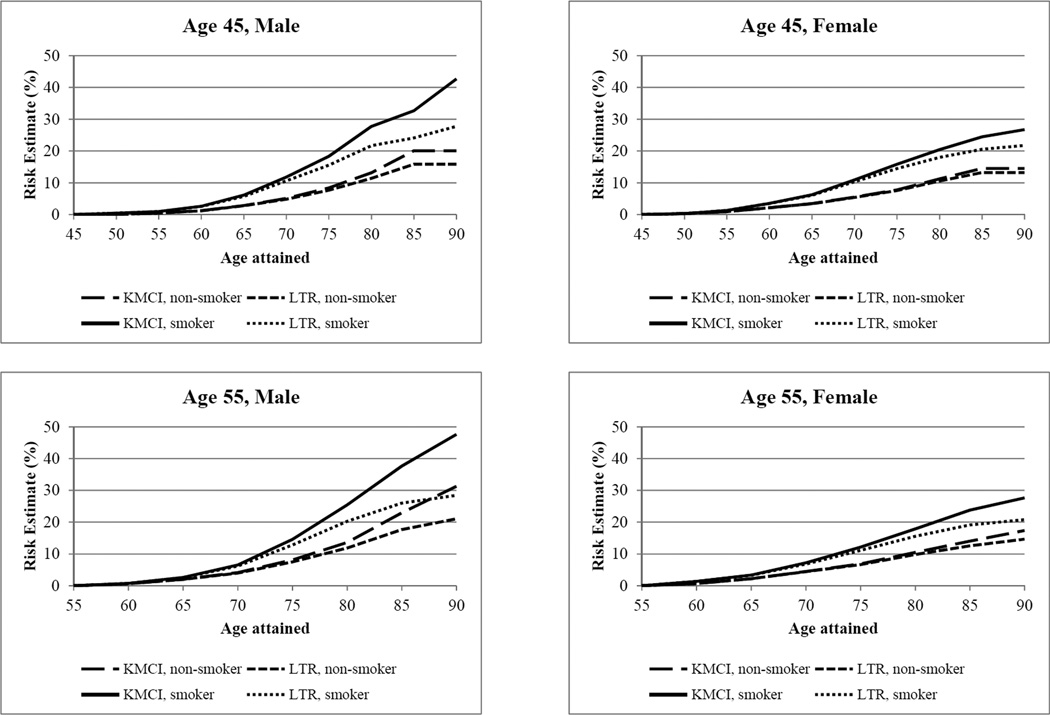
Results: There were a total of 11,317 cancer-related deaths. At age 45 years, the lifetime risk of cancer death for male smokers is 27.7 % (95 % CI 24.0-31.4 %) compared to 15.8 % (95 % CI 12.7-18.9 %) for male non-smokers. At age 45 years, the lifetime risk of cancer death for female smokers is 21.7 % (95 % CI 18.8-24.6 %) compared to 13.2 % (95 % CI 11.0-15.4 %) for female non-smokers. Remaining lifetime risk for cancer death declined with age, and men have a greater risk for cancer death compared to women. Adjustment for competing risk of death, particularly representing cardiovascular mortality, yielded a greater change in lifetime risk estimates for men and smokers compared to women and non-smokers.
Conclusions: At the population level, the lifetime risk for cancer death remains significantly higher for smokers compared to non-smokers, regardless of sex. These estimates may provide clinicians with useful information for counseling individual patients and highlight the need for continued public health efforts related to smoking cessation.
Conflict of interest statement
The authors declare that they have no conflict of interest.
Figures

References
-
- Jemal A, Siegel R, Ward E, Hao Y, Xu J, Thun M. Cancer statistics, 2009. CA Cancer J Clin. 2009;59:225–249. - PubMed
-
- Adami HO, Day NE, Trichopoulos D, Willett WC. Primary and secondary prevention in the reduction of cancer morbidity and mortality. Eur J Cancer. 2001;37(Suppl 8):S118–S127. - PubMed
-
- Sasco AJ, Secretan MB, Straif K. Tobacco smoking and cancer: a brief review of recent epidemiological evidence. Lung Cancer. 2004;45(Suppl 2):S3–S9. - PubMed
Publication types
MeSH terms
Grants and funding
- N01WH42129-32/WH/WHI NIH HHS/United States
- N01WH32100-2/WH/WHI NIH HHS/United States
- N01 WH022110/WH/WHI NIH HHS/United States
- N01WH32108-9/WH/WHI NIH HHS/United States
- N01WH42107-26/WH/WHI NIH HHS/United States
- N01WH32122/WH/WHI NIH HHS/United States
- N01WH32105-6/WH/WHI NIH HHS/United States
- N01WH32111-13/WH/WHI NIH HHS/United States
- N01WH32118-32119/WH/WHI NIH HHS/United States
- R21 HL085375/HL/NHLBI NIH HHS/United States
- N01WH24152/WH/WHI NIH HHS/United States
- N01WH32115/WH/WHI NIH HHS/United States
- N01WH44221/WH/WHI NIH HHS/United States
LinkOut - more resources
Full Text Sources
