. 2012 Aug 7;109(32):13034-9.
doi: 10.1073/pnas.1110994109. Epub 2012 Jul 23.

Factors associated with the diversification of the gut microbial communities within chimpanzees from Gombe National Park

Affiliations

Factors associated with the diversification of the gut microbial communities within chimpanzees from Gombe National Park

Patrick H Degnan et al. Proc Natl Acad Sci U S A. .

Abstract

The gastrointestinal tract harbors large and diverse populations of bacteria that vary among individuals and within individuals over time. Numerous internal and external factors can influence the contents of these microbial communities, including diet, geography, physiology, and the extent of contact among hosts. To investigate the contributions of such factors to the variation and changes in gut microbial communities, we analyzed the distal gut microbiota of individual chimpanzees from two communities in Gombe National Park, Tanzania. These samples, which were derived from 35 chimpanzees, many of whom have been monitored for multiple years, provide an unusually comprehensive longitudinal depth for individuals of known genetic relationships. Although the composition of the great-ape microbiota has been shown to codiversify with host species, indicating that host genetics and phylogeny have played a major role in its differentiation over evolutionary timescales, the geneaological relationships of individual chimpanzees did not coincide with the similarity in their gut microbial communities. However, the inhabitants from adjacent chimpanzee communities could be distinguished based on the contents of their gut microbiota. Despite the broad similarity of community members, as would be expected from shared diet or interactions, long-term immigrants to a community often harbored the most distinctive gut microbiota, suggesting that individuals retain hallmarks of their previous gut microbial communities for extended periods. This pattern was reinforced in several chimpanzees sampled over long temporal scales, in which the major constituents of the gut microbiota were maintained for nearly a decade.


Conflict of interest statement

The authors declare no conflict of interest.

Figures
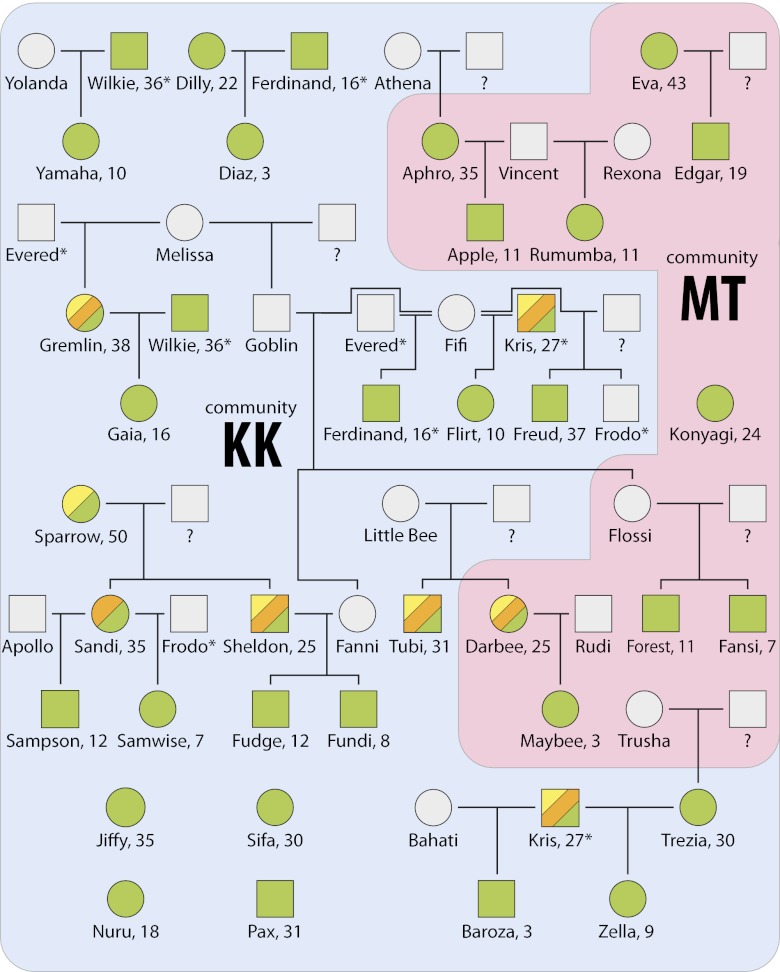
Fig. 1.
Fig. 1.
Pedigree of sampled chimpanzees from Gombe National Park. Genealogies of chimpanzees (circles, females; squares, males) from the Kasekela (KK, blue) and Mitumba (MT, red) communities whose gut microbial communities were analyzed. Individual chimpanzees are categorized by their current community affiliation. Individuals were sampled in 2008 (green), 2001 (orange), and/or 2000 (yellow). Those left uncolored are individuals whose gut microbiotae were not surveyed. For all sampled individuals, ages in 2008 are provided next to each name. Question marks indicate fathers of unknown identity, and asterisks denote individuals shown more than once.
Fig. 2.
Fig. 2.
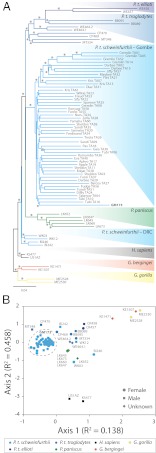
Relationship of gut microbial communities in Gombe chimpanzees to those of other great apes. (A) Neighbor-joining phylogenetic reconstruction of log abundances of microbial phylotypes (99% OTUs) present in Gombe chimpanzees and other great apes. Phylogenies and the bootstrap support for branching orders in these phylogenies were generated by using default parsimony and neighbor-joining parameters in PAUP 4b10 (30) as in ref. . Colored triangles delineate species or subspecies boundaries, and bootstrap values ≥75 are marked with asterisks. (B) Nonmetric multidimensional scaling ordination of Sørensen distances of the microbial phylotypes detected in great ape guts. Colors match the species and subspecies designations in A and in ref. with points representing previously analyzed samples labeled. The cluster of points corresponding to the gut microbial communities of Gombe chimpanzees are outlined with a dashed line.
Fig. 3.
Fig. 3.
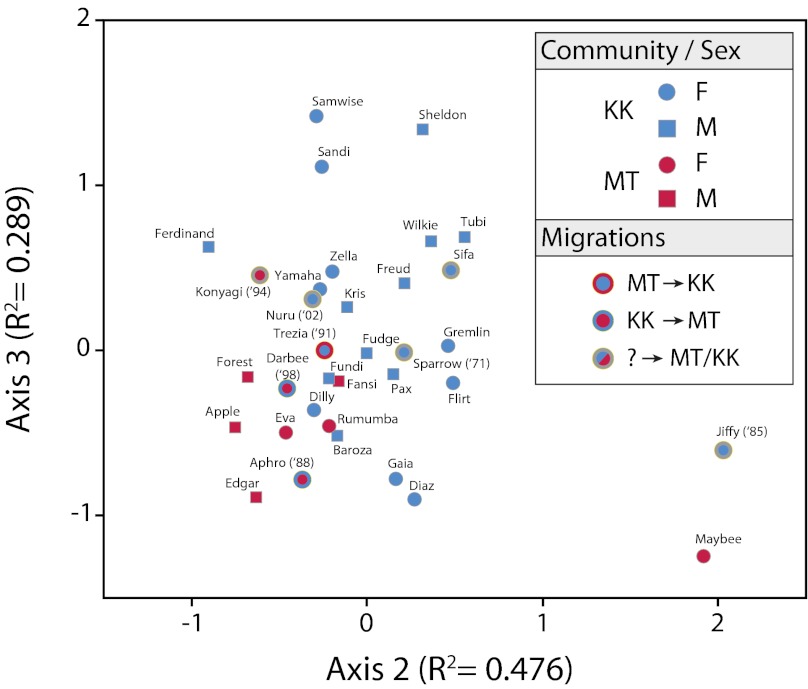
Chimpanzee microbiota assort by community affiliation of host. Nonmetric multidimensional scaling ordination analysis of 34 chimpanzees sampled in 2008 distinguishes two groups that correspond to the two (KK and MT) chimpanzee communities. Individuals are labeled according to the key, with year and direction of immigration included when applicable.
Fig. 4.
Fig. 4.
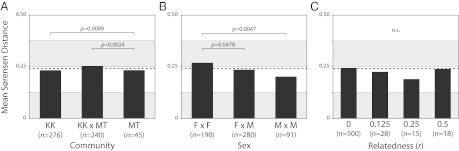
Gut microbiota differentiate by chimpanzee community affiliation and sex but not degree of genetic relatedness. Estimates of microbial community similarity (Sørensen distances) of Gombe chimpanzees within and between communities (A), sexes (B), and coefficients of relatedness (C) were compared by using nonparametric comparisons of each pair using the Wilcoxon method. Levels of significance are only reported for comparisons reaching significant P values (as observed in samples sorted by community affiliation and sex).
Fig. 5.
Fig. 5.
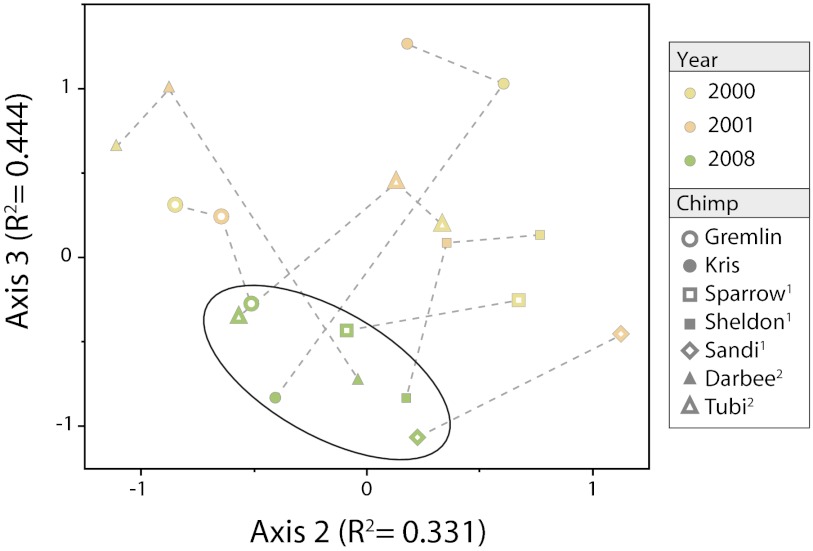
Temporal changes in chimpanzee gut microbial communities. NMS ordination of seven chimpanzees sampled through time can be distinguished according to the sampling year (2000, yellow; 2001, orange; 2008, green). Sample identifiers (individual and year) are presented in the key, and dashed lines connect samples derived from a single chimpanzee host. Ellipse encompasses all samples from 2008. Note that several of these chimpanzees are related: 1Sparrow is the mother of Sheldon and Sandi; 2Darbee and Tubi are presumed to be half-siblings.

Comment in

References

    1. Savage DC. Microbial ecology of the gastrointestinal tract. Annu Rev Microbiol. 1977;31:107–133. - PubMed
    1. Mackie RI, Sghir A, Gaskins HR. Developmental microbial ecology of the neonatal gastrointestinal tract. Am J Clin Nutr. 1999;69:1035S–1045S. - PubMed
    1. Turnbaugh PJ, et al. The human microbiome project. Nature. 2007;449:804–810. - PMC - PubMed
    1. Mariat D, et al. The Firmicutes/Bacteroidetes ratio of the human microbiota changes with age. BMC Microbiol. 2009;9:123. - PMC - PubMed
    1. Koenig JE, et al. Succession of microbial consortia in the developing infant gut microbiome. Proc Natl Acad Sci USA. 2011;108(Suppl 1):4578–4585. - PMC - PubMed

Publication types