Comparative Study
. 2012 Sep;87(3):518-23.
doi: 10.4269/ajtmh.2012.12-0097. Epub 2012 Jul 23.

Prevalence and diversity of Bartonella spp. in bats in Peru

Affiliations
Comparative Study

Prevalence and diversity of Bartonella spp. in bats in Peru

Ying Bai et al. Am J Trop Med Hyg. 2012 Sep.

Abstract

Bartonella infections were investigated in bats in the Amazon part of Peru. A total of 112 bats belonging to 19 species were surveyed. Bartonella bacteria were cultured from 24.1% of the bats (27/112). Infection rates ranged from 0% to 100% per bat species. Phylogenetic analyses of gltA of the Bartonella isolates revealed 21 genetic variants clustering into 13 divergent phylogroups. Some Bartonella strains were shared by bats of multiple species, and bats of some species were infected with multiple Bartonella strains, showing no evident specific Bartonella sp.-bat relationships. Rarely found in other bat species, the Bartonella strains of phylogroups I and III discovered from the common vampire bats (Desmodus rotundus) were more specific to the host bat species, suggesting some level of host specificity.


Figures
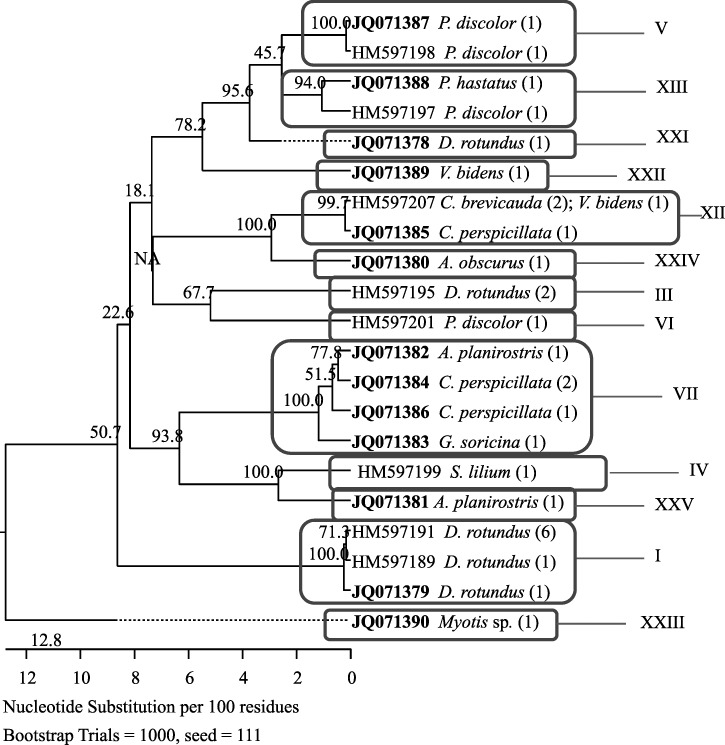
Figure 1.
Figure 1.
Phylogenetic relationships of the Bartonella genotypes based on partial sequences of gltA detected in bats from Peru compared with previously described Bartonella genotypes detected in Guatemalan bats. The phylogenetic tree was constructed by the neighboring-joining method, and bootstrap values were calculated with 1,000 replicates. A total of 21 Bartonella genotypes were identified among the 30 isolates obtained from bats in Peru, of which 13 genotypes were novel. The other eight genotypes were identical to Bartonella genotypes previously described from bats in Guatemala. Each genotype is indicated by its GenBank accession number, with novel genotypes in boldface. After each accession number is the bat species from which bartonella isolates of the genotype were obtained. Numbers in parentheses are the number of isolates obtained from bats of the indicated species. The Bartonella genotypes formed 13 phylogroups. Each square-circled clade represents a phylogroup and is marked by a unique Roman number using the description in the work by Bai and others.

References

    1. Simmons NB. Order Chiroptera. In: Wilson DE, Reeder DM, editors. Mammal Species of the World: A Taxonomic and Geographic Reference. 3rd Ed. Baltimore, MD: Johns Hopkins University Press; 2005. pp. 312–529.
    1. Messenger SL, Smith JS, Orciari LA, Yager PA, Rupprecht CE. Emerging pattern of rabies deaths and increased viral infectivity. Emerg Infect Dis. 2003;9:151–154. - PMC - PubMed
    1. Calisher CH, Childs JE, Field HE, Holmes KV, Schountz T. Bats: important reservoir hosts of emerging viruses. Clin Microbiol Rev. 2006;19:531–545. - PMC - PubMed
    1. Turmelle AS, Olival KJ. Correlates of viral richness in bats (order Chiroptera) EcoHealth. 2009;6:522–539. - PMC - PubMed
    1. Bai Y, Kosoy M, Recuenco S, Alvarez D, Moran D, Turmelle A, Ellison J, Garcia DL, Estevez A, Lindblade K, Rupprecht C. Bartonella spp. in bats, Guatemala. Emerg Infect Dis. 2011;17:1269–1271. - PMC - PubMed

Publication types

Substances