. 2013 Mar;16(2):445-58.
doi: 10.1017/S1461145712000661. Epub 2012 Jul 25.

Modification of cocaine self-administration by buspirone (buspar®): potential involvement of D3 and D4 dopamine receptors

Affiliations

Modification of cocaine self-administration by buspirone (buspar®): potential involvement of D3 and D4 dopamine receptors

Jack Bergman et al. Int J Neuropsychopharmacol. 2013 Mar.

Abstract

Converging lines of evidence indicate that elevations in synaptic dopamine levels play a pivotal role in the reinforcing effects of cocaine, which are associated with its abuse liability. This evidence has led to the exploration of dopamine receptor blockers as pharmacotherapy for cocaine addiction. While neither D1 nor D2 receptor antagonists have proven effective, medications acting at two other potential targets, D3 and D4 receptors, have yet to be explored for this indication in the clinic. Buspirone, a 5-HT1A partial agonist approved for the treatment of anxiety, has been reported to also bind with high affinity to D3 and D4 receptors. In view of this biochemical profile, the present research was conducted to examine both the functional effects of buspirone on these receptors and, in non-human primates, its ability to modify the reinforcing effects of i.v. cocaine in a behaviourally selective manner. Radioligand binding studies confirmed that buspirone binds with high affinity to recombinant human D3 and D4 receptors (∼98 and ∼29 nm respectively). Live cell functional assays also revealed that buspirone, and its metabolites, function as antagonists at both D3 and D4 receptors. In behavioural studies, doses of buspirone that had inconsistent effects on food-maintained responding (0.1 or 0.3 mg/kg i.m.) produced a marked downward shift in the dose-effect function for cocaine-maintained behaviour, reflecting substantial decreases in self-administration of one or more unit doses of i.v. cocaine in each subject. These results support the further evaluation of buspirone as a candidate medication for the management of cocaine addiction.


Conflict of interest statement

Statement of Interest None.

Figures
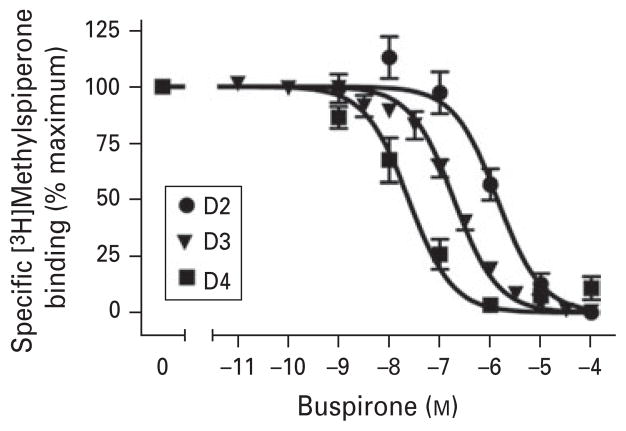
Fig. 1
Fig. 1
Inhibition of [3H]methylspiperone binding to human recombinant D2, D3 or D4 dopamine receptors by buspirone. Membranes from HEK293 cells were prepared and used for radioligand binding assays as described in Method. Specific binding is expressed as a percentage of the maximum observed in each experiment. Results are the average of three independent experiments, each done in triplicate. The average ki values for buspirone and its metabolites are shown in Table 1.
Fig. 2
Fig. 2
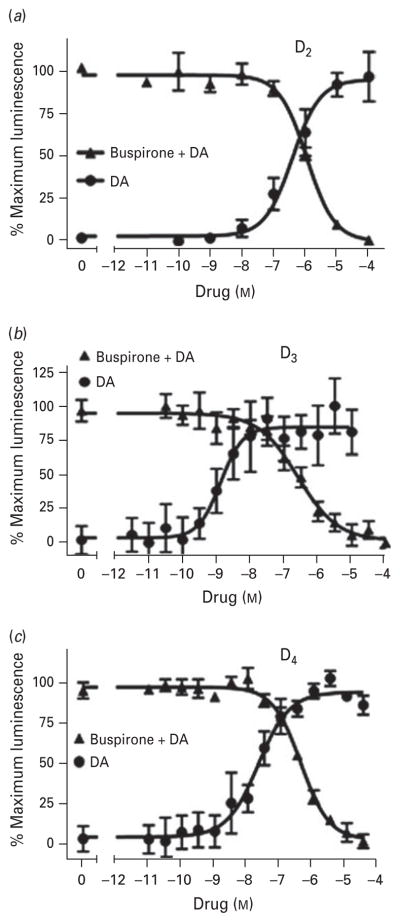
Buspirone antagonizes dopamine (DA)-induced receptor-β-arrestin interactions at human recombinant D2, D3 or D4 DA receptors. CHO-K1 cells stably expressing (a) D2, (b) D3, or (c) D4 receptors were incubated with the indicated concentrations of either DA or buspirone plus an EC90 concentration of DA for 60 min. Following treatment with assay reagent (DiscoveRx Inc.), luminescence was measured as described in Method. Data are normalized to the maximum response in each experiment and are plotted as mean±S.E.M. of three independent experiments, each performed in triplicate. The average IC50 values for buspirone are shown in Table 2. The average EC50 values (mean±S.E.M.) for DA are: (a) 150±30 nM; (b) 1.8±0.17 nM; (c) 400±57 nM.
Fig. 3
Fig. 3
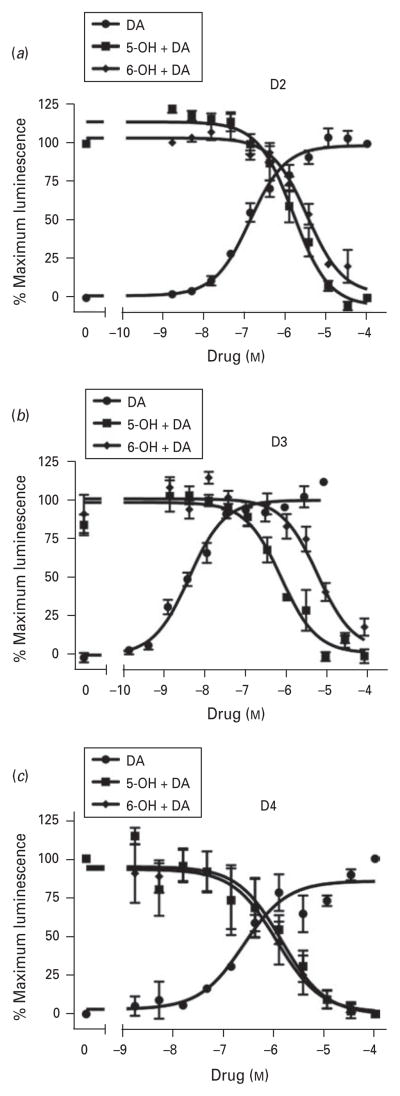
The active metabolites of buspirone antagonize dopamine (DA)-induced receptor-β-arrestin interactions at human recombinant D2, D3 or D4 DA receptors. Details are shown in Fig. 2.
Fig. 4
Fig. 4
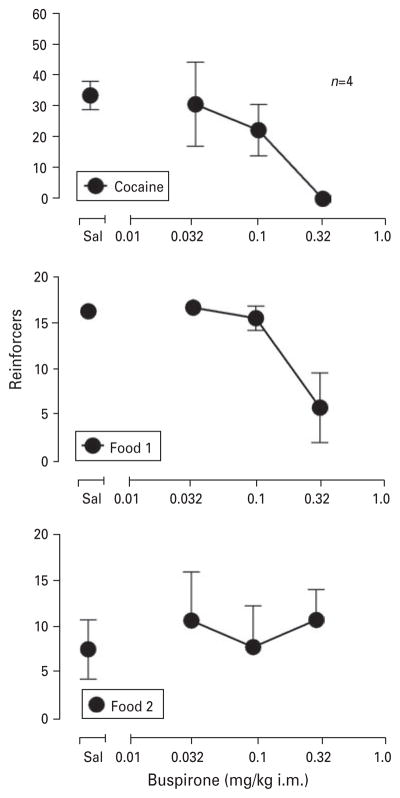
Mean effects of buspirone (0.03–0.32 mg/kg) on behaviour maintained by 0.032 mg/kg per injection cocaine. Abscissa: Pretreatment dose of buspirone. Ordinate: Number of total cocaine injections that were self-administered in the 100-min drug component or number of food pellets that were delivered during food 1 and food 2. The results shown above ‘Sal’ represent the effects of saline pretreatment and serve as baseline values for comparison with the effects of buspirone. The effects of 0.1 and 0.32 mg/kg buspirone shown here were determined in all monkeys; the effects of 0.032 mg/kg buspirone were determined in three monkeys. Data for individual subjects are shown in Table 2.
Fig. 5
Fig. 5
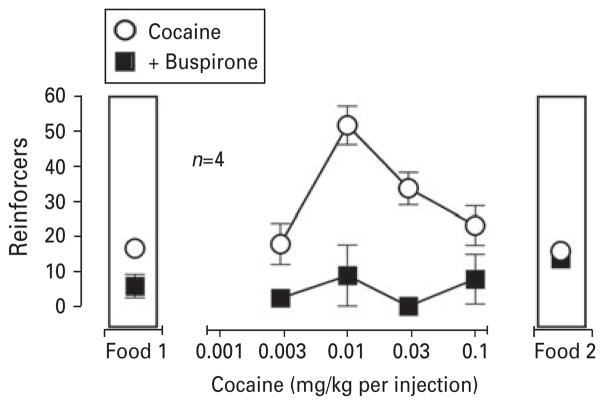
Mean effects of buspirone on behaviour maintained by different doses of i.v. cocaine or food reinforcement. Abscissa: Dose of cocaine that was available for i.v. self-administration (mg/kg per injection; log scale) or the availability of food reinforcement during the first and last components of the session (food 1 and food 2). Ordinate: Number of cocaine injections that were self-administered in the 100-min drug component during which that dose was available or number of food pellets that were delivered during the 5-min food components (food 1 and food 2). Open symbols represent data for i.v. cocaine self-administration during control sessions averaged for the group of four monkeys. Filled symbols represent average data for i.v. cocaine self-administration and food-maintained behaviour following pre-session i.m. administration of buspirone (0.32 mg/kg or, for monkey 96D155, 0.1 mg/kg) for the group of four subjects. Data for individual subjects are shown in Table 3.

References

    1. Anderson AL, Reid MS, Li SH, Holmes T, et al. Modafinil for the treatment of cocaine dependence. Drug and Alcohol Dependence. 2009;104:133–139. - PMC - PubMed
    1. Banala AK, Levy BA, Khatri SS, Furman CA, et al. N-(3-Fluoro-4-(4-(2-methoxy or 2,3-dichlorophenyl) piperazine-1-yl)butyl)arylcarboxamides as selective dopamine D3 receptor ligands: critical role of the carboxamide linker for D3 receptor selectivity. Journal of Medicinal Chemistry. 2011;54:581–594. - PMC - PubMed
    1. Bergman J, Kamien JB, Spealman RD. Antagonism of cocaine self-administration by selective dopamine D1 and D2 antagonists. Behavioural Pharmacology. 1990;1:355–363. - PubMed
    1. Brauer LH, de Wit H. Subjective responses to d-amphetamine alone and after primozide pretreatment in normal, healthy volunteers. Biological Psychiatry. 1996;39:26–32. - PubMed
    1. Brody D, Adler LA, Kim T, Angrist B, et al. Effects of buspirone in seven schizophrenic subjects. Journal of Clinical Psychopharmacology. 1990;10:68–69. - PubMed

Publication types

MeSH terms

LinkOut - more resources