. 2013 Mar;16(2):477-83.
doi: 10.1017/S1461145712000685. Epub 2012 Jul 25.

A physiological role for the dopamine D5 receptor as a regulator of BDNF and Akt signalling in rodent prefrontal cortex

Affiliations

A physiological role for the dopamine D5 receptor as a regulator of BDNF and Akt signalling in rodent prefrontal cortex

Melissa L Perreault et al. Int J Neuropsychopharmacol. 2013 Mar.

Abstract

The dopamine D5 receptor (D5R) exhibits a wide distribution in prefrontal cortex (PFC) but its role in this region has not yet been elucidated. In the present study, we identified a novel physiological function for the D(5)R as a regulator of brain-derived neurotrophic factor (BDNF) and Akt signalling in PFC. Specifically, acute activation of the D(5)R by the dopamine agonist SKF 83959 enhanced BDNF expression and signalling through its receptor, tropomyosin receptor kinase B (TrkB), in rats and in mice gene-deleted for the D1 receptor but not the D(5)R. These changes were concomitant with increased expression of GAD67, a protein whose down-regulation has been implicated in the aetiology of schizophrenia. Furthermore, D(5)R activation increased phosphorylation of Akt at the Ser(473) site, consequently decreasing the activity of its substrate GSK-3β. These findings could have wide-reaching implications given evidence showing activation of these pathways in PFC has therapeutic effects in neuropsychiatric disorders such as drug addiction, schizophrenia and depression.


Conflict of interest statement

Statement of Interest: None.

Figures

Fig. 1
Fig. 1
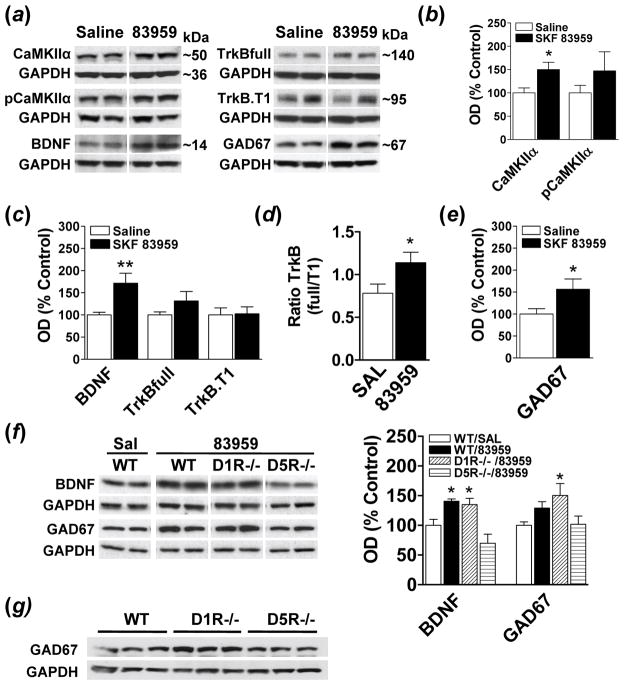
Increased BDNF signalling by the D5R in rodent PFC. (a) Representative blots depicting the effects of a single injection of the PLC-lined dopamine agonist SKF 83959 on CaMKIIα, pCaMKIIα, BDNF, TrkBfull, TrkB.T1, and GAD67 in rat PFC 90 minutes post injection (n=8–9 rats/group). GAPDH was used as a loading control. (b) SKF 83959 (1.5 mg/kg) increased total expression levels of CaMKIIα but did not alter phosphorylation of CaMKIIα at Thr286. (c) Expression of BDNF was elevated following SKF 83959, with no changes in the total expression levels of TrkBfull and TrkB.T1. (d) An increase in the ratio of TrkBfull:TrkB.T1, an index of receptor signalling, was evident following SKF 83959 administration. (e) SKF 83959 increased GAD67 expression in rat PFC. (f) Increased BDNF and GAD67 expression in D1R−/− mice, but not D5R−/− mice, following SKF 83959 (3 mg/kg) administration (n=6–7 mice/group). (g) Increased basal GAD67 expression in D1R−/− mice. Representative blots are also shown. Bars shown represent means ± s.e.m. and, with the exception of the TrkBfull:TrkB.T1 ratio, are expressed as a percentage of saline-treated controls. *P<0.05, ** P<0.01.
Fig. 2
Fig. 2
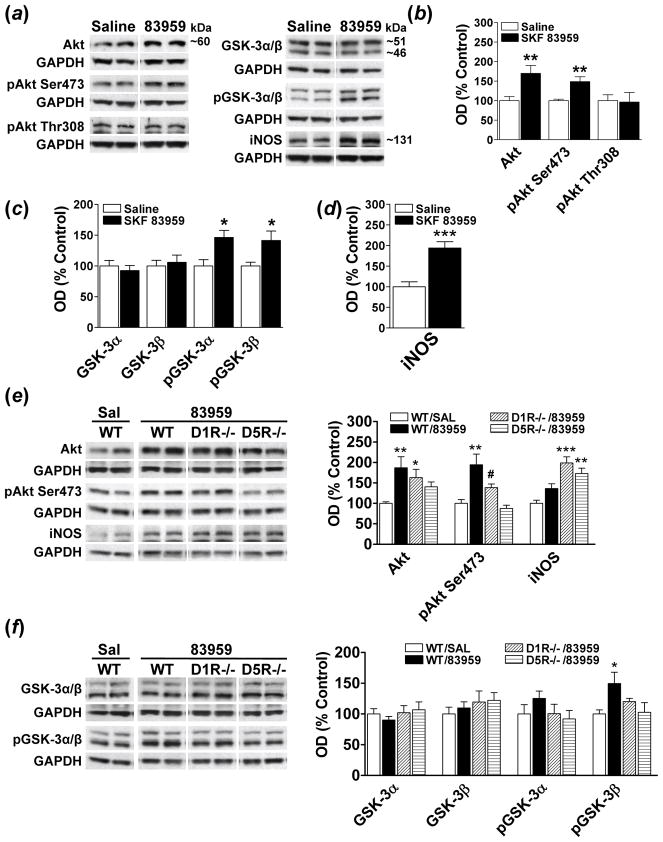
Regulation of Akt-GSK-3 signalling by the D5R in rodent PFC. (a) Representative blots depicting the effects of SKF 83959 on proteins associated with Akt-GSK-3 signalling in rat PFC 90 minutes post injection (n=8–9 rats/group). GAPDH was used as a loading control. (b) SKF 83959 (1.5 mg/kg) increased expression of Akt and phosphorylation of Akt at Ser473 with no effect on pAkt Thr308. (c) Phosphorylation levels of GSK-3α and GSK-3β were elevated following SKF 83959. (d) Expression of iNOS, a downstream target of GSK-3β, was also increased by SKF 83959. (e) Enhanced Akt expression in D1R−/− mice, but not D5R−/− mice, following SKF 83959 (3 mg/kg) administration. Phosphorylation of Akt at Ser 473 was also significantly higher in D1R−/− mice than in D5R −/− mice. iNOS levels were elevated in response to SKF 83959 in both gene-deleted strains. (f) Phosphorylation of GSK-3β was elevated in wiltype mice but not in D1R−/− or D5R−/− mice following SKF 83959 (n=6–7 mice/group). Representative blots are also shown. Bars shown represent means ± s.e.m. and are expressed as a percentage of saline-treated controls. *P<0.05, ** P<0.01, *** P<0.001 compared to saline-treated controls, # P<0.05 compared to D1R−/− mice.

References

    1. Alimohamad H, Rajakumar N, Seah YH, Rushlow W. Antipsychotics alter the protein expression levels of beta-catenin and GSK-3 in the rat medial prefrontal cortex and striatum. Biological Psychiatry. 2005;57:533–542. - PubMed
    1. Beaulieu JM. A role for Akt and glycogen synthase kinase-3 as integrators of dopamine and serotonin neurotransmission in mental health. Journal of Psychiatry and Neuroscience. 2012;37:7–16. - PMC - PubMed
    1. Berglind WJ, Whitfield TW, Jr, LaLumiere RT, Kalivas PW, et al. A single intra-PFC infusion of BDNF prevents cocaine-induced alterations in extracellular glutamate within the nucleus accumbens. Journal of Neuroscience. 2009;29:3715–3719. - PMC - PubMed
    1. Cotrufo T, Viegi A, Berardi N, Bozzi Y, et al. Effects of neurotrophins on synaptic protein expression in the visual cortex of dark-reared rats. Journal of Neuroscience. 2003;23:3566–3571. - PMC - PubMed
    1. Emamian ES, Hall D, Birnbaum MJ, Karayiorgou M, et al. Convergent evidence for impaired AKT1-GSK3beta signaling in schizophrenia. Nature Genetics. 2004;36:131–137. - PubMed

Publication types

MeSH terms

Substances