Review
. 2013 Jun;28(6):863-74.
doi: 10.1007/s00467-012-2259-9. Epub 2012 Jul 25.

Current insights into renal ciliopathies: what can genetics teach us?

Affiliations
Review

Current insights into renal ciliopathies: what can genetics teach us?

Heleen H Arts et al. Pediatr Nephrol. 2013 Jun.

Abstract

Ciliopathies are a group of clinically and genetically overlapping disorders whose etiologies lie in defective cilia. These are antenna-like organelles on the apical surface of numerous cell types in a variety of tissues and organs, the kidney included. Cilia play essential roles during development and tissue homeostasis, and their dysfunction in the kidney has been associated with renal cyst formation and renal failure. Recently, the term "renal ciliopathies" was coined for those human genetic disorders that are characterized by nephronophthisis, cystic kidneys or renal cystic dysplasia. This review focuses on renal ciliopathies from a human genetics perspective. We survey the newest insights with respect to gene identification and genotype-phenotype correlations, and we reflect on candidate ciliopathies. The opportunities and challenges of next-generation sequencing (NGS) for genetic renal research and clinical DNA diagnostics are also reviewed, and we discuss the contribution of NGS to the development of personalized therapy for patients with renal ciliopathies.


Figures
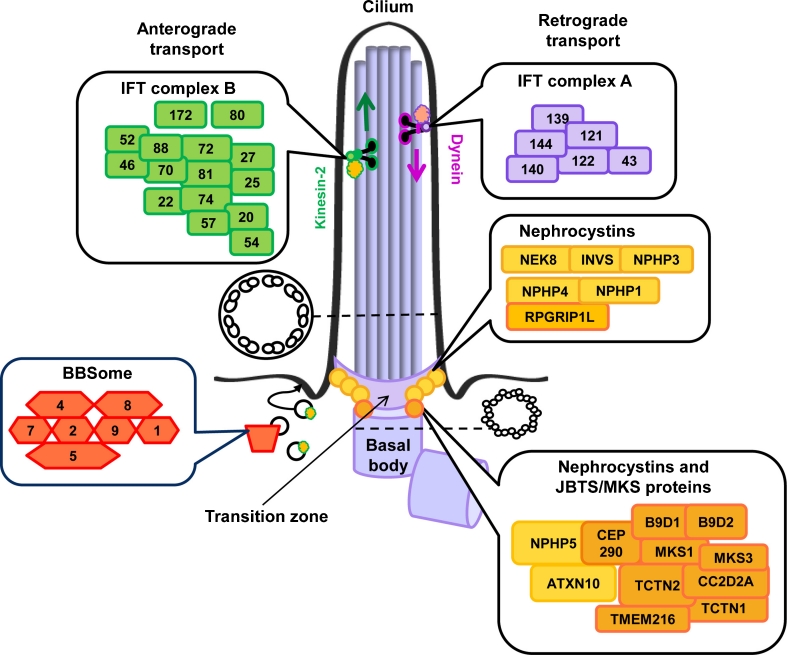
Fig. 1
Fig. 1
The primary cilium and ciliary protein complexes. The primary cilium is a membrane-enclosed antenna-like structure with a ring-shaped skeleton that consists of 9 doublets of microtubules. The ciliary base is called the “basal body”, and consists of triplets of microtubules. Ciliary transport, intraflagellar transport (IFT), occurs from base-to-tip mediated by the IFT complex B (green) in association with a kinesin II motor and from tip-to-base by the IFT complex A (purple) in association with the cytoplasmic dynein motor 2. Other protein complexes are the BBSome (red) consisting of various BBS proteins, and networks of nephrocystins (yellow), and Meckel–Gruber (MKS) and/or Joubert (JBTS) syndrome-associated proteins (orange). The BBSome is involved in trafficking membrane proteins to the cilium, while most nephrocystins and MKS/JBTS proteins localize to the transition zone where they are important for ciliogenesis, regulation of ciliary signaling and the docking and filtering of vesicles/proteins at the cilium
Fig. 2
Fig. 2
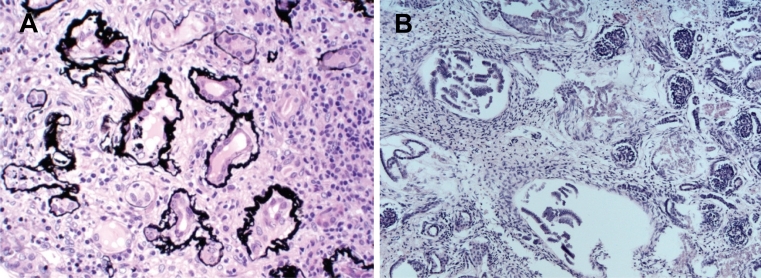
Nephronophthisis and renal cystic dysplasia. a Pathohistology of nephronophthisis. A cross section through a renal biopsy from a Sensenbrenner patient shows interstitial fibrosis and tubular membrane disruptions (thickened, irregular basement membranes). Image courtesy of Eric Steenbergen. b Cystic dysplastic kidneys with marked interstitial fibrosis and cysts of different sizes form in a fetus with Meckel–Gruber syndrome. Image courtesy of Carsten Bergmann
Fig. 3
Fig. 3
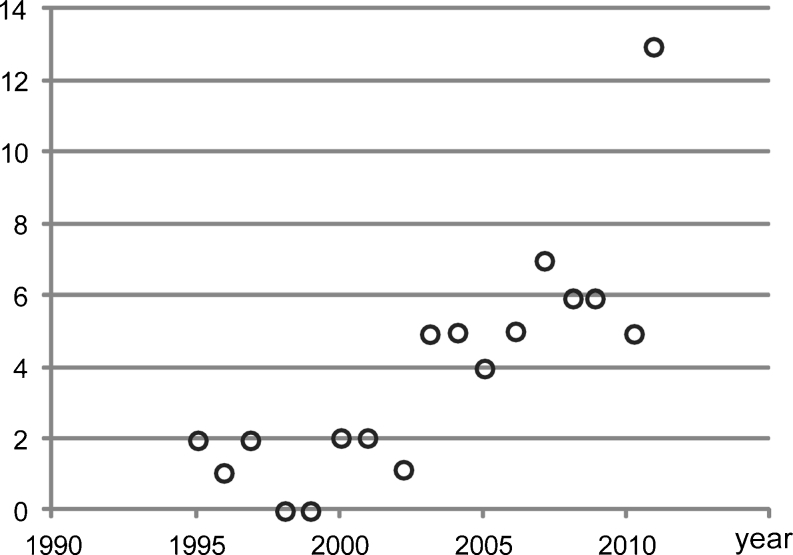
Gene identification for renal ciliopathies in the period from 1995 to 2011. Open circles indicate the number of genetic causes that were identified in the corresponding year. X-axis: time in years; y-axis: number of genetic causes
Fig. 4
Fig. 4
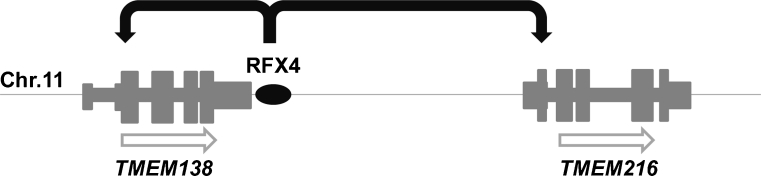
Gene regulation of two adjacent nonhomologous disease genes. The neighboring TMEM138 and TMEM216, mutated in Joubert syndrome, are regulated by transcription factor RFX4, which binds to a noncoding conserved regulatory intergenic region (black oval). Open arrows indicate that both genes are located on the sense strand of chromosome 11

References

    1. Dobell C. Antony van Leeuwenhoek and his 'Little Animals'. Amsterdam: Swets & Zeitlinger; 1932. p. 135.
    1. Bloodgood RA. From central to rudimentary to primary: the history of an underappreciated organelle whose time has come. The primary cilium. In: Sloboda RD, editor. Primary cilia. Amsterdam: Elsevier; 2009. p. 4. - PubMed
    1. Bergmann C. Educational paper: ciliopathies. Eur J Pediatr. 2011 - PMC - PubMed
    1. Hildebrandt F, Benzing T, Katsanis N. Ciliopathies. N Engl J Med. 2011;364:1533–1543. doi: 10.1056/NEJMra1010172. - DOI - PMC - PubMed
    1. Ishikawa H, Marshall WF. Ciliogenesis: building the cell's antenna. Nat Rev Mol Cell Biol. 2011;12:222–234. doi: 10.1038/nrm3085. - DOI - PubMed

Publication types

Supplementary concepts