


Overexpression of manganese superoxide dismutase ameliorates high-fat diet-induced insulin resistance in rat skeletal muscle
- PMID: 22829583
- PMCID: PMC3468429
- DOI: 10.1152/ajpendo.00577.2011
Overexpression of manganese superoxide dismutase ameliorates high-fat diet-induced insulin resistance in rat skeletal muscle
Abstract
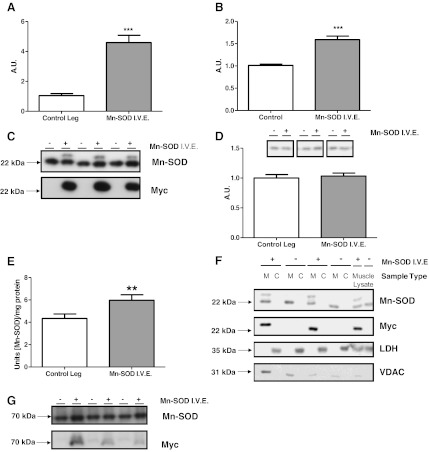
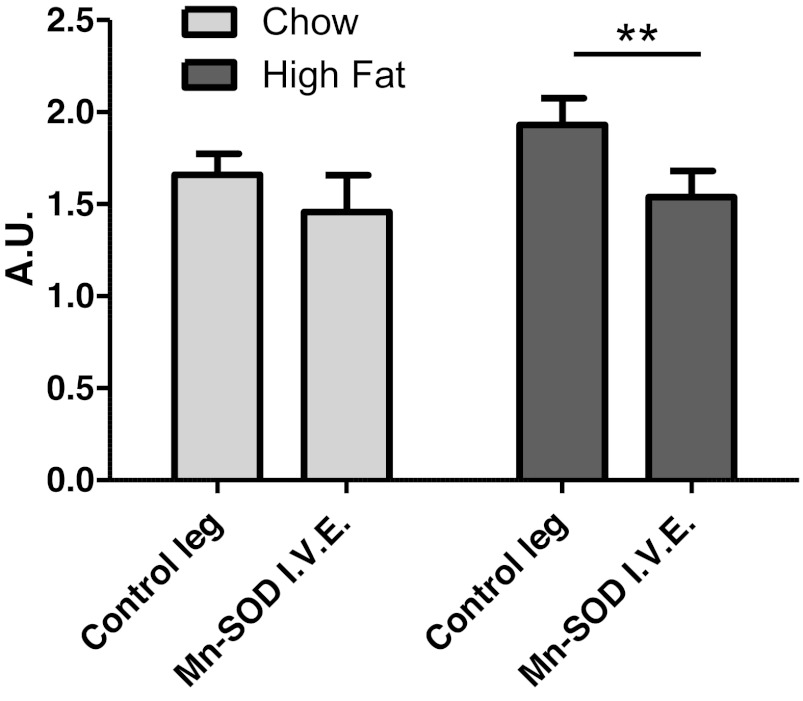
Elevated mitochondrial reactive oxygen species have been suggested to play a causative role in some forms of muscle insulin resistance. However, the extent of their involvement in the development of diet-induced insulin resistance remains unclear. To investigate, manganese superoxide dismutase (MnSOD), a key mitochondrial-specific enzyme with antioxidant modality, was overexpressed, and the effect on in vivo muscle insulin resistance induced by a high-fat (HF) diet in rats was evaluated. Male Wistar rats were maintained on chow or HF diet. After 3 wk, in vivo electroporation (IVE) of MnSOD expression and empty vectors was undertaken in right and left tibialis cranialis (TC) muscles, respectively. After one more week, insulin action was evaluated using hyperinsulinemic euglycemic clamp, and tissues were subsequently analyzed for antioxidant enzyme capacity and markers of oxidative stress. MnSOD mRNA was overexpressed 4.5-fold, and protein levels were increased by 70%, with protein detected primarily in the mitochondrial fraction of muscle fibers. This was associated with elevated MnSOD and glutathione peroxidase activity, indicating that the overexpressed MnSOD was functionally active. The HF diet significantly reduced whole body and TC muscle insulin action, whereas overexpression of MnSOD in HF diet animals ameliorated this reduction in TC muscle glucose uptake by 50% (P < 0.05). Decreased protein carbonylation was seen in MnSOD overexpressing TC muscle in HF-treated animals (20% vs. contralateral control leg, P < 0.05), suggesting that this effect was mediated through an altered redox state. Thus interventions causing elevation of mitochondrial antioxidant activity may offer protection against diet-induced insulin resistance in skeletal muscle.
Figures


References
-
- Anderson EJ, Lustig ME, Boyle KE, Woodlief TL, Kane DA, Lin CT, Price JW, 3rd, Kang L, Rabinovitch PS, Szeto HH, Houmard JA, Cortright RN, Wasserman DH, Neufer PD. Mitochondrial H2O2 emission and cellular redox state link excess fat intake to insulin resistance in both rodents and humans. J Clin Invest 119: 573–581, 2009 - PMC - PubMed
-
- Bachmann OP, Dahl DB, Brechtel K, Machann J, Haap M, Maier T, Loviscach M, Stumvoll M, Claussen CD, Schick F, Häring HU, Jacob S. Effects of intravenous and dietary lipid challenge on intramyocellular lipid content and the relation with insulin sensitivity in humans. Diabetes 50: 2579–2584, 2001 - PubMed
-
- Barrett WC, DeGnore JP, Keng YF, Zhang ZY, Yim MB, Chock PB. Roles of superoxide radical anion in signal transduction mediated by reversible regulation of protein-tyrosine phosphatase 1b. J Biol Chem 274: 34543–34546, 1999 - PubMed
-
- Beers RF, Jr, Sizer IW. A spectrophotometric method for measuring the breakdown of hydrogen peroxide by catalase. J Biol Chem 195: 133–140, 1952 - PubMed
-
- Bloch-Damti A, Bashan N. Proposed mechanisms for the induction of insulin resistance by oxidative stress. Antioxid Redox Signal 7: 1553–1567, 2005 - PubMed
Publication types
MeSH terms
Substances
LinkOut - more resources
Full Text Sources
Research Materials
Miscellaneous
