. 2013 May 1;207(9):1433-41.
doi: 10.1093/infdis/jis476. Epub 2012 Jul 24.

Community-wide, contemporaneous circulation of a broad spectrum of human rhinoviruses in healthy Australian preschool-aged children during a 12-month period

Affiliations

Community-wide, contemporaneous circulation of a broad spectrum of human rhinoviruses in healthy Australian preschool-aged children during a 12-month period

Ian M Mackay et al. J Infect Dis. .

Abstract

Human rhinovirus (HRV) replication triggers exacerbation of asthma and causes most acute respiratory illnesses (ARIs), which may manifest as influenza-like illness. The recent assignment of 60 previously unknown HRV types to a third HRV species, Human rhinovirus C, raised questions about the prevalence of these picornavirus types in the community, the extent of HRV diversity at a single site, and whether the HRVs have an equally diverse clinical impact on their hosts. We quantified HRV diversity, and there was no clinical impact attributable to HRV species and genotypes among a community population of preschool-aged children with ARI who provided respiratory samples during 2003. All HRV species were represented among 138 children with ARI, and 74 distinct HRV types were cocirculating. Fever accompanied 32.8% of HRV-positive ARI cases. HRVs were less likely than DNA viruses to be codetected with another virus, suggesting virus interference at the community level, demonstrated by the inverse correlation between influenza virus detection and HRV detection.


Figures
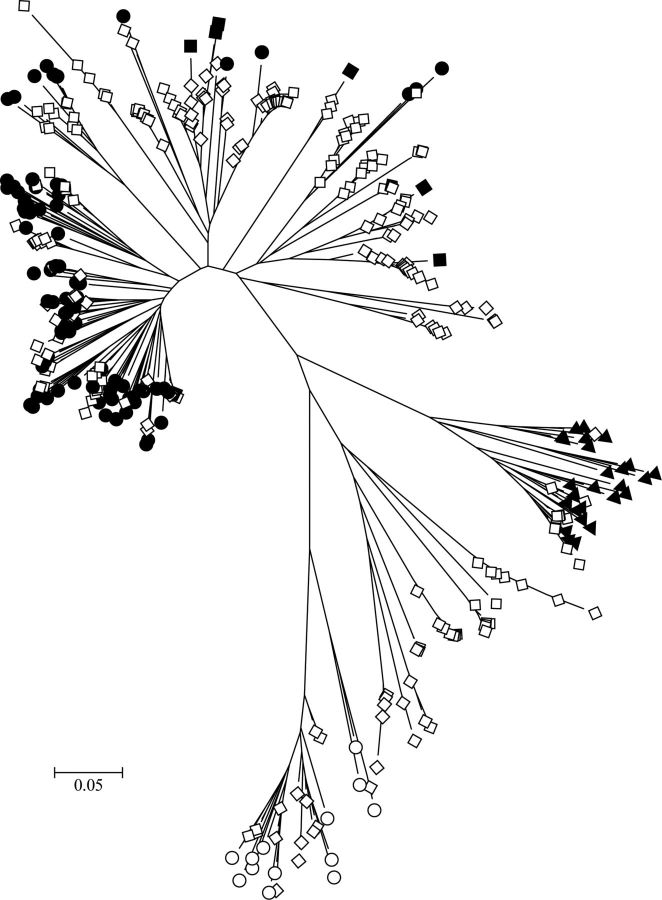
Figure 1.
Figure 1.
Evolutionary relationships among characterized and cohort human rhinovirus (HRV) sequences assigned to the genus Enterovirus. The evolutionary history was inferred using the neighbor-joining method in MEGA5 [37, 38]. The optimal tree is shown drawn to scale, with branch lengths in the same units as those of the evolutionary distances (base substitutions per site; maximum composite likelihood method [39]) The analysis involved 401 nucleotide sequences, including completely sequenced referenced types [40]. Sequences from this study (open diamonds) were included with previously characterized Human rhinovirus A (filled circles), Human rhinovirus B (filled triangles), Human rhinovirus C (filled diamonds), and enterovirus (open circles) types.
Figure 2.
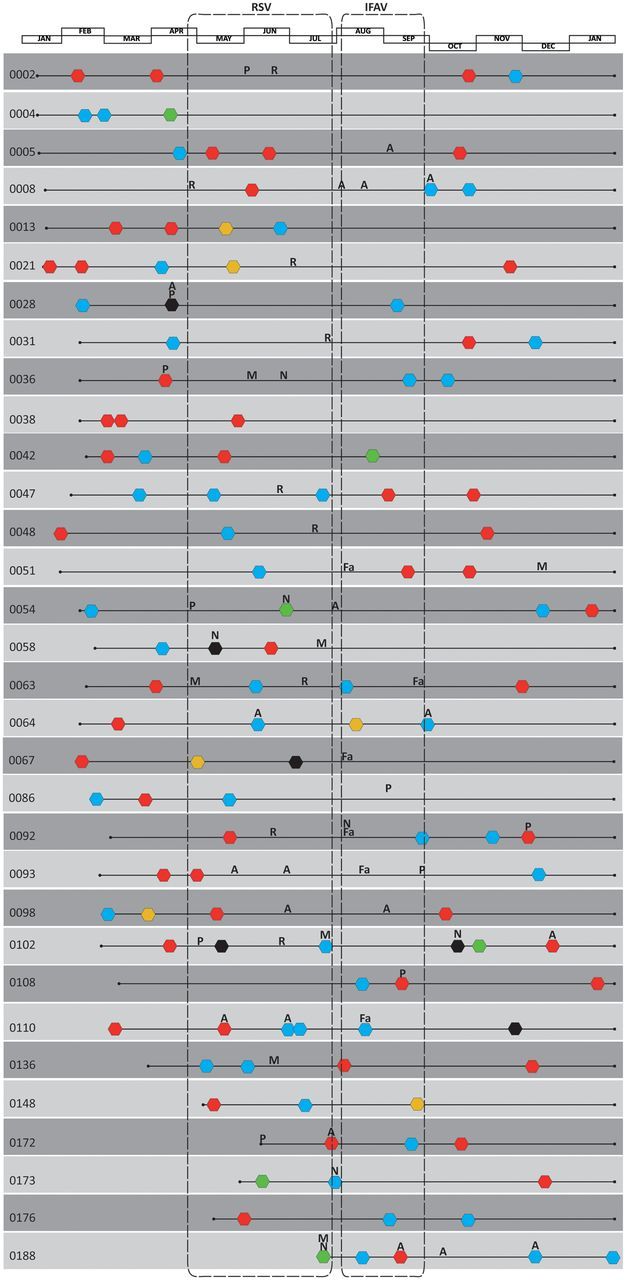
Figure 2.
Timeline of all the viruses identified in 60 children (29.6% of all human rhinovirus [HRV]–positive children) who had ≥2 picornaviruses detected during their enrollment. All respiratory syncytial virus (R) and influenza A virus (Fa) detections were contained within periods encapsulated using dashed boxes. Abbreviations: A, adenovirus; black hexagons, untypable picornavirus; blue hexagons, Human rhinovirus C; green hexagons, enterovirus; M, metapneumovirus; N, coronavirus NL63; P, parainfluenzavirus; red hexagons, Human rhinovirus A; yellow hexagons, Human rhinovirus B.
Figure 3.
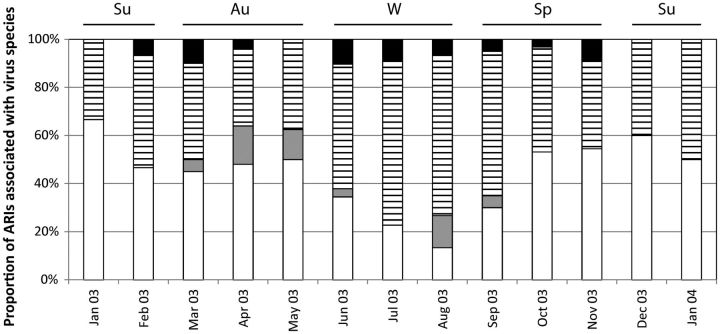
Figure 3.
Proportion of total picornavirus identifications that were Human rhinovirus A (HRV-A; white bars), Human rhinovirus B (HRV-B; grey bars), Human rhinovirus C (stripes), and enterovirus (black bars), by month, during 2003–2004. Abbreviations: ARI, acute respiratory infection; Au, autumn (Mar–May); Su, summer (Dec–Feb); Sp, spring (Sep–Nov); W, winter (Jul–Aug). HRV-C was more common in winter than HRV-A (P = .624).

References

    1. Lambert SB, Allen KM, Carter RC, Nolan TM. The cost of community-managed viral respiratory illnesses in a cohort of healthy preschool-aged children. Resp Res. 2008;9:1–11. - PMC - PubMed
    1. Gwaltney JM, Jr., Hendley JO, Simon G, Jordan WS., Jr Rhinovirus infections in an industrial population. 3. Number and prevalence of serotypes. Am J Epidemiol. 1968;87:158–66. - PubMed
    1. Wisdom A, McWilliam Leitch EC, Gaunt E, Harvala H, Simmonds P. Screening and comprehensive VP4/2-typing of human rhinoviruses (HRVs) and enteroviruses: comprehensive VP4-VP2 typing reveals high incidence and genetic diversity HRV species C. J Clin Microbiol. 2009;47:3958–67. - PMC - PubMed
    1. Hamre D, Connelly AP, Procknow JJ. Virologic studies of acute respiratory disease in young adults. IV Virus isolations during four years of surveillance. Am J Epidemiol. 1966;83:238–49. - PubMed
    1. Monto AS, Bryan ER, Ohmit S. Rhinovirus infections in Tecumseh, Michigan: frequency of illness and number of serotypes. J Infect Dis. 1987;156:43–9. - PubMed

Publication types