


Oxidative stress in genetic mouse models of Parkinson's disease
- PMID: 22829959
- PMCID: PMC3399377
- DOI: 10.1155/2012/624925
Oxidative stress in genetic mouse models of Parkinson's disease
Abstract
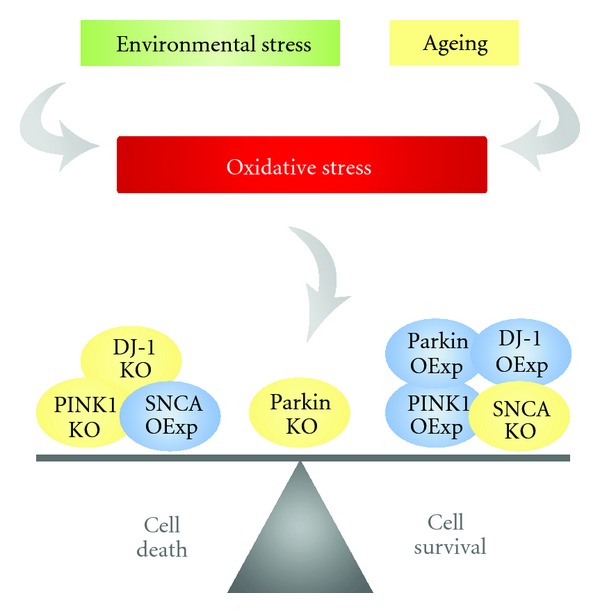
There is extensive evidence in Parkinson's disease of a link between oxidative stress and some of the monogenically inherited Parkinson's disease-associated genes. This paper focuses on the importance of this link and potential impact on neuronal function. Basic mechanisms of oxidative stress, the cellular antioxidant machinery, and the main sources of cellular oxidative stress are reviewed. Moreover, attention is given to the complex interaction between oxidative stress and other prominent pathogenic pathways in Parkinson's disease, such as mitochondrial dysfunction and neuroinflammation. Furthermore, an overview of the existing genetic mouse models of Parkinson's disease is given and the evidence of oxidative stress in these models highlighted. Taken into consideration the importance of ageing and environmental factors as a risk for developing Parkinson's disease, gene-environment interactions in genetically engineered mouse models of Parkinson's disease are also discussed, highlighting the role of oxidative damage in the interplay between genetic makeup, environmental stress, and ageing in Parkinson's disease.
Figures

References
-
- Obeso JA, Rodriguez-Oroz MC, Goetz CG, et al. Missing pieces in the Parkinson's disease puzzle. Nature Medicine. 2010;16(6):653–661. - PubMed
-
- Crosiers D, Theuns J, Cras P, Van Broeckhoven C. Parkinson disease: insights in clinical, genetic and pathological features of monogenic disease subtypes. Journal of Chemical Neuroanatomy. 2011;42(2):131–141. - PubMed
-
- Sundal C, Fujioka S, Uitti RJ, Wszolek ZK. Autosomal dominant Parkinson's disease. Parkinsonism & Related Disorders. 2012;18, supplement 1:S7–S10. - PubMed
-
- Reichmann H. View point: etiology in Parkinson’s disease. Dual hit or spreading intoxication. Journal of the Neurological Sciences. 2011;310(1-2):9–11. - PubMed
-
- Lesage S, Brice A. Role of Mendelian genes in “sporadic” Parkinson's disease. Parkinsonism & Related Disorders. 2012;18, supplement 1:S66–S70. - PubMed
Publication types
MeSH terms
LinkOut - more resources
Full Text Sources
Medical
