


Clinical parameters model for predicting pathologic complete response following preoperative chemoradiation in patients with esophageal cancer
- PMID: 22831985
- PMCID: PMC3457750
- DOI: 10.1093/annonc/mds210
Clinical parameters model for predicting pathologic complete response following preoperative chemoradiation in patients with esophageal cancer
Abstract
Background: Approximately 25% of patients with esophageal cancer (EC) who undergo preoperative chemoradiation, achieve a pathologic complete response (pathCR). We hypothesized that a model based on clinical parameters could predict pathCR with a high (≥60%) probability.
Patients and methods: We analyzed 322 patients with EC who underwent preoperative chemoradiation. All the patients had baseline and postchemoradiation positron emission tomography (PET) and pre- and postchemoradiation endoscopic biopsy. Logistic regression models were used for analysis, and cross-validation via the bootstrap method was carried out to test the model.
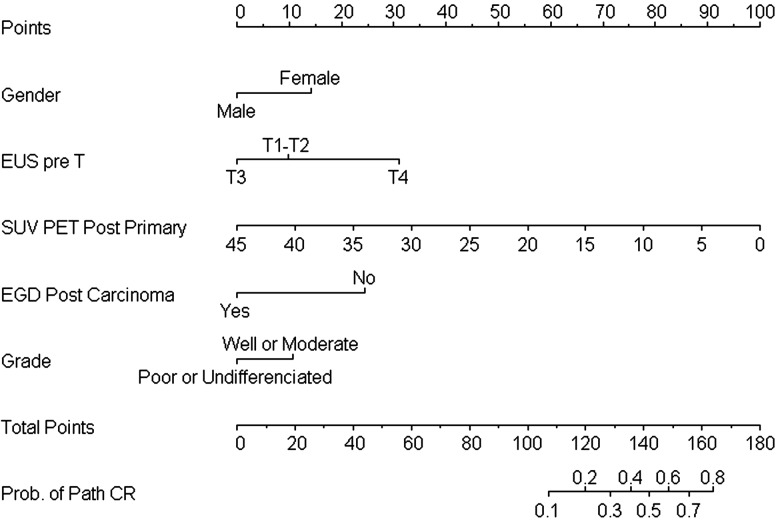
Results: The 70 (21.7%) patients who achieved a pathCR lived longer (median overall survival [OS], 79.76 months) than the 252 patients who did not achieve a pathCR (median OS, 39.73 months; OS, P = 0.004; disease-free survival, P = 0.003). In a logistic regression analysis, the following parameters contributed to the prediction model: postchemoradiation PET, postchemoradiation biopsy, sex, histologic tumor grade, and baseline (EUS)T stage. The area under the receiver-operating characteristic curve was 0.72 (95% confidence interval [CI] 0.662-0.787); after the bootstrap validation with 200 repetitions, the bias-corrected AU-ROC was 0.70 (95% CI 0.643-0.728).
Conclusion: Our data suggest that the logistic regression model can predict pathCR with a high probability. This clinical model could complement others (biomarkers) to predict pathCR.
Figures
References
-
- Parkin DM, Bray F, Ferlay J, et al. Global cancer statistics, 2002. CA Cancer J Clin. 2005;55(2):74–108. - PubMed
-
- Ferlay J, Shin HR, Bray F, et al. Estimates of worldwide burden of cancer in 2008: GLOBOCAN 2008. Int J Cancer. 2010 doi:10.1002/ijc.25516. - DOI - PubMed
-
- Cancer Research UK. Oesophageal (gullet) cancer. [on-line] 2008 http://info.cancerresearchuk.org/cancerstats/types/oesophagus/incidence/ (14 October 2008, date last accessed)
-
- Brown LM, Devesa SS, Chow WH. Incidence of adenocarcinoma of the esophagus among white Americans by sex, stage, and age. J Natl Cancer Inst. 2008;100(16):1184–1187. doi:10.1093/jnci/djn211. - DOI - PMC - PubMed
-
- Pohl H, Welch HG. The role of overdiagnosis and reclassification in the marked increase of esophageal adenocarcinoma incidence. J Natl Cancer Inst. 2005;97(2):142–146. - PubMed
Publication types
MeSH terms
Grants and funding
LinkOut - more resources
Full Text Sources
Medical
Molecular Biology Databases
