. 2011 Jul 26;1(7):e23.
doi: 10.1038/tp.2011.25.

Potentiation of ghrelin signaling attenuates cancer anorexia-cachexia and prolongs survival

Affiliations

Potentiation of ghrelin signaling attenuates cancer anorexia-cachexia and prolongs survival

N Fujitsuka et al. Transl Psychiatry. .

Abstract

Cancer anorexia-cachexia syndrome is characterized by decreased food intake, weight loss, muscle tissue wasting and psychological distress, and this syndrome is a major source of increased morbidity and mortality in cancer patients. This study aimed to clarify the gut-brain peptides involved in the pathogenesis of the syndrome and determine effective treatment for cancer anorexia-cachexia. We show that both ghrelin insufficiency and resistance were observed in tumor-bearing rats. Corticotropin-releasing factor (CRF) decreased the plasma level of acyl ghrelin, and its receptor antagonist, α-helical CRF, increased food intake of these rats. The serotonin 2c receptor (5-HT2cR) antagonist SB242084 decreased hypothalamic CRF level and improved anorexia, gastrointestinal (GI) dysmotility and body weight loss. The ghrelin receptor antagonist (D-Lys3)-GHRP-6 worsened anorexia and hastened death in tumor-bearing rats. Ghrelin attenuated anorexia-cachexia in the short term, but failed to prolong survival, as did SB242084 administration. In addition, the herbal medicine rikkunshito improved anorexia, GI dysmotility, muscle wasting, and anxiety-related behavior and prolonged survival in animals and patients with cancer. The appetite-stimulating effect of rikkunshito was blocked by (D-Lys3)-GHRP-6. Active components of rikkunshito, hesperidin and atractylodin, potentiated ghrelin secretion and receptor signaling, respectively, and atractylodin prolonged survival in tumor-bearing rats. Our study demonstrates that the integrated mechanism underlying cancer anorexia-cachexia involves lowered ghrelin signaling due to excessive hypothalamic interactions of 5-HT with CRF through the 5-HT2cR. Potentiation of ghrelin receptor signaling may be an attractive treatment for anorexia, muscle wasting and prolong survival in patients with cancer anorexia-cachexia.


Figures
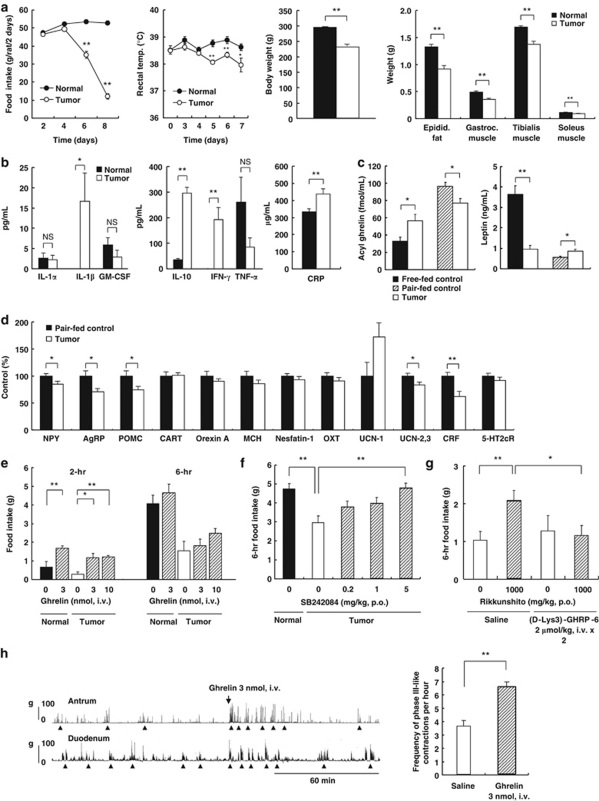
Figure 1
Figure 1
Cancer anorexia–cachexia. (a) Food intake, rectal temperatures and weights of tumor-bearing rats (n=6–8). (bd) Plasma and hypothalamic appetite-regulating peptides (n=8–10). (eg) Effects of ghrelin, the serotonin 2c receptor (5-HT2cR) antagonist SB242084 and rikkunshito on food intake of tumor-bearing rats and blockade by the ghrelin receptor (GHS-R) antagonist (D-Lys3)-GHRP-6 (n=8–10). (h) Fasted gastrointestinal (GI) motor activity in tumor-bearing rats on day 5. Ghrelin increased the frequency of phase III-like contractions (▴) in the duodenum (n=8). *P<0.05; **P<0.01. AgRP: agouti-related peptide; CART: cocaine- and amphetamine-regulated transcript; MCH: melanin-concentrating hormone; OXT: oxytocin; UCN, urocortin.
Figure 2
Figure 2
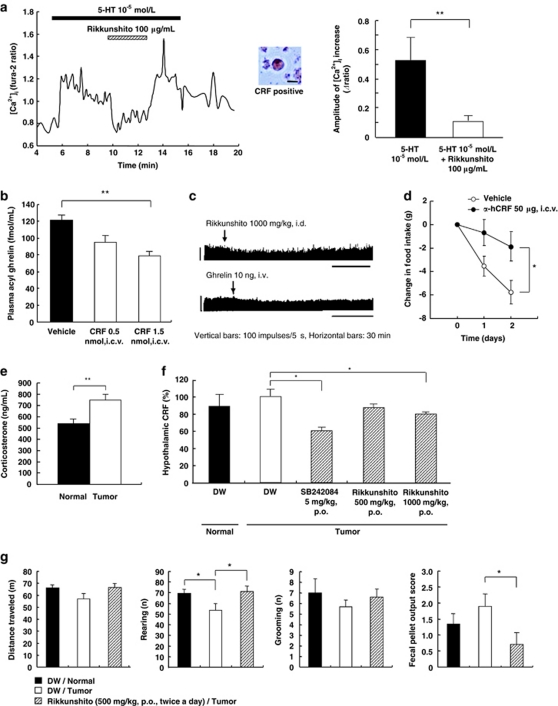
Involvement of corticotropin-releasing factor (CRF) in cancer anorexia. (a) The serotonin (5-HT)-induced cytosolic Ca2+ concentration ([Ca2+]i) increase was suppressed by rikkunshito in single CRF neurons isolated from the paraventricular nucleus (PVN). (b) Inhibitory effect of CRF on plasma acyl ghrelin concentrations in fasted rats (n=8–9). (c) Inhibitory effects of ghrelin and rikkunshito on the efferent activity of the adrenal sympathetic nerve in rats. (d) Food intake was increased in tumor-bearing rats by daily administration of the CRF receptor antagonist α-helical CRF (n=9–10). (e) Plasma corticosterone concentration of tumor-bearing rats (n=12). (f) Hypothalamic CRF levels in tumor-bearing rats were decreased by SB242084 or rikkunshito (n=10). (g) Daily administration of rikkunshito in tumor-bearing rats improved rearing and decreased fecal pellet output score in an open-field test (n=9–10). *P<0.05; **P<0.01. DW: distilled water.
Figure 3
Figure 3
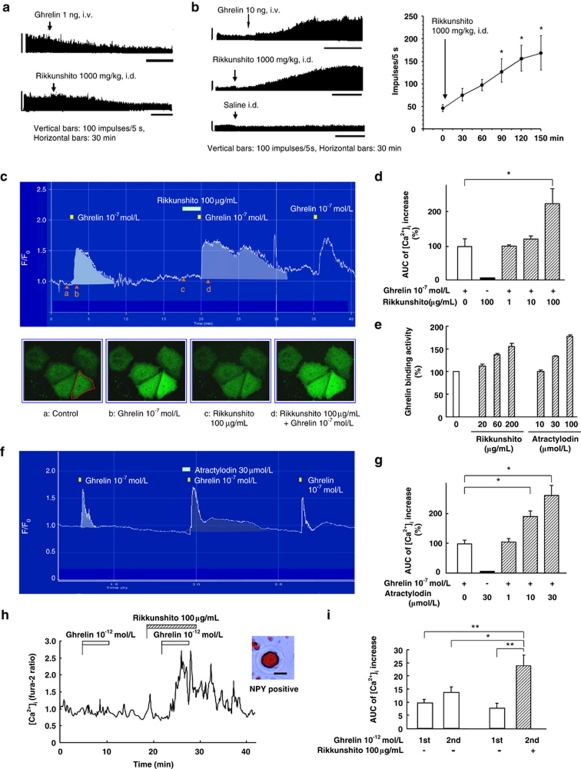
Ghrelin signaling and rikkunshito. (a, b) Effects of ghrelin and rikkunshito on the afferent (a) and efferent (b, n=6) activities of the gastric vagus nerve in rats. (c, d) Changes in F/F0 fluorescence evoked by ghrelin in ghrelin receptor (GHS-R)-expressing cells. Representative Ca2+-imaging figures were taken as indicated by the arrowheads in the figures (ad) and the intensities within the area of a cell (red line). [Ca2+]i increase in the area under the curve (AUC) was evaluated (n=6–9). (e) Effect of rikkunshito and atractylodin on ghrelin/GHS-R binding activity. (f, g) Atractylodin enhanced the ghrelin-induced [Ca2+]i increase in GHS-R-expressing cells (n=8–12). (h, i) Ghrelin (10−12 mol l−1) increased the [Ca2+]i in single neuropeptide Y (NPY) neurons isolated from the arcuate nucleus (ARC). The increase in AUC of the [Ca2+]i in response to secondary ghrelin with rikkunshito (n=22) was significantly greater than the response to primary or secondary ghrelin without rikkunshito (n=32). *P<0.05; **P<0.01.
Figure 4
Figure 4
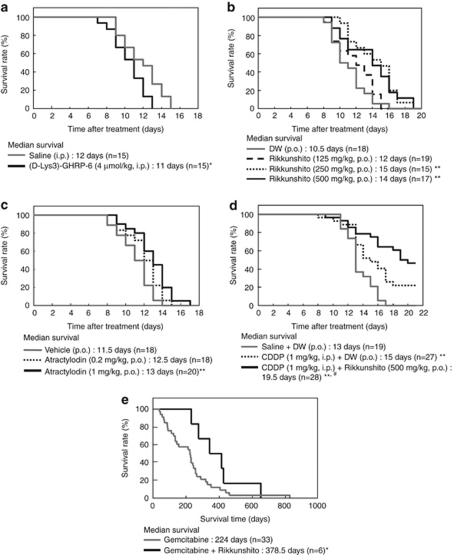
Survival of tumor-bearing rats and patients with pancreatic cancer. (a) Administration of (D-Lys3)-GHRP-6 decreased the median survival of tumor-bearing rats. (b, c) Administration of rikkunshito and atractylodin increased the median survival of tumor-bearing rats. (d) Survival of tumor-bearing rats was increased by intraperitoneal (i.p.) administration of cisplatin (CDDP) and further prolonged by co-administration of rikkunshito. (e) Rikkunshito prolonged the median survival of pancreatic cancer patients with ascites who were treated with gemcitabine. *P<0.05; **P<0.01 vs control group; #P<0.05 vs CDDP+DW. DW: distilled water.
Figure 5
Figure 5
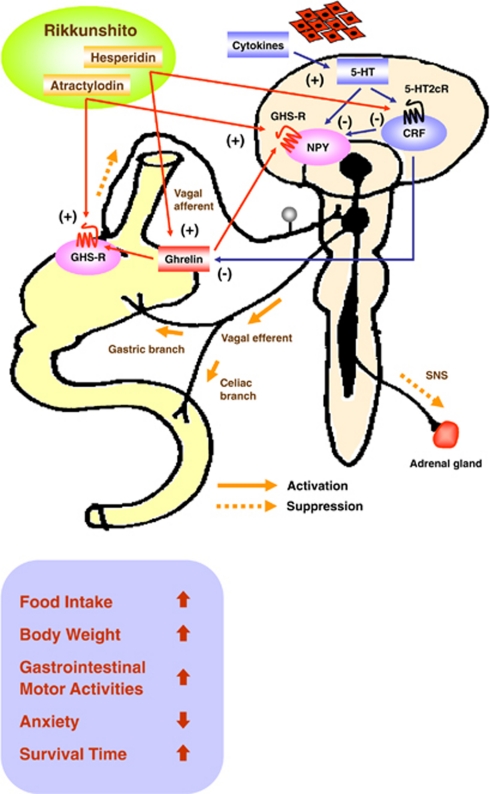
Ghrelin signaling and cancer anorexia–cachexia. Hypothalamic corticotropin-releasing factor (CRF) neurons are activated by cytokines through serotonin (5-HT) and the 5-HT 2c receptor (5-HT2cR), which shows functional divergence. Our data demonstrate the existence of a novel 5-HT-CRF neuronal pathway that inhibits ghrelin secretion and has a pathogenetic role in cancer anorexia–cachexia syndrome. The traditional herbal medicine rikkunshito improves anorexia, weight loss, gastrointestinal (GI) dysmotility, anxiety-related behavior and survival. Rikkunshito and its active component hesperidin stimulate ghrelin secretion from stomach by interrupting this 5-HT-CRF pathway via 5-HT2cR antagonism. Another active component atractylodin potentiates the action of ghrelin by presumably allosterically sensitizing the GHS-R on the vagal afferent terminals of stomach or neuropeptide Y (NPY) neurons of the hypothalamic arcuate nucleus (ARC). The 5-HT2cR antagonist improved anorexia–cachexia in the short term, but failed to improve survival. Thus, both the release of ghrelin and the potentiation of ghrelin/GHS-R signaling are important for mitigating ghrelin insufficiency and resistance, which are characteristics of cancer anorexia–cachexia syndrome.

References

    1. Tisdale MJ. Biology of cachexia. J Natl Cancer Inst. 1997;89:1763–1773. - PubMed
    1. Mantovani G, Maccio A, Massa E, Madeddu C. Managing cancer-related anorexia/cachexia. Drugs. 2001;61:499–514. - PubMed
    1. Inui A. Eating behavior in anorexia nervosa—an excess of both orexigenic and anorexigenic signalling. Mol Psychiatry. 2001;6:620–624. - PubMed
    1. Perboni S, Inui A. Anorexia in cancer: role of feeding-regulatory peptides. Philos Trans R Soc Lond Ser B. 2006;361:1281–1289. - PMC - PubMed
    1. Morley JE, Farr SA. Cachexia and neuropeptide Y. Nutrition. 2008;24:815–819. - PubMed

Publication types

MeSH terms