


The genetic association between personality and major depression or bipolar disorder. A polygenic score analysis using genome-wide association data
- PMID: 22833196
- PMCID: PMC3309491
- DOI: 10.1038/tp.2011.45
The genetic association between personality and major depression or bipolar disorder. A polygenic score analysis using genome-wide association data
Abstract
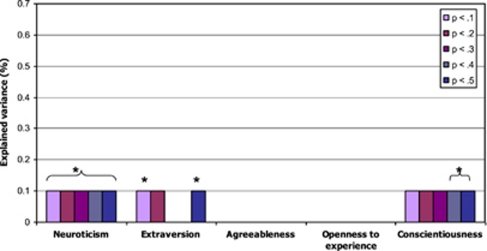
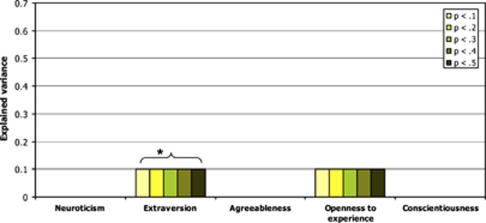
The relationship between major depressive disorder (MDD) and bipolar disorder (BD) remains controversial. Previous research has reported differences and similarities in risk factors for MDD and BD, such as predisposing personality traits. For example, high neuroticism is related to both disorders, whereas openness to experience is specific for BD. This study examined the genetic association between personality and MDD and BD by applying polygenic scores for neuroticism, extraversion, openness to experience, agreeableness and conscientiousness to both disorders. Polygenic scores reflect the weighted sum of multiple single-nucleotide polymorphism alleles associated with the trait for an individual and were based on a meta-analysis of genome-wide association studies for personality traits including 13,835 subjects. Polygenic scores were tested for MDD in the combined Genetic Association Information Network (GAIN-MDD) and MDD2000+ samples (N=8921) and for BD in the combined Systematic Treatment Enhancement Program for Bipolar Disorder and Wellcome Trust Case-Control Consortium samples (N=6329) using logistic regression analyses. At the phenotypic level, personality dimensions were associated with MDD and BD. Polygenic neuroticism scores were significantly positively associated with MDD, whereas polygenic extraversion scores were significantly positively associated with BD. The explained variance of MDD and BD, ∼0.1%, was highly comparable to the variance explained by the polygenic personality scores in the corresponding personality traits themselves (between 0.1 and 0.4%). This indicates that the proportions of variance explained in mood disorders are at the upper limit of what could have been expected. This study suggests shared genetic risk factors for neuroticism and MDD on the one hand and for extraversion and BD on the other.
Figures
References
-
- American Psychiatric Association Diagnostic and Statistical Manual of Mental Disorders 4th Edition4th edn.APA: Washington DC; 1994
-
- Costa PT, McCrae R. Manual for the Revised NEO Personality Inventory (NEO-PI-R) and NEO Five-Factor Inventory (NEO-FFI) Psychological Assessment Resources: Odessa; 1992.
-
- Eysenck HJ, Eysenck SBG. Manual of the Eysenck Personality Questionnaire. Educational and Industrial Testing Service: San Diego, CA; 1975.
-
- Kotov R, Gamez W, Schmidt F, Watson D. Linking ‘big' personality traits to anxiety, depressive, and substance use disorders: a meta-analysis. Psychol Bull. 2010;136:768–821. - PubMed
-
- Bagby RM, Bindseil KD, Schuller DR, Rector NA, Young LT, Cooke RG, et al. Relationship between the five-factor model of personality and unipolar, bipolar and schizophrenic patients. Psychiatry Res. 1997;70:83–94. - PubMed
Publication types
MeSH terms
Grants and funding
- R01 MH066206/MH/NIMH NIH HHS/United States
- R01 AA007728/AA/NIAAA NIH HHS/United States
- DA12854/DA/NIDA NIH HHS/United States
- 076113/WT_/Wellcome Trust/United Kingdom
- P01CA89392/CA/NCI NIH HHS/United States
- R01 AA013321/AA/NIAAA NIH HHS/United States
- R01 MH059160/MH/NIMH NIH HHS/United States
- HHSN268200782096C/HG/NHGRI NIH HHS/United States
- U01 HG004422/HG/NHGRI NIH HHS/United States
- R01 DA012854/DA/NIDA NIH HHS/United States
- K08 DA019951/DA/NIDA NIH HHS/United States
- AA07580/AA/NIAAA NIH HHS/United States
- G0700704/MRC_/Medical Research Council/United Kingdom
- AA14041/AA/NIAAA NIH HHS/United States
- AA13326/AA/NIAAA NIH HHS/United States
- DA019951/DA/NIDA NIH HHS/United States
- U01HG004438/HG/NHGRI NIH HHS/United States
- R01 AA007535/AA/NIAAA NIH HHS/United States
- U01 HG004438/HG/NHGRI NIH HHS/United States
- U10AA008401/AA/NIAAA NIH HHS/United States
- R01 AA014041/AA/NIAAA NIH HHS/United States
- K05 AA017688/AA/NIAAA NIH HHS/United States
- U01 HG004446/HG/NHGRI NIH HHS/United States
- ZIA AG000197/ImNIH/Intramural NIH HHS/United States
- AA13320/AA/NIAAA NIH HHS/United States
- Z99 AG999999/ImNIH/Intramural NIH HHS/United States
- N01-AG-1-2109/AG/NIA NIH HHS/United States
- P50 AA011998/AA/NIAAA NIH HHS/United States
- AA13321/AA/NIAAA NIH HHS/United States
- AA10248/AA/NIAAA NIH HHS/United States
- P01 CA089392/CA/NCI NIH HHS/United States
- R01 AA013326/AA/NIAAA NIH HHS/United States
- ZIA AG000196/ImNIH/Intramural NIH HHS/United States
- R56 DA012854/DA/NIDA NIH HHS/United States
- T32 AA007580/AA/NIAAA NIH HHS/United States
- MH66206/MH/NIMH NIH HHS/United States
- G1001245/MRC_/Medical Research Council/United Kingdom
- R01 DA019963/DA/NIDA NIH HHS/United States
- AA07728/AA/NIAAA NIH HHS/United States
- R01 DA013423/DA/NIDA NIH HHS/United States
- R01 MH079799/MH/NIMH NIH HHS/United States
- AA11998/AA/NIAAA NIH HHS/United States
- U10 AA008401/AA/NIAAA NIH HHS/United States
- R37 AA007728/AA/NIAAA NIH HHS/United States
- BB/F019394/1/BB_/Biotechnology and Biological Sciences Research Council/United Kingdom
- R01 AA013320/AA/NIAAA NIH HHS/United States
- R01 079799/PHS HHS/United States
LinkOut - more resources
Full Text Sources
Other Literature Sources
Medical
