. 2012 Jul 19:3:119.
doi: 10.3389/fphar.2012.00119. eCollection 2012.

Heme oxygenase-1, oxidation, inflammation, and atherosclerosis

Affiliations

Heme oxygenase-1, oxidation, inflammation, and atherosclerosis

Jesus A Araujo et al. Front Pharmacol. .

Abstract

Atherosclerosis is an inflammatory process of the vascular wall characterized by the infiltration of lipids and inflammatory cells. Oxidative modifications of infiltrating low-density lipoproteins and induction of oxidative stress play a major role in lipid retention in the vascular wall, uptake by macrophages and generation of foam cells, a hallmark of this disorder. The vasculature has a plethora of protective resources against oxidation and inflammation, many of them regulated by the Nrf2 transcription factor. Heme oxygenase-1 (HO-1) is a Nrf2-regulated gene that plays a critical role in the prevention of vascular inflammation. It is the inducible isoform of HO, responsible for the oxidative cleavage of heme groups leading to the generation of biliverdin, carbon monoxide, and release of ferrous iron. HO-1 has important antioxidant, antiinflammatory, antiapoptotic, antiproliferative, and immunomodulatory effects in vascular cells, most of which play a significant role in the protection against atherogenesis. HO-1 may also be an important feature in macrophage differentiation and polarization to certain subtypes. The biological effects of HO-1 are largely attributable to its enzymatic activity, which can be conceived as a system with three arms of action, corresponding to its three enzymatic byproducts. HO-1 mediated vascular protection may be due to a combination of systemic and vascular local effects. It is usually expressed at low levels but can be highly upregulated in the presence of several proatherogenic stimuli. The HO-1 system is amenable for use in the development of new therapies, some of them currently under experimental and clinical trials. Interestingly, in contrast to the HO-1 antiatherogenic actions, the expression of its transcriptional regulator Nrf2 leads to proatherogenic effects instead. This suggests that a potential intervention on HO-1 or its byproducts may need to take into account any potential alteration in the status of Nrf2 activation. This article reviews the available evidence that supports the antiatherogenic role of HO-1 as well as the potential pathways and mechanisms mediating vascular protection.

Keywords: atherosclerosis; bilirubin; carbon monoxide; heme oxygenase; inflammation; iron; oxidative stress.


Figures
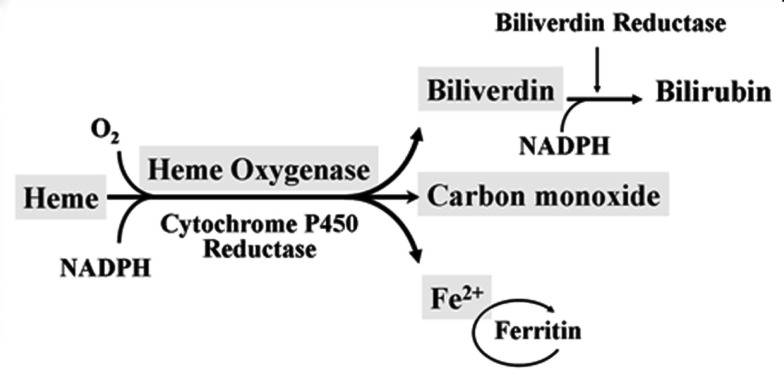
Figure 1
Figure 1
Heme oxygenase enzymatic activity. HO enzymatic leads to the generation of biliverdin, release of carbon monoxide (CO) and Fe2+. Biliverdin is transformed into bilirubin by the biliverdin reductase (BVR) enzyme. Fe2+ can be bound by the iron storage protein ferritin.
Figure 2
Figure 2
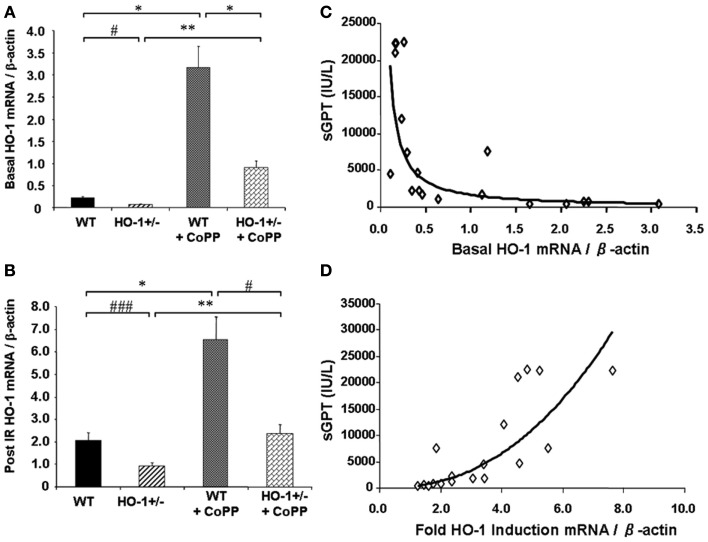
Basal HO-1 protects against oxidation and inflammation. HO-1+/− and HO+/+ (WT) mice were subjected to partial liver warm ischemia for 90 min followed by 6 h of reperfusion. Two groups of mice were treated with CoPP. (A) Basal HO-1 mRNA levels, (B) Post-ischemia reperfusion (IR) HO-1 mRNA levels, (C) Basal HO-1 levels correlated negatively with post-IR serum GPT levels (R2 = 0.69, p < 0.0001) (D) HO-1 fold induction had a positive correlation with sGPT levels instead (R2 = 0.75, p = 0.0001). Taken from Tsuchihashi et al. (2006). Copyright 2006. The American Association of Immunologists, Inc.
Figure 3
Figure 3
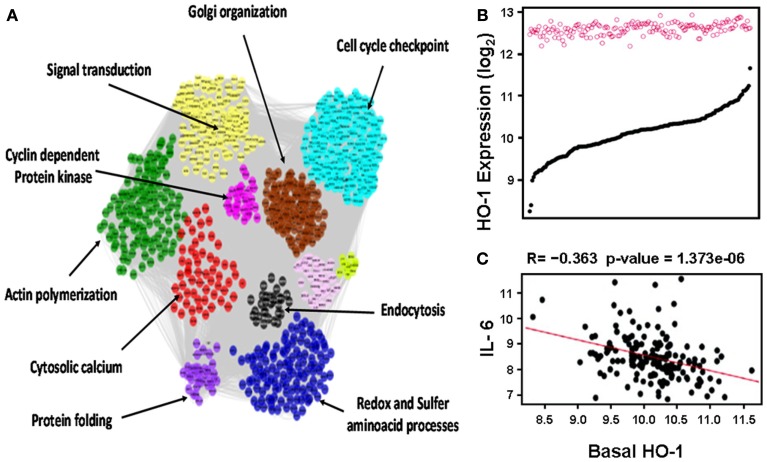
Heme oxygenase-1 is a critical gene in the activation of endothelial cells by oxPAPC. (A) Visualization of the whole network consisting of 2000 transcripts, organized into 11 modules, shown by distinct colors. Network was constructed based on genomic expression data of HACEs from 149 donors, treated with oxPAPC. Examples of module enrichment in specific pathways are shown. HO-1 is a “hub” of gene-gene interactions in the blue module, enriched in redox and sulfur aminoacid processes. (B) HO-1 mRNA expression. Basal levels varied approximately ninefold at baseline (black curve) but only approximately twofold after treatment with oxPAPC (red circles). (C) Basal HO-1 mRNA levels correlated negatively with IL-6 mRNA expression. Taken from Romanoski et al. (2011).
Figure 4
Figure 4
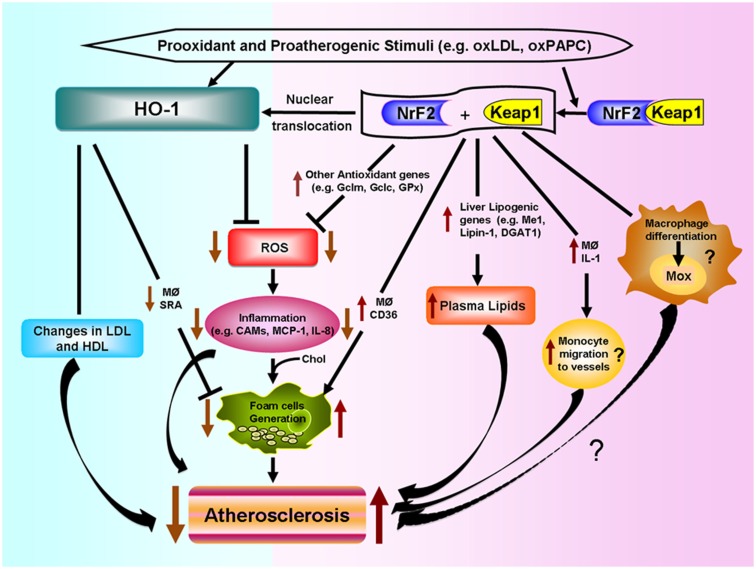
Differential effects of HO-1 and NRF2 in atherosclerosis. Prooxidant and proatherogenic stimuli such as oxLDL and oxPAPC can induce HO-1 expression in vascular cells via Nrf2 activation or other pathways. HO-1 expression leads to decreased ROS generation, decreased inflammatory events such as lower expression of cell adhesion molecules (CAMs) and decreased secretion of inflammatory factors such as monocyte chemotactic protein (MCP)-1 and IL-8. HO-1 also leads to decreased foam cell formation and changes in LDL and HDL lipoproteins, all of which lead to decreased atherogenesis. Nrf2 is bound by chaperone Keap1 in the cytosol. Electrophilic agents lead to dissociation of the Nrf2-Keap1 complex, with release of Nrf2 and nuclear translocation that leads to the induction of HO-1 and several other antioxidant genes that result in decreased ROS formation. However, Nrf2 expression promotes atherosclerotic lesion development. Possible mechanisms include: (1) increased macrophage lipid uptake and foam cell formation, (2) increased lipogenesis and greater levels of non-HDL plasma cholesterol, (3) greater macrophage secretion of IL-1 and monocyte migration to the vessels, and (4) possible macrophage differentiation into a proatherosclerotic phenotype.
Figure 5
Figure 5
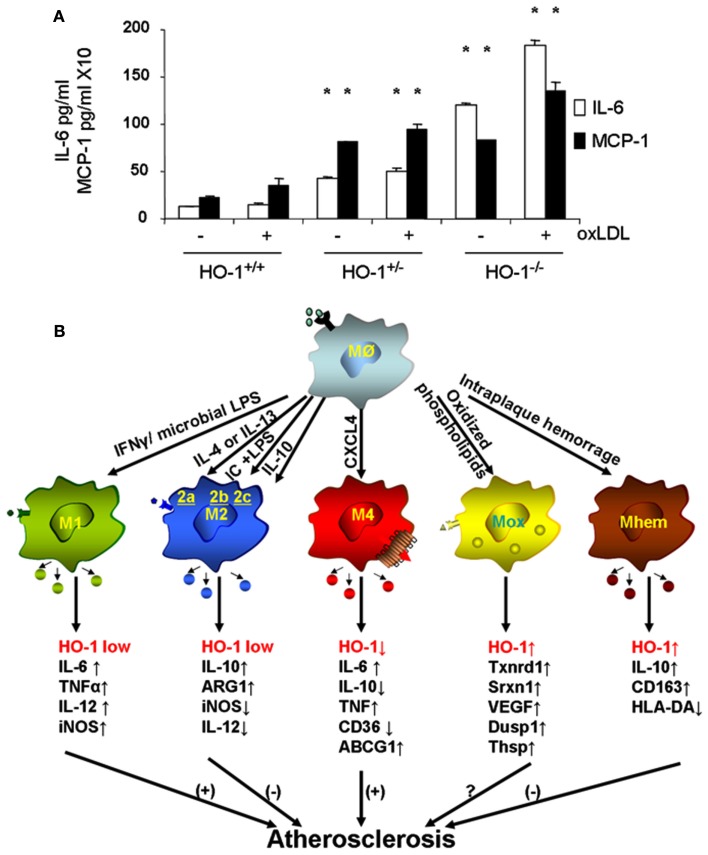
Heme oxygenase-1 inhibits macrophage proinflammatory activity. (A) Peritoneal macrophages from HO-1+/+, HO-1+/−, and HO-1+/+ mice were cultured in the presence or absence of oxLDL 50 μg/ml for 6 h. IL-6 and MCP-1 were determined by ELISA. *p < 0.001 as compared with controls. Data taken from Orozco et al. (2007). (B) HO-1 expression varies in different subtypes of macrophages. Upon monocyte differentiation into macrophages, they can polarize into one of the five proposed subtypes, M1, M2, M4, Mox, and Mhem. Each subtype is induced by specific stimuli as shown along the arrows that derive from the macrophage Mø atop, and characterized by a set of phenotypic markers and/or gene expression shown below each one of them. While some of macrophage subtypes are proposed to simulate atherogenesis such as M1 and M4, others are proposed to inhibit lesion development such as M2 and Mhem. Mox macrophages, generated after treatment with oxPAPC, are dependent on Nrf2 with a role in atherogenesis still to be determined.

References

    1. Abraham N. G., Kappas A. (2008). Pharmacological and clinical aspects of heme oxygenase. Pharmacol. Rev. 60, 79–127 10.1124/pr.107.07104 - DOI - PubMed
    1. Amersi F., Buelow R., Kato H., Ke B., Coito A. J., Shen X. D., Zhao D., Zaky J., Melinek J., Lassman C. R., Kolls J. K., Alam J., Ritter T., Volk H. D., Farmer D. G., Ghobrial R. M., Busuttil R. W., Kupiec-Weglinski J. W. (1999). Upregulation of heme oxygenase-1 protects genetically fat Zucker rat livers from ischemia/reperfusion injury. J. Clin. Invest. 104, 1631–1639 10.1172/JCI7903 - DOI - PMC - PubMed
    1. Araujo J. (2011). Particulate air pollution, systemic oxidative stress, inflammation, and atherosclerosis. Air Qual. Atmos. Health 4, 79–93 10.1007/s11869-010-0101-8 - DOI - PMC - PubMed
    1. Araujo J., Ishikawa K., Lusis A. J. (2002). “Heme Oxygenase and Atherosclerosis,” in Heme Oxygenase: Biology and Medicine, ed. Abraham N. (New York: Kluwer Publisher; ), 269–278
    1. Araujo J. A. (2012). Nrf2 and the promotion of atherosclerosis: lessons to be learned. Clin. Lipidol. 7, 123–116 10.2217/clp.12.5 - DOI

LinkOut - more resources