Review
. 2012 Feb;3(2):181-94.
doi: 10.4155/tde.11.156.

The shape of things to come: importance of design in nanotechnology for drug delivery

Affiliations
Review

The shape of things to come: importance of design in nanotechnology for drug delivery

Yaling Liu et al. Ther Deliv. 2012 Feb.

Abstract

The design of nanoparticle (NP) size, shape and surface chemistry has a significant impact on their performance. While the influences of the particle size and surface chemistry on drug delivery have been studied extensively, little is known about the effect of particle shapes on nanomedicine. In this perspective article, we discuss recent progress on the design and fabrication of NPs of various shapes and their unique delivery properties. The shapes of these drug carriers play an important role in therapeutic delivery processes, such as particle adhesion, distribution and cell internalization. We envision that stimuli-responsive NPs, which actively change their shapes and other properties, might pave way to the next generation of nanomedicine.


Figures
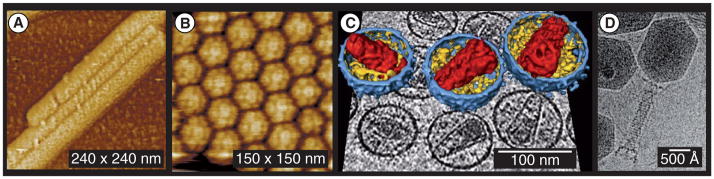
Figure 1
Figure 1. Viruses with different shapes
(A) Cylindrical helical virus; (B) Brome mosaic virus exhibits icosahedral symmetry; (C) HIVs with enveloped membrane; and (D) the complex shape of phage T4. (A and B) Reprinted with permission from [34]. © Society for General Microbiology (2001). (C) Reprinted with permission from [106]. © Elsevier (2006). (D) Reprinted with permission from [35]. © Elsevier (2004).
Figure 2
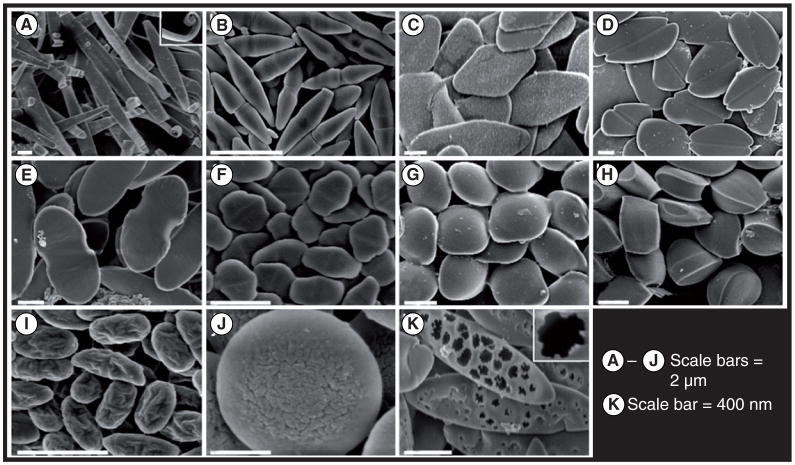
Figure 2. Particles of varying shapes are made by using a combination of stretching and liquefying
(A) Ribbons with curled ends; (B) bicones; (C) diamond disks; (D) emarginated disks; (E) flat pills; (F) elongated hexagonal disks; (G) ravioli; (H) tacos; (I) wrinkled prolate ellipsoids; (J) wrinkled oblate ellipses; and (K) porous elliptical disks. Reprinted with permission from [49]. © National Academy of Sciences of the USA, PNAS (2007).
Figure 3
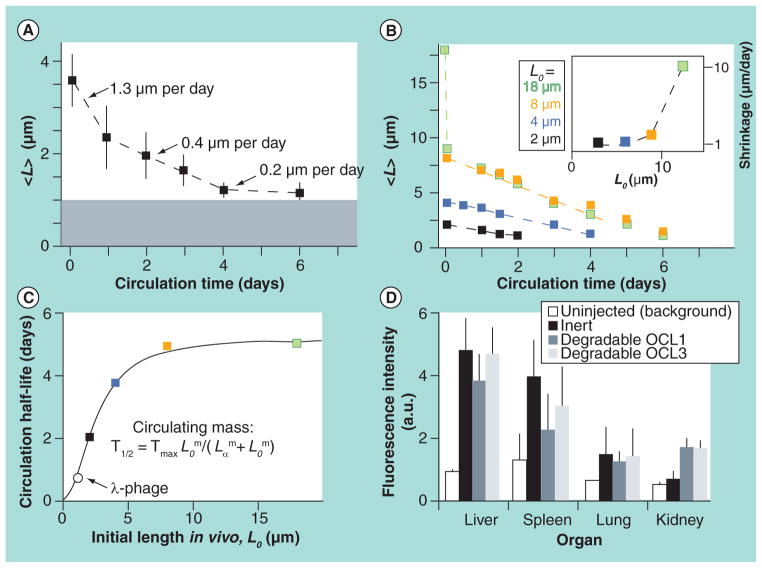
Figure 3. Kinetics of filomicelle of various lengths in vivo
(A) The length of inert filomicelles shortens with the circulation time. The optical diffraction limit of length measurements is marked by the grey region. (B) The initial length of the degradable filomicelles (OCL3) determines its shortening rate (Inset plot: length dependent shrinkage rate). (C) A saturable increase in half-life of circulating mass is exhibited by filomicelles, fitting a cooperative clearance model with τmax = 5.2 days, m = 2.1 and Lo = 2.5 μm. (D) The distribution of inert and degradable filomicelles in clearance organs (Lo = 4 or 8 μm after 4 days of circulation in rats). OCL: Polyethylene glycol-polycaprolactone assembled polymersomes. Reprinted by permission from [15]. © Macmillan Publishers Ltd. Nature (2007).
Figure 4
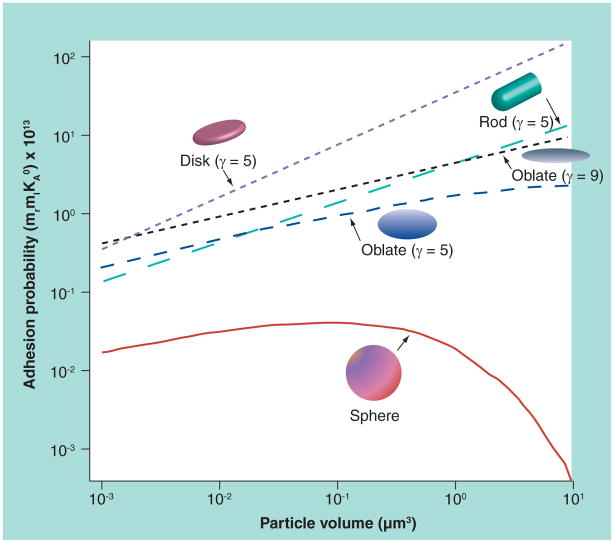
Figure 4. Adhesion probabilities of nanoparticles of various shapes as a function of particle volume
γ is the aspect ratio. Reprinted with permission from [71]. © The Royal Society of Medicine Press Ltd, Exp. Biol. Med. (2011).
Figure 5
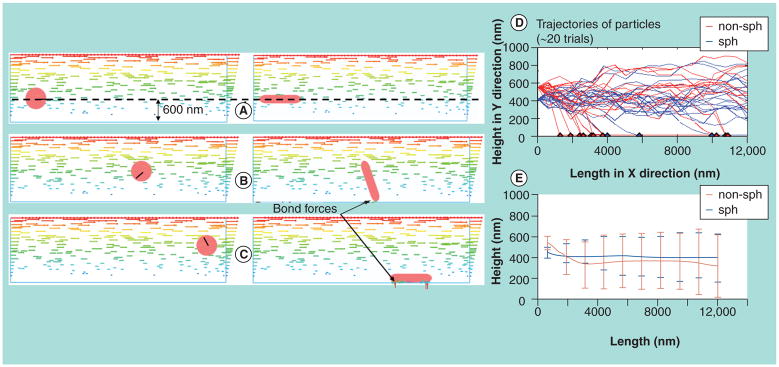
Figure 5. Shape-dependent particle adhesion kinetics
The left column of (A), (B) and (C) shows a spherical particle washed away without contact with surface; Right hand column of (A), (B) and (C) shows a nanorod tumbles and gets deposited. (A), (B) and (C) are at times t = 0, 0.5 and 0.75 s, respectively. The line labeled on the spherical particle indicates its rotation. The horizontal arrows in fluid domain indicate the fluid field. Arrows shown on nanoparticles indicate the magnitude and direction of bonding forces. Right column shows comparing trajectories of nanorod and nanosphere to study shape effect on particle adhesion kinetics. (D) Trajectories of 20 independent trials of nanorod and nanosphere, where red spot indicates adhesion of nanorod and blue spot indicates adhesion of nanosphere at that location. (E) Mean trajectory of 20 trials of nanorod and nanosphere with standard deviation shown as vertical bar. Reprinted by permission from [72]. © American Scientific publishers, J. Nanosci. Nanotechnol. (2011).
Figure 6
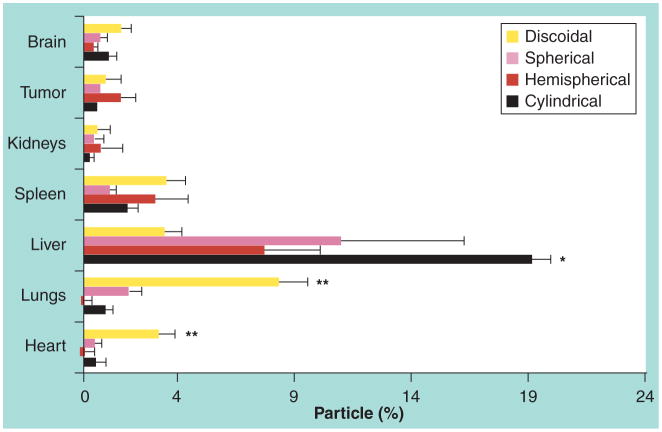
Figure 6. In vivo silicon accumulation in various organs relative to the injected dose for nonspherical particles
The percentage of silicon in each organ corresponds to the number of particles. The difference between the discoidal and the other particles with p < 0.001 is represented by the star symbol. Reprinted with permission from [74]. © Elsevier (2010).
Figure 7
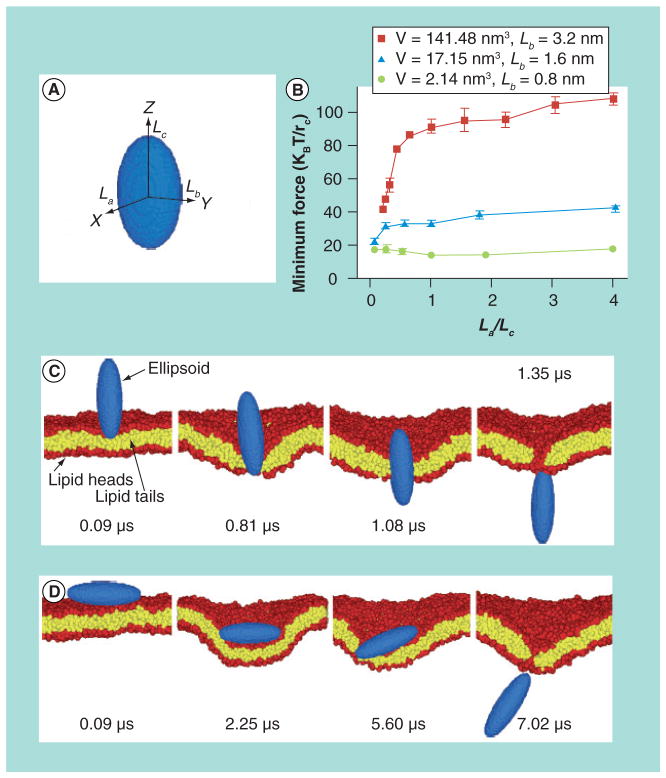
Figure 7. Penetration of ellipsoidal nanoparticles with different shapes across a lipid bilayer
(A) Ellipsoid particle, where La, Lb and Lc represent the half-lengths of the three axes. (B) Minimum driving forces required to attract ellipsoids of different volumes through the lipid bilayer. By varying the aspect ratio, the shape anisotropy of the particles are adjusted (La/Lc) at fixed Lb and volume. (C,D) Computer-simulated diagram showing the translocation of ellipsoids with (C) vertical and (D) horizontal starting orientations. La = 1.6 nm, Lb = 3.2 nm and Lc = 6.4 nm for (C), and La = 6.4 nm, Lb = 3.2 nm and Lc = 1.6 nm for (D). Reprinted with permission from [77]. © Nature Publishing Group (2010).
Figure 8
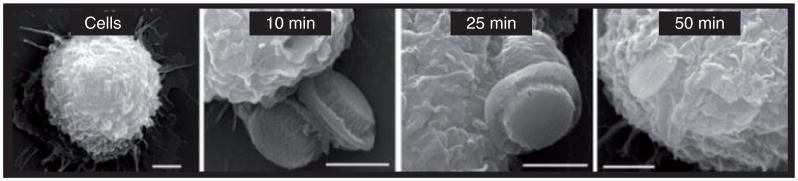
Figure 8. Cellular engulfment of silicon microparticles (S1MPs) by J774A.1 macrophages
Scanning electron microscope images of J444A.1 cells incubated with S1MPs (at a ratio of 1:5) for different lengths of time demonstrating particle orientation during uptake and varying degrees of internalization (10, 50, 50 and 40 k). Reprinted with permission from [78]. © John Wiley & Sons (2010).
Figure 9
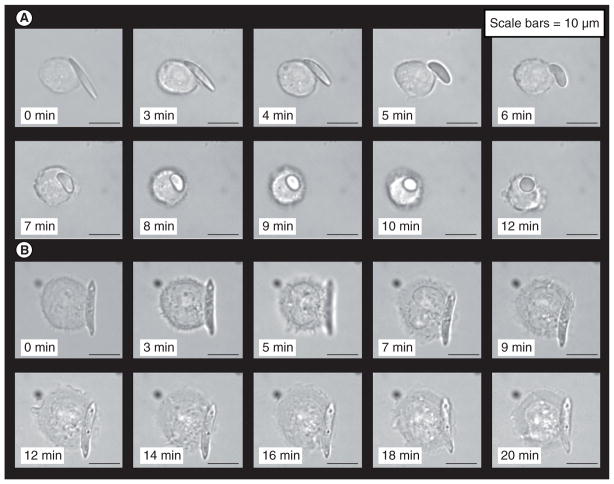
Figure 9. Shape-dependent phagocytosis by macrophage recorded using time-lapse video microscopy
(A) Shape-switching poly(lactic-co-glycolic acid) (PLGA)-ester elliptical disk (mixture of two PLGAs, AR = 5) quickly being phagocytized and internalized by the macrophage as the particle switches to near-spherical shape. (B) Macrophage spreads on a PLGA-acid elliptical disk (molecular mass 4.1 kDa, Tg[mid] = 27°C, AR = 5), but could not complete phagocytosis. Particle does not switch shape at pH 7.4. Reprinted with permission from [102]. © National Academy of Sciences of the USA, PNAS (2010).

References

    1. Samad A, Sultana Y, Aqil M. Liposomal drug delivery systems: an update review. Curr Drug Deliv. 2007;4(4):297–305. - PubMed
    1. Sharma G, Anabousi S, Ehrhardt C, Ravi Kumar MN. Liposomes as targeted drug delivery systems in the treatment of breast cancer. J Drug Target. 2006;14(5):301–310. - PubMed
    1. Sutton D, Nasongkla N, Blanco E, Gao J. Functionalized micellar systems for cancer targeted drug delivery. Pharm Res. 2007;24(6):1029–1046. - PubMed
    1. Torchilin VP. Targeted polymeric micelles for delivery of poorly soluble drugs. Cell Mol Life Sci. 2004;61(19–20):2549–2559. - PMC - PubMed
    1. Gao X, Yang L, Petros JA, Marshall FF, Simons JW, Nie S. In vivo molecular and cellular imaging with quantum dots. Curr Opin Biotechnol. 2005;16(1):63–72. - PubMed

Website

    1. NIH. Nanotechnology. www.nih.gov/science/nanotechnology.

Publication types

LinkOut - more resources