Review
. 2012 Sep;21(9):1323-50.
doi: 10.1517/13543784.2012.704020. Epub 2012 Jul 27.

Targeting memory processes with drugs to prevent or cure PTSD

Affiliations
Review

Targeting memory processes with drugs to prevent or cure PTSD

Christopher K Cain et al. Expert Opin Investig Drugs. 2012 Sep.

Abstract

Introduction: Post-traumatic stress disorder (PTSD) is a chronic debilitating psychiatric disorder resulting from exposure to a severe traumatic stressor and an area of great unmet medical need. Advances in pharmacological treatments beyond the currently approved SSRIs are needed.

Areas covered: Background on PTSD, as well as the neurobiology of stress responding and fear conditioning, is provided. Clinical and preclinical data for investigational agents with diverse pharmacological mechanisms are summarized.

Expert opinion: Advances in the understanding of stress biology and mechanisms of fear conditioning plasticity provide a rationale for treatment approaches that may reduce hyperarousal and dysfunctional aversive memories in PTSD. One challenge is to determine if these components are independent or reflect a common underlying neurobiological alteration. Numerous agents reviewed have potential for reducing PTSD core symptoms or targeted symptoms in chronic PTSD. Promising early data support drug approaches that seek to disrupt dysfunctional aversive memories by interfering with consolidation soon after trauma exposure, or in chronic PTSD, by blocking reconsolidation and/or enhancing extinction. Challenges remain for achieving selectivity when attempting to alter aversive memories. Targeting the underlying traumatic memory with a combination of pharmacological therapies applied with appropriate chronicity, and in combination with psychotherapy, is expected to substantially improve PTSD treatment.


Figures
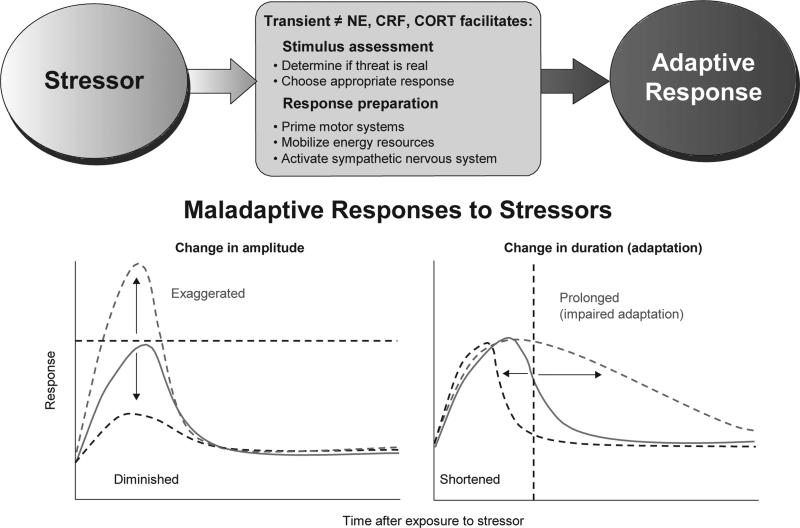
Figure 1
Figure 1
The Stress Response System (SRS). TOP: The SRS is composed of behavioral, endocrine, and autonomic components which act in concert to generate an appropriate, adaptive response to a stressor. Three key mediators in the SRS are norepinephrine (NE), corticotropin releasing factor (CRF) and cortisol (CORT). Stressor-induced release of NE, CRF and CORT facilitates physiological processes which allow the organism to evaluate the stressor and choose an adaptive response, while in parallel activating effector systems. Execution of a successful response will minimize the impact of the stressor and in parallel, feedback inhibitory systems will ensure that the stress response system will return to normal, pre-stress levels. BOTTOM: Abnormal activation of NE, CRF and CORT pathways can result in a dysfunctional SRS in which normal alarm reactions may be maladaptive. A complex interplay of genetic risk factors, vulnerability factors (prior history), stressor factors (intensity, duration, chronicity), may be expressed neuronally as imbalances in different neurochemical pathways and functionally, as different alterations in the alarm reaction. Thus, the CRF and NE hyperactivation, and perhaps CORT hypoactivation, seen in different disorders may be manifested as alarm reactions with exaggerated or diminished amplitude and/or prolonged or shortened duration. Hypothetical curves represent a normal physiological response to a stressor that, after reaching a maximum, declines to baseline level. Examples are stress hormone responses or levels of physiological arousal. Return to baseline could result from successful removal of the activating threatening stimulus and/or from feedback inhibition processes (e.g. CORT inhibition of pituitary mediated ACTH release). Exposure to traumatic stimuli, possibly in conjunction with vulnerability attributable to genetic and/or environmental (e.g. prior history of stress) factors, has the potential to produce sustained maladaptive responses (dashed lines). Adapted from [217], printed with permission from Bentham Publishers.
Figure 2
Figure 2
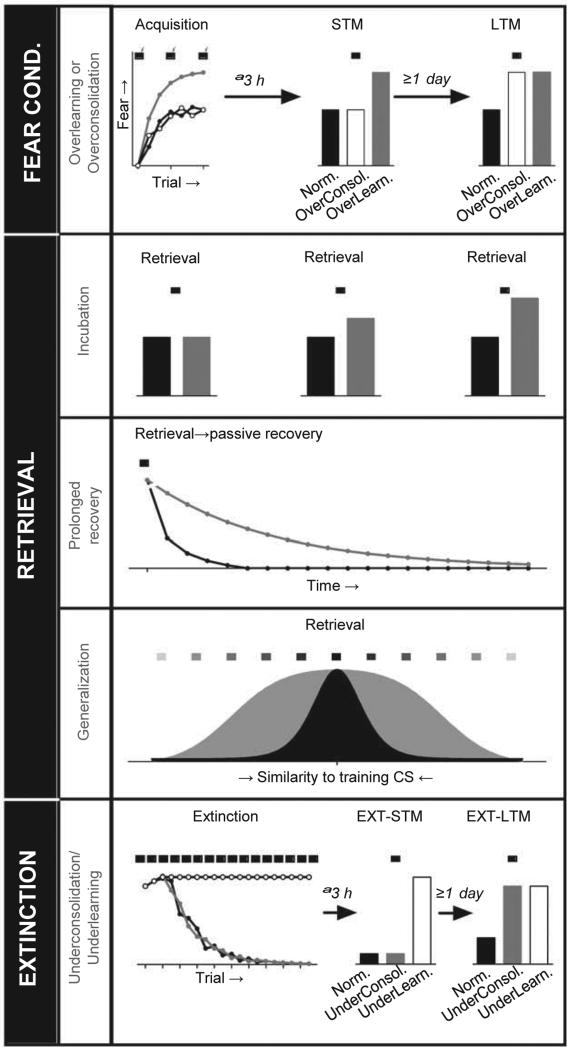
FC Processes Could Contribute to PTSD. Prior experience(s) and/or biological factors may interact with stress-responding and associative memory to produce PTSD. Precise analyses of memory processes may continue to refine our understanding of the core memory deficits in PTSD. Identification of specific impairments should help identify brain regions and cellular/molecular mechanisms important for PTSD and its treatment. For instance, recent studies suggest that extinction consolidation/retrieval and generalization/discrimination are impaired in PTSD, highlighting the importance of inhibitory learning and PFC function. Note that this list is not exhaustive and important learning processes like latent inhibition, conditioned inhibition and avoidance learning have been omitted. Black bars/lines represent normal FC and gray or white bars/lines represent potential abnormalities in PTSD.
Figure 3
Figure 3
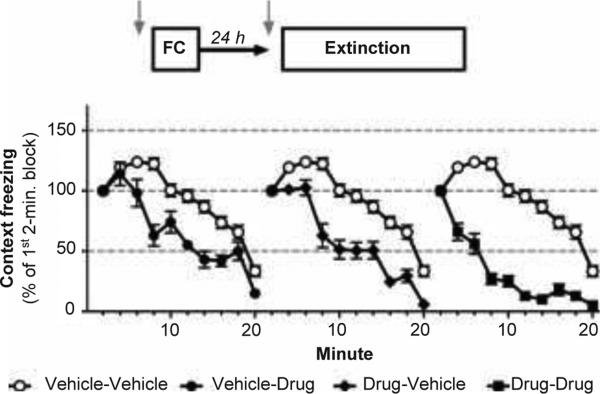
The CRF1 receptor antagonist antalarmin weakens FC and accelerates fear extinction in rats. CRF powerfully modulates memory and stress-responding through activation of CRF1 receptors. However, no data exists on the potential utility of these drugs for treating PTSD. We reanalyzed data from a 1999 study by Deak et al published in Endocrinology (experiment 1) examining the effect of antalarmin on context FC and retrieval [159]. Since this experiment used 20-min LTM tests that produced significant extinction, we hypothesized that antalarmin reduced retrieval primarily by facilitating fear extinction. Original data were generously provided by Terrence Deak for the new analysis. Since antalarmin did slightly weaken initial fear retrieval as assessed by freezing behavior, we normalized responding to freezing in the first 2-min of the test to evaluate extinction. Rats were injected with Drug or Vehicle prior to context FC on Day 1. On Day 2, half of each group received the same treatment and half received the opposite treatment. (Left) Antalarmin accelerated extinction learning in rats that were conditioned drug-free. (Middle) Rats conditioned after antalarmin injections showed faster extinction when tested drug-free on Day 2. (Right) These effects were additive, as rats injected with antalarmin pre-conditioning and pre-extinction extinguished faster than any other group. These data support the notion that CRF1 receptors antagonists may be particularly useful drugs for PTSD since they can blunt fear learning and facilitate fear suppression when combined with CS exposure. However, since the experiment wasn't designed to assess extinction processes it remains unclear whether the facilitation by antalarmin acutely translates to LTM for extinction in the drug-free state.

References

    1. Friedman MJ, Resick PA, Bryant RA, Brewin CR. Considering ptsd for dsm-5. Depress Anxiety. 2011;28(9):750–69. - PubMed
    1. Friedman MJ, Resick PA, Bryant RA, et al. Classification of trauma and stressor-related disorders in dsm-5. Depress Anxiety. 2011;28(9):737–49. - PubMed
    1. Foa EB. Psychosocial therapy for posttraumatic stress disorder. J Clin Psychiatry. 2006;67(Suppl 2):40–5. - PubMed
    1. Kowalik J, Weller J, Venter J, Drachman D. Cognitive behavioral therapy for the treatment of pediatric posttraumatic stress disorder: a review and meta-analysis. J Behav Ther Exp Psychiatry. 2011;42(3):405–13. - PubMed
    1. Kessler RC, Berglund P, Demler O, et al. Lifetime prevalence and age-of- onset distributions of dsm-iv disorders in the national comorbidity survey replication. Arch Gen Psychiatry. 2005;62(6):593–602. - PubMed

Publication types

MeSH terms