


GiA Roots: software for the high throughput analysis of plant root system architecture
- PMID: 22834569
- PMCID: PMC3444351
- DOI: 10.1186/1471-2229-12-116
GiA Roots: software for the high throughput analysis of plant root system architecture
Abstract
Background: Characterizing root system architecture (RSA) is essential to understanding the development and function of vascular plants. Identifying RSA-associated genes also represents an underexplored opportunity for crop improvement. Software tools are needed to accelerate the pace at which quantitative traits of RSA are estimated from images of root networks.
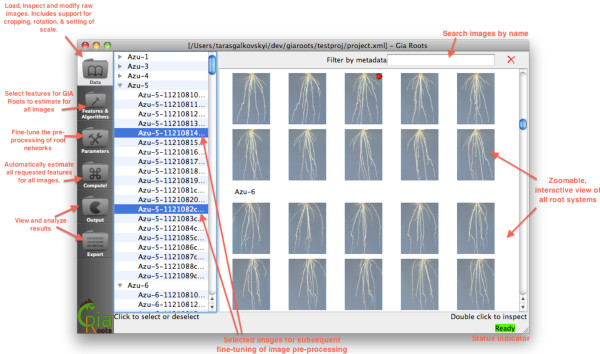
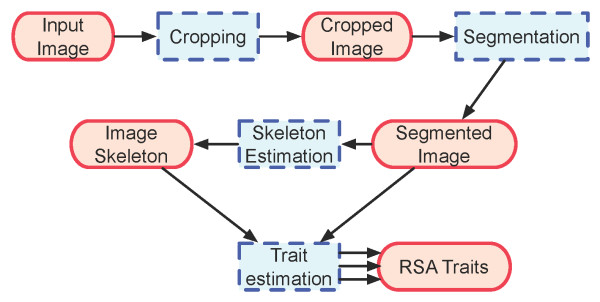
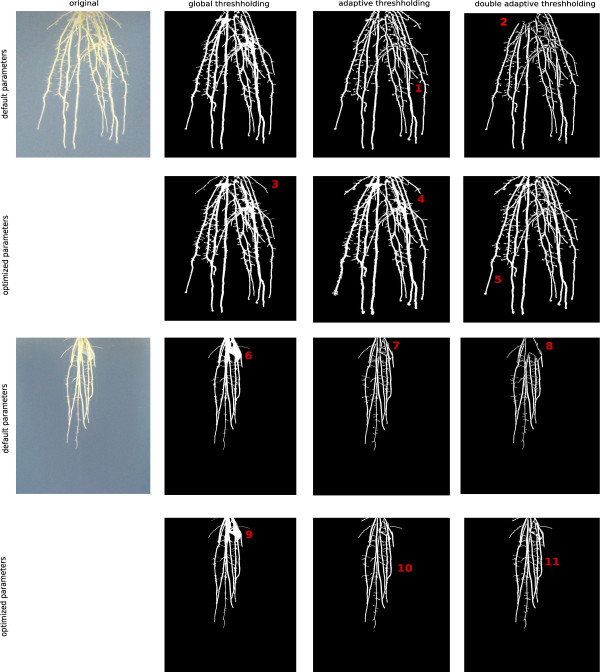
Results: We have developed GiA Roots (General Image Analysis of Roots), a semi-automated software tool designed specifically for the high-throughput analysis of root system images. GiA Roots includes user-assisted algorithms to distinguish root from background and a fully automated pipeline that extracts dozens of root system phenotypes. Quantitative information on each phenotype, along with intermediate steps for full reproducibility, is returned to the end-user for downstream analysis. GiA Roots has a GUI front end and a command-line interface for interweaving the software into large-scale workflows. GiA Roots can also be extended to estimate novel phenotypes specified by the end-user.
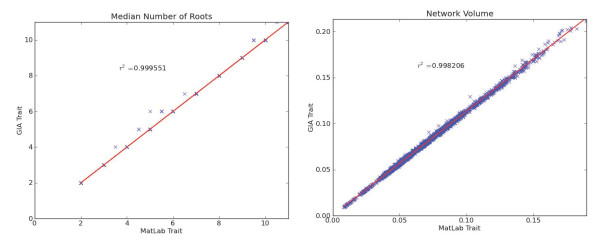
Conclusions: We demonstrate the use of GiA Roots on a set of 2393 images of rice roots representing 12 genotypes from the species Oryza sativa. We validate trait measurements against prior analyses of this image set that demonstrated that RSA traits are likely heritable and associated with genotypic differences. Moreover, we demonstrate that GiA Roots is extensible and an end-user can add functionality so that GiA Roots can estimate novel RSA traits. In summary, we show that the software can function as an efficient tool as part of a workflow to move from large numbers of root images to downstream analysis.
Figures
References
-
- Casper BB, Jackson RB. Plant competition underground. Ann Rev Ecol Syst. 1997;28:545–570. doi: 10.1146/annurev.ecolsys.28.1.545. - DOI
-
- Hodge A, Robinson D, Griffiths B, Fitter A. Why plants bother: root proliferation results in increased nitrogen capture from an organic patch when two grasses compete. Plant Cell and Dev. 1999;22(7):811–820.
-
- Ennos AR. The scaling of root anchorage. J Theor Biol. 1993;161(1):61–75. doi: 10.1006/jtbi.1993.1040. - DOI
Publication types
MeSH terms
LinkOut - more resources
Full Text Sources
Other Literature Sources
