


Increased risks of malaria due to limited residual life of insecticide and outdoor biting versus protection by combined use of nets and indoor residual spraying on Bioko Island, Equatorial Guinea
- PMID: 22835049
- PMCID: PMC3458978
- DOI: 10.1186/1475-2875-11-242
Increased risks of malaria due to limited residual life of insecticide and outdoor biting versus protection by combined use of nets and indoor residual spraying on Bioko Island, Equatorial Guinea
Abstract
Background: Malaria is endemic on Bioko Island, Equatorial Guinea, with year-round transmission. In 2004 an intensive malaria control strategy primarily based on indoor residual spraying (IRS) was launched. The limited residual life of IRS poses particular challenges in a setting with year-round transmission, such as Bioko. Recent reports of outdoor biting by Anopheles gambiae are an additional cause for concern. In this study, the effect of the short residual life of bendiocarb insecticide and of children spending time outdoors at night, on malaria infection prevalence was examined.
Methods: Data from the 2011 annual malaria indicator survey and from standard WHO cone bioassays were used to examine the relationship between time since IRS, mosquito mortality and prevalence of infection in children. How often children spend time outside at night and the association of this behaviour with malaria infection were also examined.
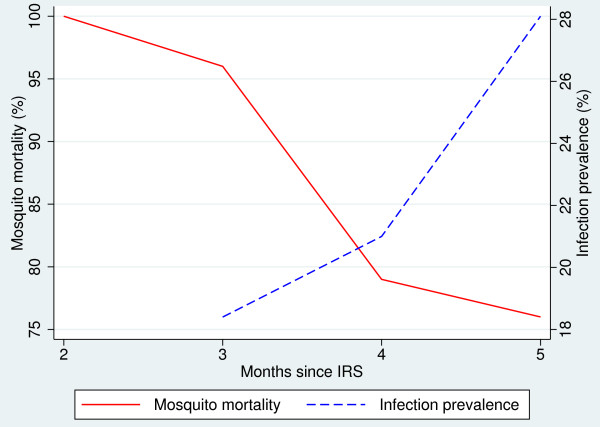
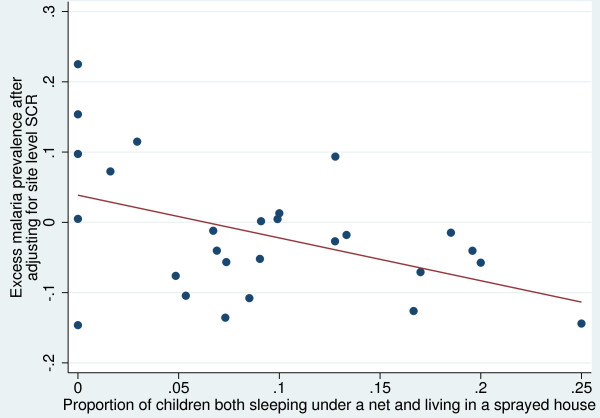
Results: Prevalence of malaria infection in two to 14 year-olds in 2011 was 18.4%, 21.0% and 28.1% in communities with median time since IRS of three, four and five months respectively. After adjusting for confounders, each extra month since IRS corresponded to an odds ratio (OR) of 1.44 (95% CI 1.15-1.81) for infection prevalence in two to 14 year-olds. Mosquito mortality was 100%, 96%, 81% and 78%, at month 2, 3, 4 and 5 respectively after spraying. Only 4.1% of children spent time outside the night before the survey between the hours of 22.00 and 06.00 and those who did were not at a higher risk of infection (OR 0.87, 95% CI 0.50-1.54). Sleeping under a mosquito net provided additive protection (OR 0.68, 95% CI 0.54-0.86).
Conclusions: The results demonstrate the epidemiological impact of reduced mosquito mortality with time since IRS. The study underscores that in settings of year-round transmission there is a compelling need for longer-lasting IRS insecticides, but that in the interim, high coverage of long-lasting insecticidal nets (LLINs) may ameliorate the loss of effect of current shorter-lasting IRS insecticides. Moreover, continued use of IRS and LLINs for indoor-oriented vector control is warranted given that there is no evidence that spending time outdoors at night increases infection prevalence in children.
Figures
References
-
- WHO. World malaria report. 2011. www.who.int/malaria/world_malaria_report_2011/en.
-
- WHO. Position statement on indoor residual spraying. [ http://www.who.int/malaria/publications/atoz/htm_mal_2006_1112/en/index....]
-
- WHO. Global malaria programme: position statement on ITNs. [ http://www.who.int/malaria/publications/atoz/itnspospaperfinal.pdf]
-
- Pinder M, Jawara M, Jarju LB, Kandeh B, Jeffries D, Lluberas MF, Mueller J, Parker D, Bojang K, Conway DJ, Lindsay SW. To assess whether indoor residual spraying can provide additional protection against clinical malaria over current best practice of long-lasting insecticidal mosquito nets in The Gambia: study protocol for a two-armed cluster-randomised trial. Trials. 2011;12:147. doi: 10.1186/1745-6215-12-147. - DOI - PMC - PubMed
MeSH terms
Substances
Grants and funding
LinkOut - more resources
Full Text Sources
Medical
