


Radiation-related risk of basal cell carcinoma: a report from the Childhood Cancer Survivor Study
- PMID: 22835387
- PMCID: PMC3611815
- DOI: 10.1093/jnci/djs298
Radiation-related risk of basal cell carcinoma: a report from the Childhood Cancer Survivor Study
Abstract
Background: Basal cell carcinoma (BCC) is the most common malignancy in the United States. Ionizing radiation is an established risk factor in certain populations, including cancer survivors. We quantified the association between ionizing radiation dose and the risk of BCC in childhood cancer survivors.
Methods: Participants in the Childhood Cancer Survivor Study who reported a BCC (case subjects, n = 199) were matched on age and length of follow-up to three study participants who had not developed a BCC (control subjects, n = 597). The radiation-absorbed dose (in Gy) to the BCC location was calculated based on individual radiotherapy records using a custom-designed dosimetry program. Conditional logistic regression was used to calculate odds ratios (ORs) and 95% confidence intervals (CIs) for associations between demographic and treatment factors, therapeutic radiation dose, and surrogate markers of sun sensitivity (skin and hair color) and the risk of BCC. A linear dose-response model was fitted to evaluate the excess odds ratio per Gy of radiation dose.
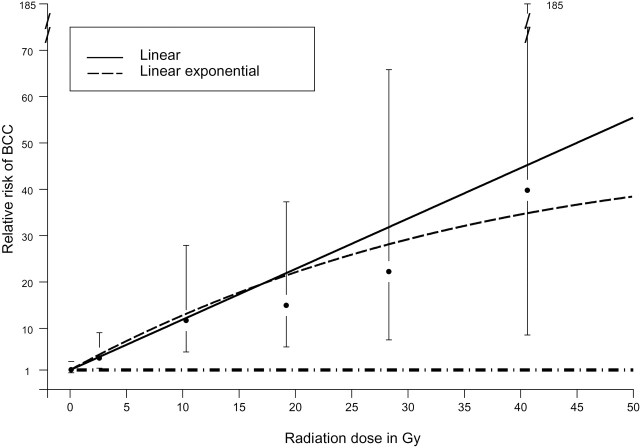
Results: Among case subjects, 83% developed BCC between the ages of 20 and 39 years. Radiation therapy, either alone or in combination with chemotherapy, was associated with an increased risk of BCC compared with no chemotherapy or radiation. The odds ratio for subjects who received 35 Gy or more to the skin site vs no radiation therapy was 39.8 (95% CI = 8.6 to 185). Results were consistent with a linear dose-response relationship, with an excess odds ratio per Gy of 1.09 (95% CI = 0.49 to 2.64). No other treatment variables were statistically significantly associated with an increased risk of BCC.
Conclusions: Radiation doses to the skin of more than 1 Gy are associated with an increased risk of BCC.
Figures
References
-
- USCSW Group United States Cancer Statistics: 1999–2007 Incidence and Mortality Web-based Report Atlanta, GA: U.S. Department of Health and Human Services, Centers for Disease Control and Prevention and National Cancer Institute; 2010.
-
- Howlader N, Noone AM, Krapcho M, Neyman N, Aminou R, Waldron W, Altekruse SF, Kosary CL, Ruhl J, Tatalovich Z, Cho H, Mariotto A, Eisner MP, Lewis DR, Chen HS, Feuer EJ, Cronin KA, Edwards BK. (eds). SEER Cancer Statistics Review, 1975-2008 National Cancer Institute; Bethesda, MD: http://seer.cancer.gov/csr/1975_2008/, based on November 2010 SEER data submission, posted to the SEER web site, 2011.
-
- McGuire JFGN, Dyson S. Nonmelanoma skin cancer of the head and neck I: histopathology and clinical behavior Am J Otol. 2009;30(2):121–133 - PubMed
-
- U.S. National Institutes of Health, 2010 Skin Cancer http://www.cancer.gov/cancertopics/types/skin Accessed October32011..
Publication types
MeSH terms
Grants and funding
LinkOut - more resources
Full Text Sources
Medical
