Review
. 2012 Dec;40(6):1545-54.
doi: 10.1183/09031936.00048912. Epub 2012 Jul 26.

The role of bronchodilator treatment in the prevention of exacerbations of COPD

Affiliations
Free PMC article
Review

The role of bronchodilator treatment in the prevention of exacerbations of COPD

Jadwiga A Wedzicha et al. Eur Respir J. 2012 Dec.
Free PMC article

Abstract

Exacerbations of chronic obstructive pulmonary disease (COPD) are natural events in the progression of the disease, and are characterised by acute worsening of symptoms, especially dyspnoea. These heterogeneous events follow increased airway inflammation, often due to infection, and lead to decreased airflow and increased lung hyperinflation relative to stable COPD. Although exacerbation frequency generally increases as COPD progresses, some patients experience frequent exacerbations (≥ 2 per year) independently of disease severity. Exacerbations, especially frequent exacerbations, are associated with impaired health-related quality of life, reduced physical activity and poor disease prognosis. The cornerstone of pharmacotherapy for stable COPD is long-acting bronchodilators, including the long-acting β(2)-agonists (LABAs) and long-acting anti-muscarinic agents (LAMAs) alone or combined with inhaled corticosteroids (ICS). While ICS treatment can potentially reduce the risk of exacerbations, clinical studies have demonstrated the efficacy of LABAs and LAMAs in reducing COPD symptoms, primarily by reducing lung hyperinflation secondary to reduced airway resistance. Sustained reduction in lung hyperinflation may in turn lessen dyspnoea during an exacerbation. Indeed, recent studies suggest that bronchodilators may also reduce the incidence of, or prevent, exacerbations. Using data from recent studies, this review explores the evidence and possible mechanisms through which bronchodilators may prevent exacerbations.


Conflict of interest statement

Statement of Interest

Statements of interest for all authors and the study itself can be found at www.erj.ersjournals.com/site/misc/statements.xhtml

Figures

Figure 1–
Figure 1–
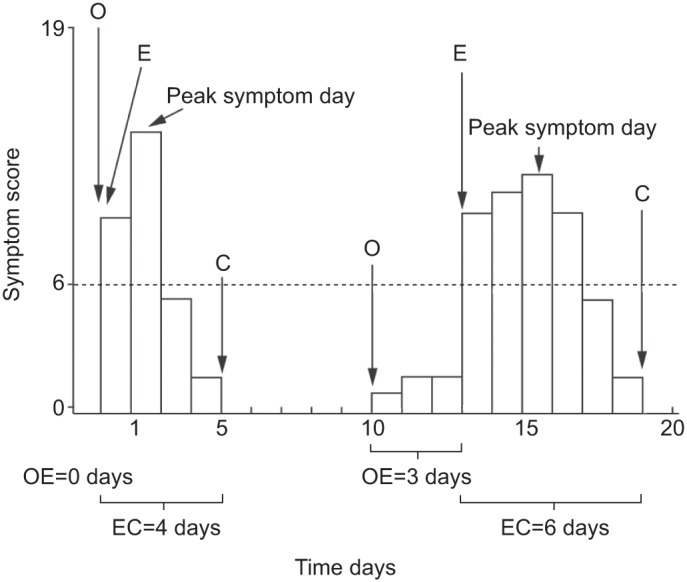
Time course and calculation of the onset and duration of exacerbation (E) intervals: a sudden onset exacerbation is shown on the left (1,115 (56%) out of 1,995 exacerbation events) and a gradual onset exacerbation is shown on the right (888 (44%) out of 1,995 exacerbation events). The opening event (O) was defined as the first day of a worsening of respiratory symptoms above usual baseline values (i.e. a daily symptom score ≥1). An exacerbation was defined as the first of at least two consecutive days on which the patient recorded at least two new or worsening symptoms, at least one of which was a major symptom (i.e. a daily symptom score of ≥6 points for two consecutive days). Closing (C) was defined as the first of five consecutive days in which symptoms had returned to their usual baseline levels. The dotted line indicates the exacerbation threshold. OE: number of days between an opening event and the first day of the exacerbation event. Reproduced from [29].
Figure 2–
Figure 2–
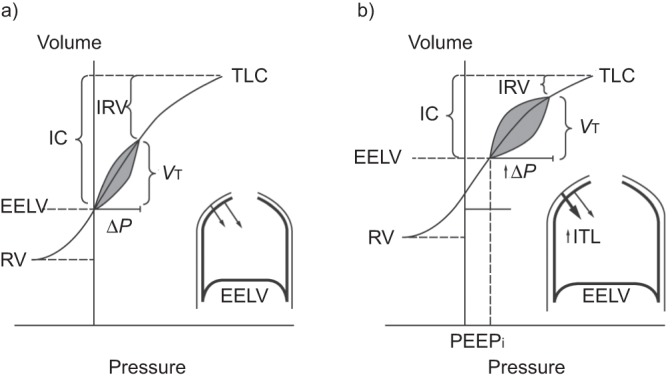
Schematic diagram of the mechanical effects of chronic obstructive pulmonary disease (COPD) exacerbation. Representative pressure–volume plots during a) stable COPD and b) COPD exacerbation. During exacerbation, worsening airflow limitation results in dynamic hyperinflation with increased end expiratory lung volume (EELV) and residual volume (RV). Corresponding reductions occur in inspiratory capacity (IC) and inspiratory reserve volume (IRV). Total lung capacity (TLC) is unchanged. As a result, tidal breathing is shifted right on the pressure–volume curve, closer to TLC. Mechanically, increased pressures must be generated to maintain tidal volume (VT). At EELV during exacerbation, intrapulmonary pressures do not return to zero, representing the development of intrinsic positive and expiratory pressure (PEEPi) which imposes increased inspiratory threshold loading (ITL) on the inspiratory muscles (inset). During the subsequent respiratory cycle, PEEPi must first be overcome in order to generate inspiratory flow. ΔP: pressure change. Reproduced from [4].
Figure 3–
Figure 3–
Time-to-event analysis of exacerbation-free survival in patients according to their forced expiratory volume in 1 s (FEV1) response to lung volume reduction surgery. Surgical responders were defined as those with a 6-month improvement in FEV1 >0.2 L and surgical non-responders as those with an FEV1 improvement <0.2 L. Reproduced from [96] with permission from the publisher.
Figure 4–
Figure 4–
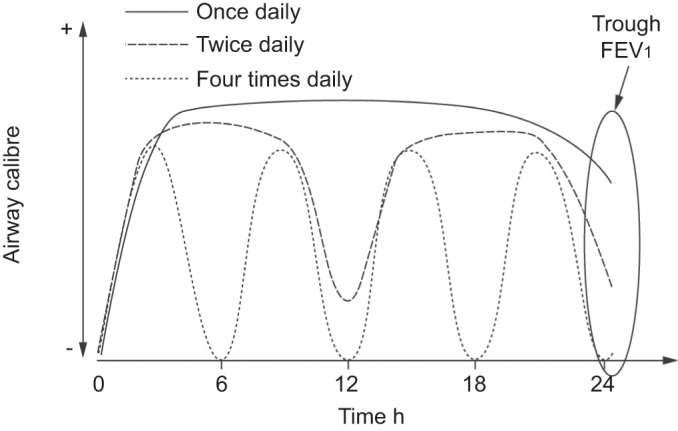
Schematic model of the effects of long-acting (once daily or twice daily) versus short-acting (four times daily) bronchodilators on 24-h airway tone (pharmacological stenting). With extended duration of bronchodilation, the net area under the time/airflow curve increases, and persistent bronchorelaxant effects of once-daily and twice-daily bronchodilators lead to increased morning forced expiratory volume in 1 s (FEV1) following the last inhalation (trough FEV1). Reproduced from [105].

References

    1. World Health Organization Chronic respiratory diseases. Burden of chronic respiratory diseases. www.who.int/respiratory/copd/burden/en/index.html Date last accessed: March 19, 2012
    1. Global Initiative for Chronic Obstructive Lung Disease Global Strategy for the Diagnosis, Management and Prevention of chronic obstructive pulmonary disease. Revised 2011. www.goldcopd.org Date last updated: December 2011. Date last accessed: March 19, 2012 - PubMed
    1. O'Donnell DE, Laveneziana P. The clinical importance of dynamic lung hyperinflation in COPD. COPD 2006; 3: 219–232 - PubMed
    1. O'Donnell DE, Parker CM. COPD exacerbations. 3: Pathophysiology. Thorax 2006; 61: 354–361 - PMC - PubMed
    1. Wedzicha JA, Seemungal TA. COPD exacerbations: defining their cause and prevention. Lancet 2007; 370: 786–796 - PMC - PubMed

Publication types

MeSH terms

Substances