


Review
doi: 10.1016/j.sbi.2012.07.006.
Epub 2012 Jul 24.
Go hybrid: EM, crystallography, and beyond
Affiliations
- PMID: 22835744
- PMCID: PMC3478466
- DOI: 10.1016/j.sbi.2012.07.006
Item in Clipboard
Review
Go hybrid: EM, crystallography, and beyond
Curr Opin Struct Biol.
2012 Oct.
Abstract
A mechanistic understanding of the molecular transactions that govern cellular function requires knowledge of the dynamic organization of the macromolecular machines involved in these processes. Structural biologists employ a variety of biophysical methods to study large macromolecular complexes, but no single technique is likely to provide a complete description of the structure-function relationship of all the constituent components. Since structural studies generally only provide snapshots of these dynamic machines as they accomplish their molecular functions, combining data from many methodologies is crucial to our understanding of molecular function.
Copyright © 2012 Elsevier Ltd. All rights reserved.
Figures
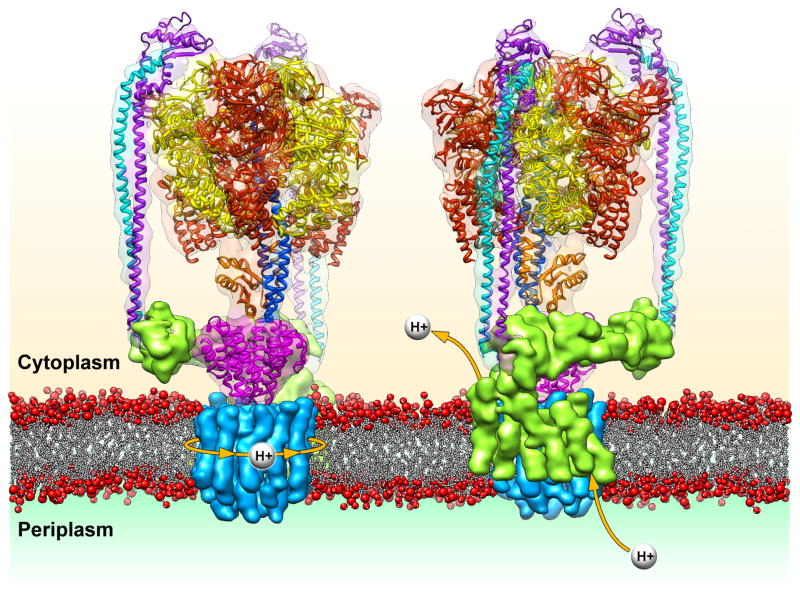
Organization of the ATP synthase and a model for proton translocation through the membrane. The crystal structures corresponding to the subunits in the extracellular domain are docked into the subnanometer EM reconstruction (EMDB ID: 5335) [15] to show the atomic organization of the catalytic hexamer (red and yellow) as it is held in position by two peripheral stalks (cyan and purple) and the central stalk (orange and dark blue). Motions from the membrane-embedded L-ring rotary motor (blue) are propagated to this central stalk via the cone-shaped C-subunit (magenta). In the model proposed by Lau and Rubinstein, [15] protons would drive the rotation of the L-ring motor as they enter through the periplasmic half-channel of subunit I and exit through the cytoplasmic half-channel.
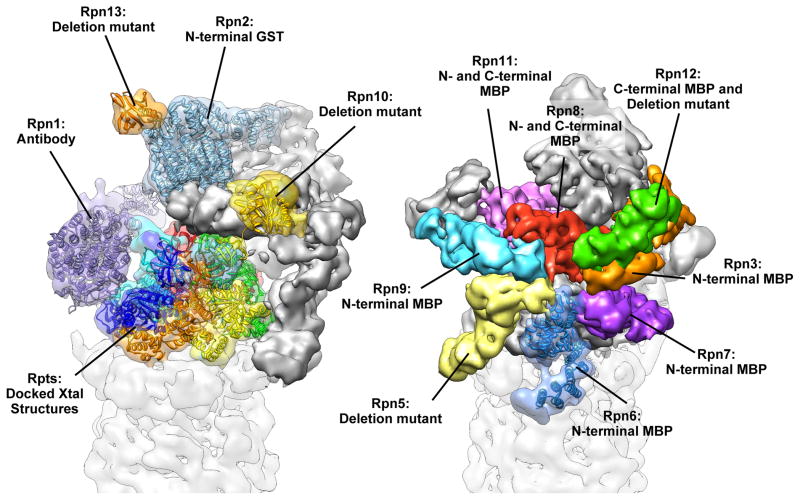
CryoEM reconstruction of the regulatory particle (RP) of the 26S proteasome (EMDB ID: 1992) [22]. The biochemical marker used to localize each subunit in the study by Martin and colleagues is noted, and atomic coordinates for known or homologous components are shown docked into their corresponding density. The complex is shown from two angles, emphasizing the two subcomponents of the RP. Colored in the left view are the subunits that constitute the base sub-complex and the ubiquitin receptors, and colored on the right are the subunits of the lid sub-complex. The Rpn2 and Rpn6 crystal structures (PDB IDs 4ady and 3txm, respectively [28,29]) were determined after completion of the initial cryoEM study. Docking of these structures illustrates the fidelity of subunit boundary delineation that was provided by the subnanometer reconstructions in the absence of crystal structures. Additionally, docking the Rpn2 crystal structure into the Rpn1 density evidences the high level of structural homology between the two largest components of the proteasome.
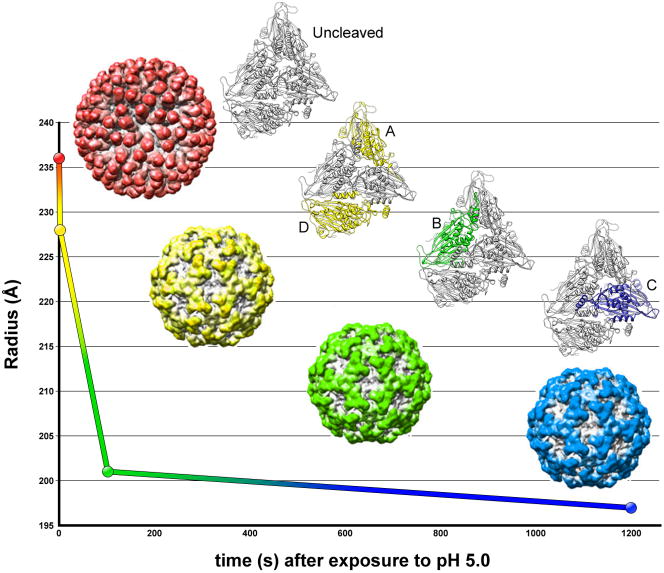
Maturation pathway of the Nudaurelia capensis ω virus (NωV). Initiating maturation by lowering the pH to 5.0, Matsui et al. used time-resolved SAXS experiments to precisely describe three distinct kinetic stages in the maturation pathway of NωV [44]. The maturation, which involve the autocatalytic cleavage of the C-terminal 74 residues, begins with an initial and dramatic reduction in capsid diameter (red to yellow), which occurs on a millisecond time scale, followed by two progressively slower reductions in size (yellow to green, and then green to blue). Further SAXS experiments showed that homogeneous populations of particles representing each of these intermediates could be attained by analyzing a non-cleaving (Glu73Gln) mutant with cryoEM at specific time points [43]. The reconstructions revealed the underlying mechanism responsible for these transitions. Autocatalytic cleavage occurs initially in subunits A and D (colored yellow in the crystal structure), followed by a slower cleavage of subunit B (green), and a final cleavage of C (blue).
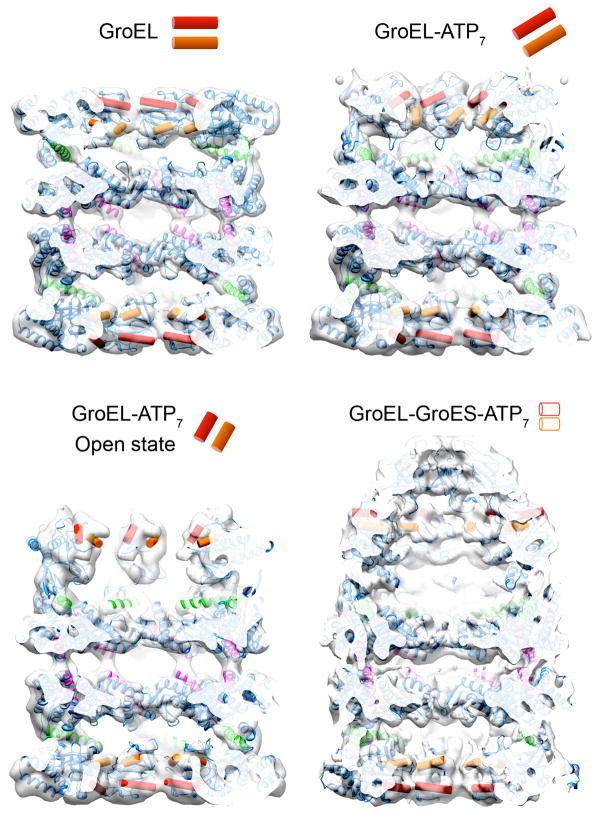
Four major conformations of the chaperonin GroEL in the binding and folding of substrate proteins. The structures are shown as cut-away cryo EM maps with docked atomic structures of the subunit domains. The red and orange cylinders, also shown schematically, delineate the layout of hydrophobic binding sites for non-native substrate proteins. Top left: unliganded state of GroEL in which both rings are lined by a continuous band of hydrophobic sites (EMD 1997). Top right: GroEL-ATP7, a conformation triggered by ATP binding to the upper ring (EMD 1998). The binding sites tilt but still form a continuous lining to the end cavity. Bottom left: GroEL-ATP7 open state, an expanded ATP state in which the binding sites detach and elevate, so that the hydrophobic lining becomes discontinuous (EMD 2000). The elevated binding sites are in position to bind the GroES lid. Bottom right: GroEL- GroES-ATP7, the final folding chamber formed by a further 100o twist of the substrate-binding domains, capped by GroES (EMD 1180). In this structure, the hydrophobic sites are occluded by contacts between subunits or with GroES, to form a hydrophilic chamber. The trajectory between the GroEL-ATP open state and the GroEL-GroES chamber is proposed to provide the power stroke of chaperonin action by ejecting the non-native polypeptide from its hydrophobic binding sites, allowing it to fold in the chamber [63].
References
-
- Yonekura K, Maki-Yonekura S, Namba K. Complete atomic model of the bacterial flagellar filament by electron cryomicroscopy. Nature. 2003;424:643–650. - PubMed
-
- Becker T, Armache JP, Jarasch A, Anger AM, Villa E, Sieber H, Motaal BA, Mielke T, Berninghausen O, Beckmann R. Structure of the no-go mRNA decay complex Dom34-Hbs1 bound to a stalled 80S ribosome. Nat Struct Mol Biol. 2011;18:715–720. - PubMed
Publication types
MeSH terms
Substances
Grants and funding
LinkOut - more resources
Full Text Sources
