


A longitudinal test of the bi-directional relations between avoidance coping and PTSD severity during and after PTSD treatment
- PMID: 22835842
- PMCID: PMC3433643
- DOI: 10.1016/j.brat.2012.06.006
A longitudinal test of the bi-directional relations between avoidance coping and PTSD severity during and after PTSD treatment
Abstract
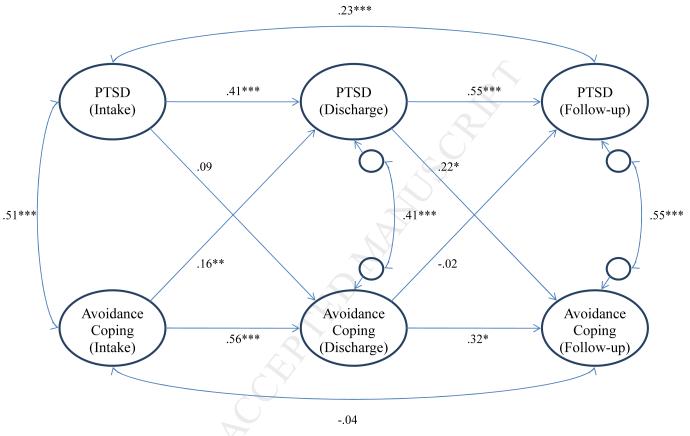
Avoidance coping and symptoms of posttraumatic stress disorder (PTSD) covary. However, relatively little research has examined the bi-directional relation between these constructs among individuals in treatment for PTSD. The current longitudinal study examined the reciprocal associations between avoidance coping and PTSD symptom severity during and after residential PTSD treatment among a sample of 1073 military veterans (88.9% male; M(age) = 52.39 years) with chronic, treatment-resistant PTSD. Greater avoidance coping at intake predicted more severe PTSD symptoms at discharge, and severity of PTSD symptoms at discharge predicted increased avoidance at follow-up. Conversely, PTSD symptom severity at intake was not related to avoidance coping at discharge, and in turn avoidance coping at discharge was not related to PTSD symptom severity at follow-up. These findings offer a number of important clinical implications including evidence suggesting avoidance may predict poorer treatment response among individuals seeking treatment for chronic PTSD, and that greater end-of-treatment PTSD symptom severity may predict increased avoidance following treatment.
Copyright © 2012 Elsevier Ltd. All rights reserved.
Figures
References
-
- American Psychiatric Association . Diagnostic and statistical manual of mental disorders. 4th ed. Author; Washington, DC: 2000. text revision.
-
- Amir M, Kaplan Z, Efroni R, Levine Y, Kotler M. Coping styles in post- traumatic stress disorder (PTSD) patients. Personality and Individual Differences. 1997;23:399–405. doi: 10.1016/S0191-8869(97)80005-0.
-
- Benotsch EG, Brailey K, Vasterling J, Uddo M, Constans JI, Sutker PB. War zone stress, personal and environmental resources, and PTSD symptoms in Gulf War veterans: A longitudinal perspective. Journal of Abnormal Psychology. 2000;109:205–213. doi: 10.1037/0021-843X.109.2.205. - PubMed
-
- Bentler PM. Comparative fit indexes in structural models. Psychological Bulletin. 1990;107:238–246. doi: 10.1037/0033-2909.107.2.238. - PubMed
-
- Bentler PM. EQS structural equations program manual. Multivariate Software; Encino, CA: 1995.
Publication types
MeSH terms
Grants and funding
LinkOut - more resources
Full Text Sources
Medical
