


Review
doi: 10.1038/nn.3159.
Neural circuitry engaged by prostaglandins during the sickness syndrome
Affiliations
- PMID: 22837039
- PMCID: PMC3748818
- DOI: 10.1038/nn.3159
Item in Clipboard
Review
Neural circuitry engaged by prostaglandins during the sickness syndrome
Nat Neurosci.
.
Abstract
During illnesses caused by infectious disease or other sources of inflammation, a suite of brain-mediated responses called the sickness syndrome occurs, which includes fever, anorexia, sleepiness, hyperalgesia and elevated corticosteroid secretion. Much of the sickness syndrome is mediated by prostaglandins acting on the brain and can be prevented by nonsteroidal anti-inflammatory drugs, such as aspirin or ibuprofen, that block prostaglandin synthesis. By examining which prostaglandins are produced at which sites and how they interact with the nervous system, researchers have identified specific neural circuits that underlie the sickness syndrome.
Figures
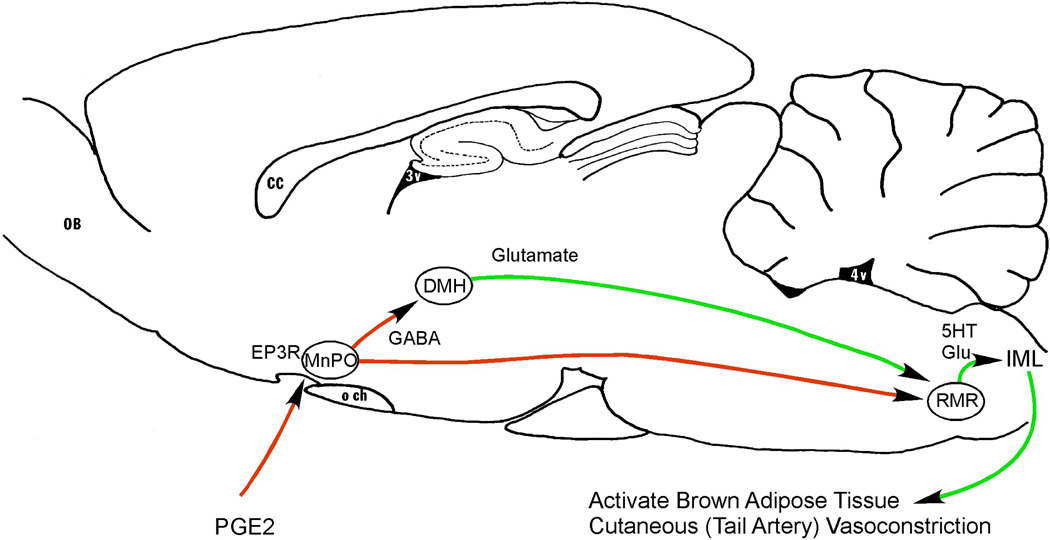
Prostaglandin E2 (PGE2) is produced by endothelial and perivascular cells along small venules at the edges of the brain, particularly in the preoptic area. It acts on EP3 receptors (EP3R) to inhibit neurons in the median preoptic nucleus (MnPO). Many of these neurons are GABAergic, and they in turn inhibit neurons in the dorsomedial nucleus of the hypothalamus (DMH) and rostral medullary raphe (RMR) that act to increase body temperature. RMR neurons use glutamate and serotonin (5HT) to excite sympathetic preganglionic neurons in the intermediolateral column of the spinal cord (IML), which activate brown adipose tissue (which produces heat) and cutaneous vasoconstriction (particularly in the tail artery, which conserves heat). Thus, PGE2 in the MnPO disinhibits these heat producing and conserving pathways and elevates body temperature. CC, corpus callosum; OB, olfactory bulb; och, optic chiasm; 4V, fourth ventricle.
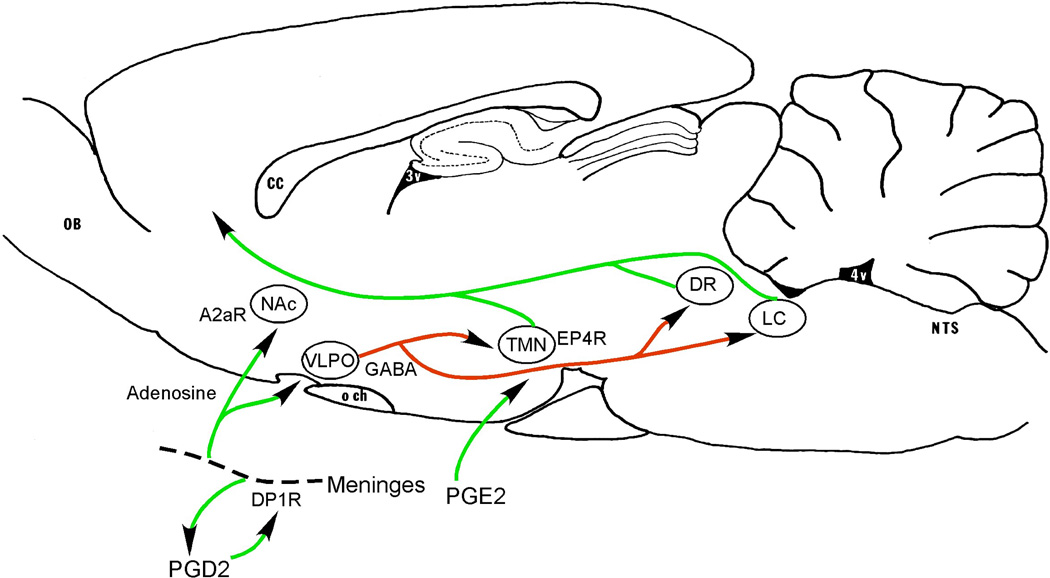
Leptomeningeal cells produce prostaglandin D2 (PGD2) which acts via DP1 receptors to induce local production of adenosine. Adenosine acts on A2a receptors in the forebrain to activate neurons in the nucleus accumbens (NAc) and the ventrolateral preoptic nucleus (VLPO). The VLPO neurons directly inhibit the arousal system, including the histaminergic tuberomammillary nucleus (TMN), the serotoninergic dorsal raphe nucleus (DR), and the noradrenergic locus coeruleus (LC), thus promoting sleep. The mechanism by which the nucleus accumbens causes sleepiness is not yet established, but it has extensive GABAergic projections to the perifornical region containing the orexin neurons. PGE2 produced during inflammation may have a counteracting effect, by exciting TMN neurons via EP4 receptors, perhaps explaining why the excess sleep observed during inflammation tends to be fragmented by frequent awakenings. Other abbreviations as in Fig. 1
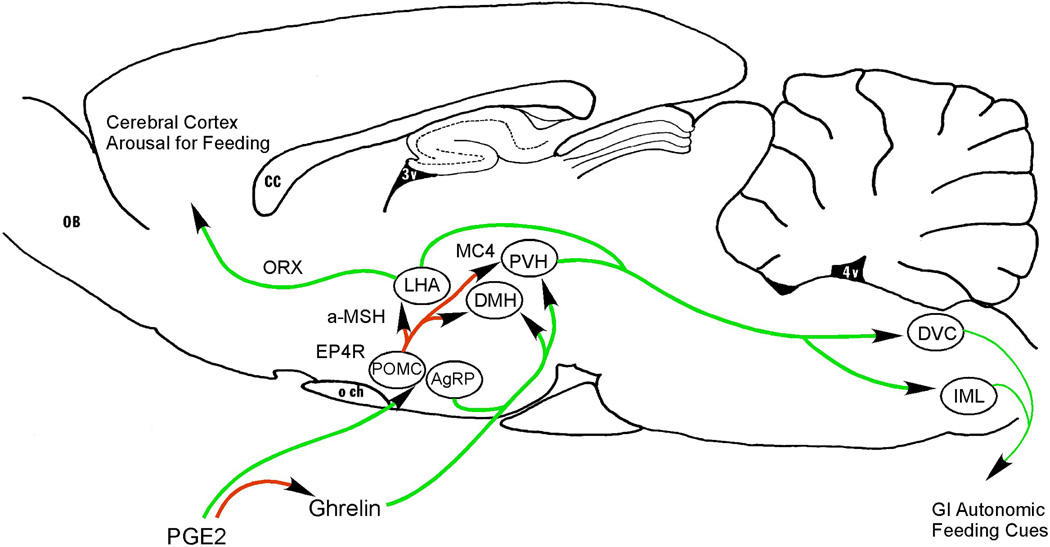
PGE2 produced by vascular and perivascular cells in the region of the median eminence acts via EP4 receptors to activate pro-opiomelanocortin (POMC) expressing neurons in the arcuate nucleus. These neurons produce α-melanocyte stimulating hormone (a-MSH) which acts via melanocortin 4 (MC4) receptors to inhibit neurons in the DMH, paraventricular nucleus (PVH), and lateral hypothalamic area (LHA) that otherwise promote feeding, by means of descending projections to autonomic regions that control the gastrointestinal system, and by ascending orexin (ORX) containing projections to the cerebral cortex. During systemic inflammation, there is also a prostaglandin-mediated fall in levels of serum ghrelin, a peptide made in the stomach that promotes feeding by acting on neurons in the DMH and PVH as well as the arcuate nucleus neurons containing agouti-related peptide (AgRP). Other abbreviations as in previous figures.
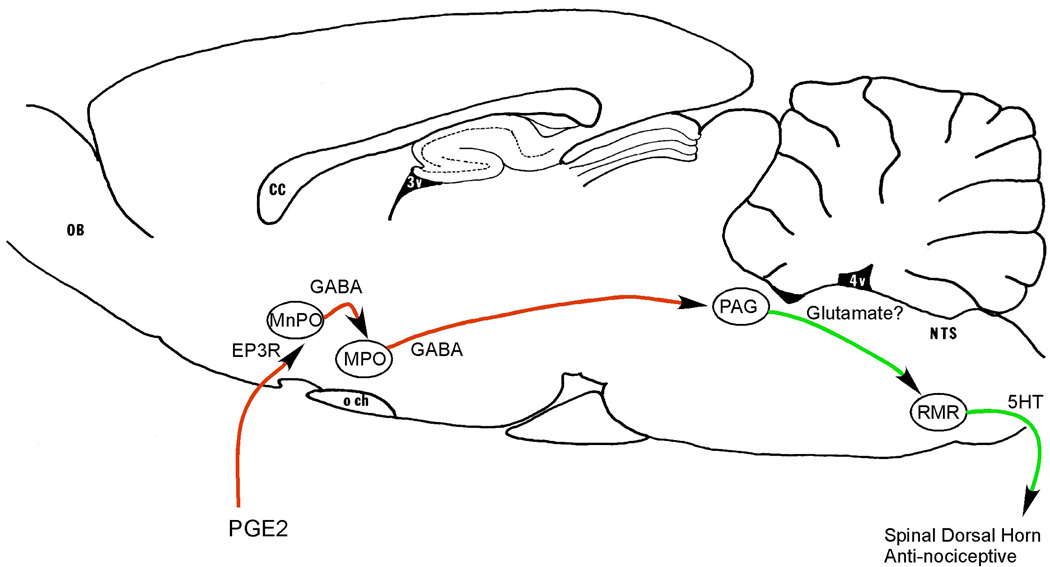
PGE2 made by vascular and perivascular cells along venules in the preoptic area acts on EP3 receptors in the MnPO. This results in disinhibition of descending inhibitory projections from the medial preoptic area (MPO) to the brainstem anti-nociceptive system, including neurons in the periaqueductal gray matter (PAG) that promote analgesia by activating descending serotoninergic neurons in the RMR, which in turn inhibit nociceptive neurons in the spinal dorsal horn. Other abbreviations as in previous figures.
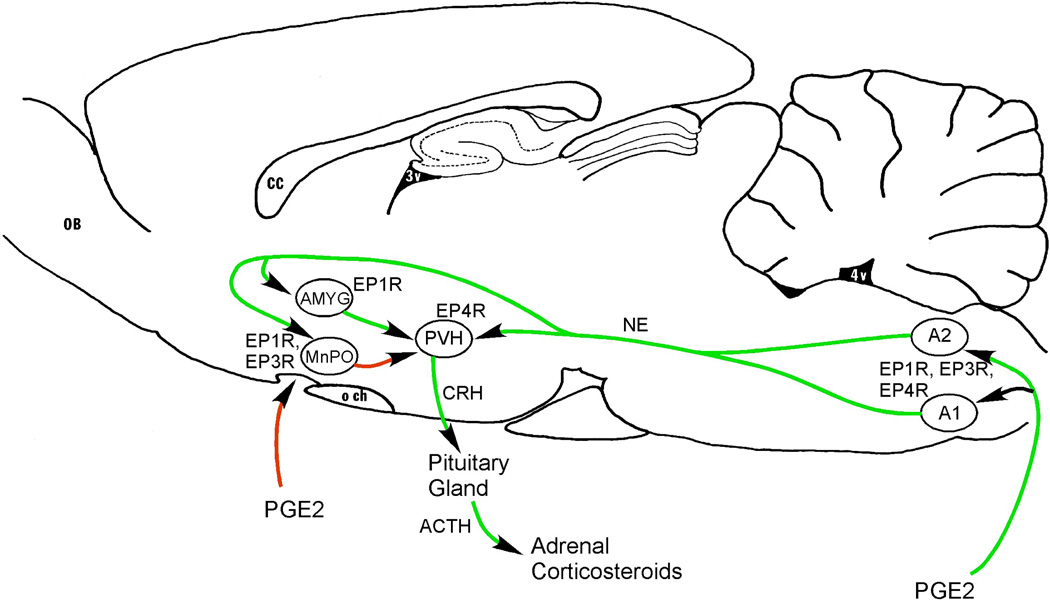
PGE2 may act at multiple locations to facilitate release of corticotropin-releasing hormone (CRH) from PVH neurons, which in turn causes secretion of adrenal corticotropic hormone (ACTH) from the pituitary, and hence adrenal corticosteroids. PGE2 activates medullary noradrenergic neurons in the A1 and A2 cell groups, which express EP1, EP3, and EP4 receptors, an input that is required for increased cFos and CRH expression in PVH neurons. In addition, EP1 or EP3 receptors are found on neurons in the MnPO, and EP1 receptors are found on neurons in the central nucleus of the amygdala (AMYG), both of which provide inputs to the CRH cells in the PVH. Other abbreviations as in previous figures.
References
-
- Kozak W, Conn CA, Kluger MJ. Lipopolysaccharide induces fever and depresses locomotor activity in unrestrained mice. Am. J. Physiol. 1994;266:R125–R135. - PubMed
-
- Elmquist JK, Scammell TE, Saper CB. Mechanisms of CNS response to systemic immune challenge: the febrile response. Trends Neurosci. 1997;20:565–570. - PubMed
-
- Konsman JP, Parnet P, Dantzer R. Cytokine-induced sickness behaviour: mechanisms and implications. Trends Neurosci. 2002;25:154–159. - PubMed
-
- Romanovsky AA, et al. First and second phases of biphasic fever: two sequential stages of the sickness syndrome? Am. J. Physiol. 1996;271:R244–R253. - PubMed
-
- Kluger MJ, Kozak W, Conn CA, Leon LR, Soszynski D. Role of fever in disease. Ann. N. Y. Acad. Sci. 1998;856:224–233. 224–233. - PubMed
Publication types
MeSH terms
Substances
Grants and funding
LinkOut - more resources
Full Text Sources
Other Literature Sources
