


Image cytometry-based detection of aneuploidy by fluorescence in situ hybridization in suspension
- PMID: 22837074
- PMCID: PMC4384178
- DOI: 10.1002/cyto.a.22101
Image cytometry-based detection of aneuploidy by fluorescence in situ hybridization in suspension
Abstract
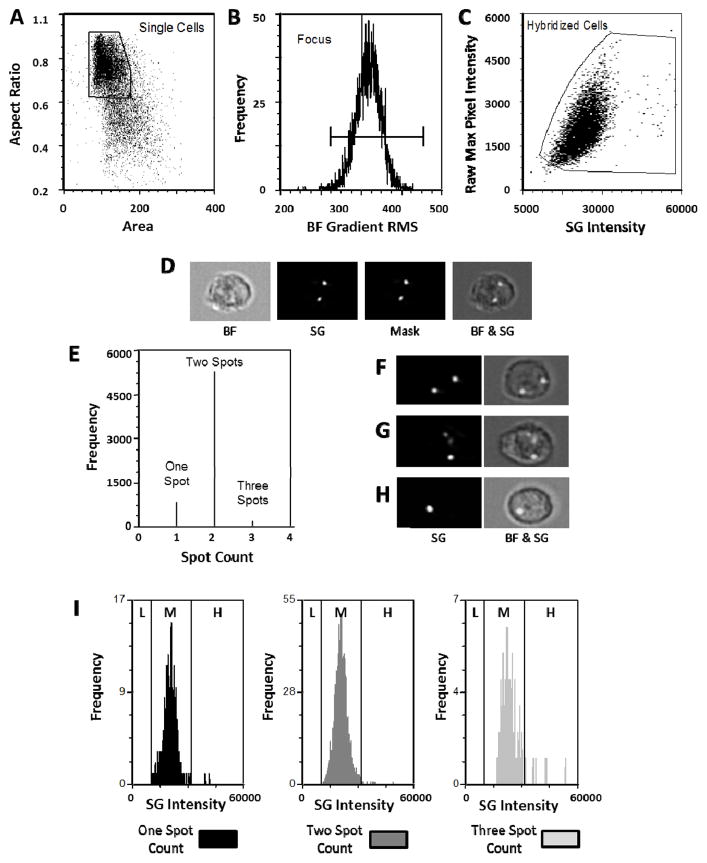
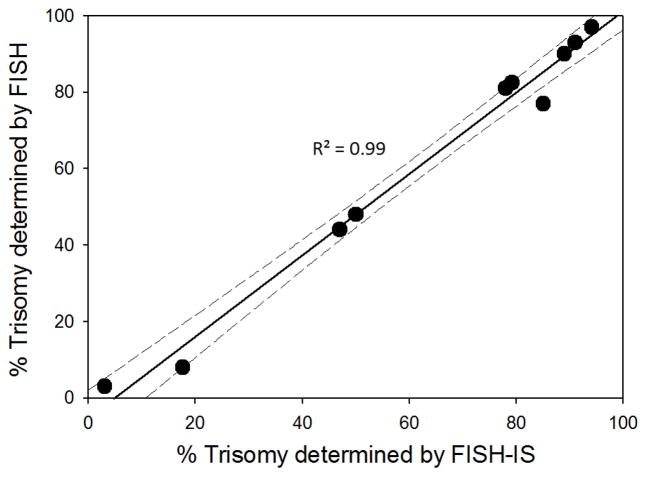
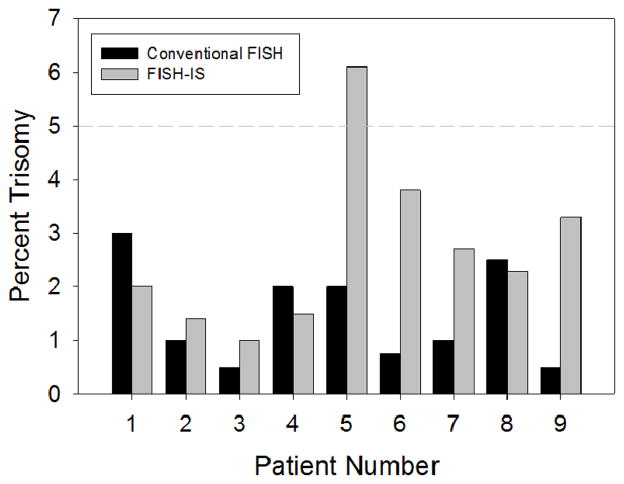
Cytogenetic abnormalities are important diagnostic and prognostic criteria for hematologic malignancies. Karyotyping and fluorescence in situ hybridization (FISH) are the conventional methods by which these abnormalities are detected. The sensitivity of these microscopy-based methods is limited by the abundance of the abnormal cells in the samples and therefore these analyses are commonly not applicable to minimal residual disease (MRD) stages. A flow cytometry-based imaging approach was developed to detect chromosomal abnormalities following FISH in suspension (FISH-IS), which enables the automated analysis of several log-magnitude higher number of cells compared with the microscopy-based approaches. This study demonstrates the applicability of FISH-IS for detecting numerical chromosome aberrations, establishes accuracy, and sensitivity of detection compared with conventional FISH, and feasibility to study procured clinical samples of acute myeloid leukemia (AML). Male and female healthy donor peripheral blood mononuclear cells hybridized with combinations of chromosome enumeration probes (CEP) 8, X, and Y served as models for disomy, monosomy, and trisomy. The sensitivity of detection of monosomies and trisomies amongst 20,000 analyzed cells was determined to be 1% with a high level of precision. A high correlation (R(2) = 0.99) with conventional FISH analysis was found based on the parallel analysis of diagnostic samples procured from 10 AML patients with trisomy 8 (+8). Additionally, FISH-IS analysis of samples procured at the time of clinical remission demonstrated the presence of residual +8 cells indicating that this approach may be used to detect MRD and associated chromosomal defects.
Copyright © 2012 International Society for Advancement of Cytometry.
Figures



References
-
- Mrozek K, Heerema NA, Bloomfield CD. Cytogenetics in acute leukemia. Blood Rev. 2004;18(2):115–36. - PubMed
-
- Grimwade D, Walker H, Oliver F, Wheatley K, Harrison C, Harrison G, Rees J, Hann I, Stevens R, Burnett A, et al. The importance of diagnostic cytogenetics on outcome in AML: analysis of 1,612 patients entered into the MRC AML 10 trial. The Medical Research Council Adult and Children’s Leukaemia Working Parties. Blood. 1998;92(7):2322–33. - PubMed
-
- Slovak ML, Kopecky KJ, Cassileth PA, Harrington DH, Theil KS, Mohamed A, Paietta E, Willman CL, Head DR, Rowe JM, et al. Karyotypic analysis predicts outcome of preremission and postremission therapy in adult acute myeloid leukemia: a Southwest Oncology Group/Eastern Cooperative Oncology Group Study. Blood. 2000;96(13):4075–83. - PubMed
-
- Byrd JC, Mrozek K, Dodge RK, Carroll AJ, Edwards CG, Arthur DC, Pettenati MJ, Patil SR, Rao KW, Watson MS, et al. Pretreatment cytogenetic abnormalities are predictive of induction success, cumulative incidence of relapse, and overall survival in adult patients with de novo acute myeloid leukemia: results from Cancer and Leukemia Group B (CALGB 8461) Blood. 2002;100(13):4325–36. - PubMed
-
- Grimwade D, Walker H, Harrison G, Oliver F, Chatters S, Harrison CJ, Wheatley K, Burnett AK, Goldstone AH. The predictive value of hierarchical cytogenetic classification in older adults with acute myeloid leukemia (AML): analysis of 1065 patients entered into the United Kingdom Medical Research Council AML11 trial. Blood. 2001;98(5):1312–20. - PubMed
Publication types
MeSH terms
Grants and funding
LinkOut - more resources
Full Text Sources
Other Literature Sources
Medical
