. 2012 Oct;93(Pt 10):2183-2194.
doi: 10.1099/vir.0.043711-0. Epub 2012 Jul 25.

Rescue of a genotype 4 human hepatitis E virus from cloned cDNA and characterization of intergenotypic chimeric viruses in cultured human liver cells and in pigs

Affiliations

Rescue of a genotype 4 human hepatitis E virus from cloned cDNA and characterization of intergenotypic chimeric viruses in cultured human liver cells and in pigs

Laura Córdoba et al. J Gen Virol. 2012 Oct.

Abstract

Hepatitis E virus (HEV) is an important but extremely understudied human pathogen. Genotypes 1 and 2 are restricted to humans, whereas genotypes 3 and 4 are zoonotic, infecting both humans and pigs. This report describes, for the first time, the successful rescue of infectious HEV in vitro and in vivo from cloned cDNA of a genotype 4 human HEV (strain TW6196E). The complete genomic sequence of the TW6196E virus was determined and a full-length cDNA clone (pHEV-4TW) was assembled. Capped RNA transcripts from the pHEV-4TW clone were replication competent in Huh7 cells and infectious in HepG2/C3A cells. Pigs inoculated intrahepatically with capped RNA transcripts from pHEV-4TW developed an active infection, as evidenced by faecal virus shedding and seroconversion, indicating the successful rescue of infectious genotype 4 HEV and cross-species infection of pigs by a genotype 4 human HEV. To demonstrate the utility of the genotype 4 HEV infectious clone and to evaluate the potential viral determinant(s) for species tropism, four intergenotypic chimeric clones were constructed by swapping various genomic regions between genotypes 1 and 4, and genotypes 1 and 3. All four chimeric clones were replication competent in Huh7 cells, but only the two chimeras with sequences swapped between genotypes 1 and 4 human HEVs produced viruses capable of infecting HepG2/C3A cells. None of the four chimeras was able to establish a robust infection in pigs. The availability of a genotype 4 HEV infectious clone affords an opportunity to delineate the molecular mechanisms of HEV cross-species infection in the future.


Figures
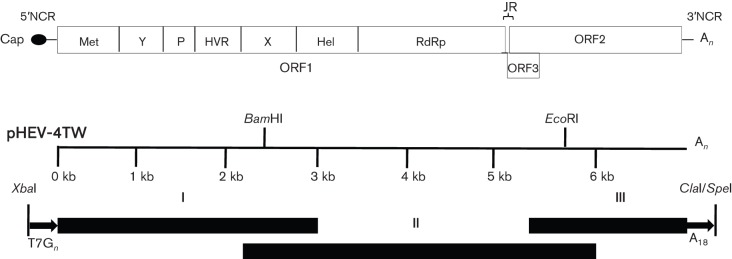
Fig. 1.
Fig. 1.
Construction of a full-length cDNA clone of genotype 4 human HEV strain TW6196E. The HEV genome consists of three ORFs (ORF1, ORF2 and ORF3), a JR, a short 5′NCR and 3′NCR, a 5′ cap structure and a 3′ poly(A) tract. The putative ORF1 functional domains are indicated: Met, methyltransferase; Y, Y domain; P, papain-like cysteine protease; HVR, hypervariable region; X, X domain; Hel, helicase; RdRp, RNA-dependent RNA polymerase. BamHI and EcoRI are unique restriction sites naturally present in the genomic sequence of strain TW6196E and were used to facilitate construction of the full-length cDNA clone. An XbaI site and a T7 promoter sequence were introduced at the 5′ end of fragment I. Eighteen As and the restriction sites SpeI and ClaI were introduced at the 3′ end of fragment III. Fragments I, II and III were ligated into the pGEM-7zf(−) vector to generate the full-length cDNA clone, designated pHEV-4TW.
Fig. 2.
Fig. 2.
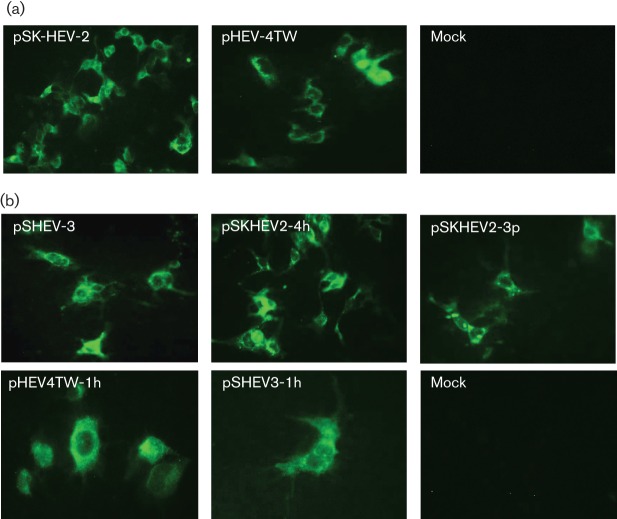
Replication competence of the genotype 4 human HEV pHEV-4TW clone and intergenotypic chimeric viruses in Huh7 cells. (a) IFA staining for HEV ORF2 antigen in Huh7 cells transfected with capped RNA transcripts from the cDNA clones of genotype 1 human HEV (pSK-HEV-2) and genotype 4 human HEV (pHEV-4TW). (b) IFA staining for HEV ORF2 antigen in Huh7 cells transfected with capped RNA transcripts from the cDNA clones of genotype 3 swine HEV (pSHEV-3) and each of the four intergenotypic chimeric viruses (pSKHEV2-4h, pSKHEV2-3p, pHEV4TW-1h and pSHEV3-1h). Mock, Mock-infected cells.
Fig. 3.
Fig. 3.
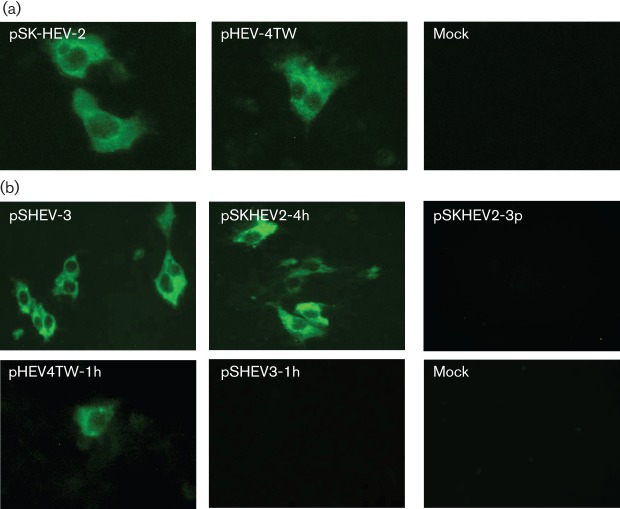
Infectivity of the genotype 4 HEV pHEV-4TW clone and intergenotypic chimeric viruses in HepG2/C3A cells. (a) IFA staining for HEV ORF2 antigen in HepG2/C3A cells infected with lysates of Huh7 cells transfected with capped RNA transcripts from the cDNA clones of genotype 1 human HEV (pSK-HEV-2) and genotype 4 human HEV (pHEV-4TW). (b) IFA staining for HEV ORF2 antigen of HepG2/C3A cells infected with lysates of Huh7 cells transfected with capped RNA transcripts from the cDNA clone of the genotype 3 swine HEV (pSHEV-3) and each of the four intergenotypic chimeric viruses (pSKHEV2-4h, pSKHEV2-3p, pHEV4TW-1h and pSHEV3-1h).
Fig. 4.
Fig. 4.
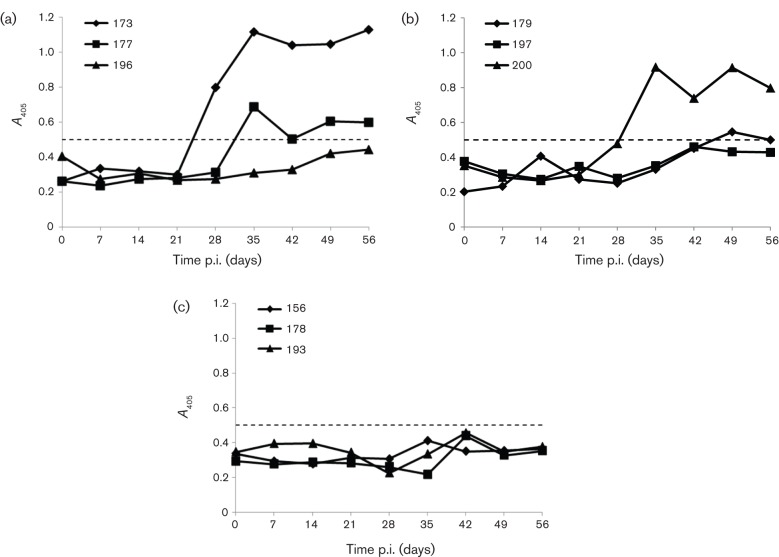
Seroconversion to anti-HEV IgG in pigs inoculated with capped RNA transcripts from the genotype 3 swine HEV pSHEV-3 clone and genotype 4 human HEV pHEV-4TW clone. An ELISA (A405) was used to detect IgG anti-HEV antibodies in pigs #173, #177 and #196 inoculated intrahepatically with capped RNA transcripts from the wild-type pSHEV-3 clone (positive control) (a), pigs #179, #197 and #200 inoculated intrahepatically with capped RNA transcripts from the genotype 4 human HEV pHEV-4TW clone (b), and pigs #156, #178 and #193 inoculated intrahepatically with PBS (negative control) (c). The ELISA cut-off value is shown as a dotted line.
Fig. 5.
Fig. 5.
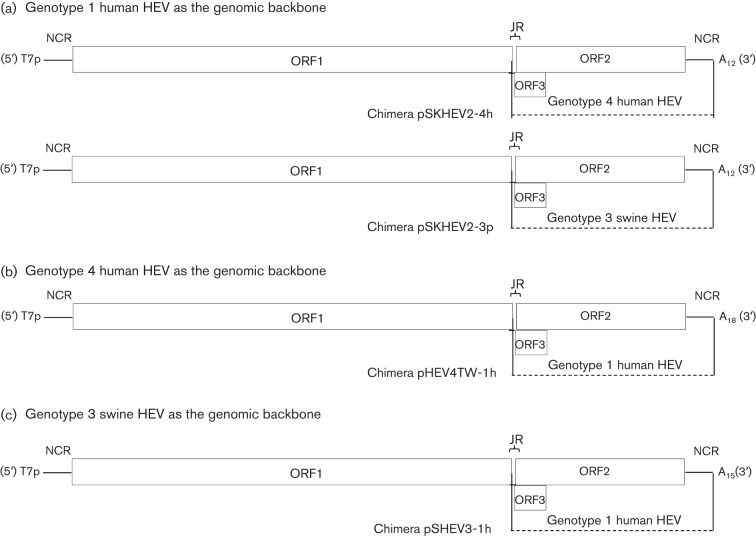
Schematic diagrams of the strategies used for construction of the four intergenotypic chimeric HEVs. (a) Two chimeric viruses were constructed using the genotype 1 human HEV infectious clone pSK-HEV-2 as the genomic backbone: chimera pSKHEV2-4h with the JR+ORF2+ORF3+3′NCR of genotype 4 human HEV replacing that of genotype 1 human HEV; and chimera pSKHEV2-3p with the JR+ORF2+ORF3+3′NCR of genotype 3 swine HEV replacing that of genotype 1 human HEV. (b) Chimera pHEV4TW-1h was constructed using the genotype 4 human HEV infectious clone pHEVTW-4 as the genomic backbone, with the JR+ORF2+ORF3+3′NCR of genotype 1 human HEV replacing that of genotype 4 human HEV. (c) Chimera pSHEV3-1h was constructed by using the genotype 3 swine HEV infectious clone pSHEV-3 as the genomic backbone, with the JR+ORF2+ORF3+3′NCR of genotype 1 human HEV replacing that of genotype 3 swine HEV.

References

    1. Agrawal S., Gupta D., Panda S. K. (2001). The 3′ end of hepatitis E virus (HEV) genome binds specifically to the viral RNA-dependent RNA polymerase (RdRp). Virology 282, 87–101 10.1006/viro.2000.0819 - DOI - PubMed
    1. Ahmad I., Holla R. P., Jameel S. (2011). Molecular virology of hepatitis E virus. Virus Res 161, 47–58 10.1016/j.virusres.2011.02.011 - DOI - PMC - PubMed
    1. Arankalle V. A., Chadha M. S., Tsarev S. A., Emerson S. U., Risbud A. R., Banerjee K., Purcell R. H. (1994). Seroepidemiology of water-borne hepatitis in India and evidence for a third enterically-transmitted hepatitis agent. Proc Natl Acad Sci U S A 91, 3428–3432 10.1073/pnas.91.8.3428 - DOI - PMC - PubMed
    1. Arankalle V. A., Chobe L. P., Chadha M. S. (2006). Type-IV Indian swine HEV infects rhesus monkeys. J Viral Hepat 13, 742–745 10.1111/j.1365-2893.2006.00759.x - DOI - PubMed
    1. Cao D., Huang Y.-W., Meng X.-J. (2010). The nucleotides on the stem–loop RNA structure in the junction region of the hepatitis E virus genome are critical for virus replication. J Virol 84, 13040–13044 10.1128/JVI.01475-10 - DOI - PMC - PubMed

Publication types

MeSH terms

Associated data

LinkOut - more resources