Review
. 2012;13(6):7109-7137.
doi: 10.3390/ijms13067109. Epub 2012 Jun 8.

Structural analysis of hypothetical proteins from Helicobacter pylori: an approach to estimate functions of unknown or hypothetical proteins

Affiliations
Review

Structural analysis of hypothetical proteins from Helicobacter pylori: an approach to estimate functions of unknown or hypothetical proteins

Sung Jean Park et al. Int J Mol Sci. 2012.

Abstract

Helicobacter pylori (H. pylori) have a unique ability to survive in extreme acidic environments and to colonize the gastric mucosa. It can cause diverse gastric diseases such as peptic ulcers, chronic gastritis, mucosa-associated lymphoid tissue (MALT) lymphoma, gastric cancer, etc. Based on genomic research of H. pylori, over 1600 genes have been functionally identified so far. However, H. pylori possess some genes that are uncharacterized since: (i) the gene sequences are quite new; (ii) the function of genes have not been characterized in any other bacterial systems; and (iii) sometimes, the protein that is classified into a known protein based on the sequence homology shows some functional ambiguity, which raises questions about the function of the protein produced in H. pylori. Thus, there are still a lot of genes to be biologically or biochemically characterized to understand the whole picture of gene functions in the bacteria. In this regard, knowledge on the 3D structure of a protein, especially unknown or hypothetical protein, is frequently useful to elucidate the structure-function relationship of the uncharacterized gene product. That is, a structural comparison with known proteins provides valuable information to help predict the cellular functions of hypothetical proteins. Here, we show the 3D structures of some hypothetical proteins determined by NMR spectroscopy and X-ray crystallography as a part of the structural genomics of H. pylori. In addition, we show some successful approaches of elucidating the function of unknown proteins based on their structural information.

Keywords: Helicobacter pylori; NMR; X-ray; hypothetical protein; structural genomics; structural homology; unknown protein.


Figures
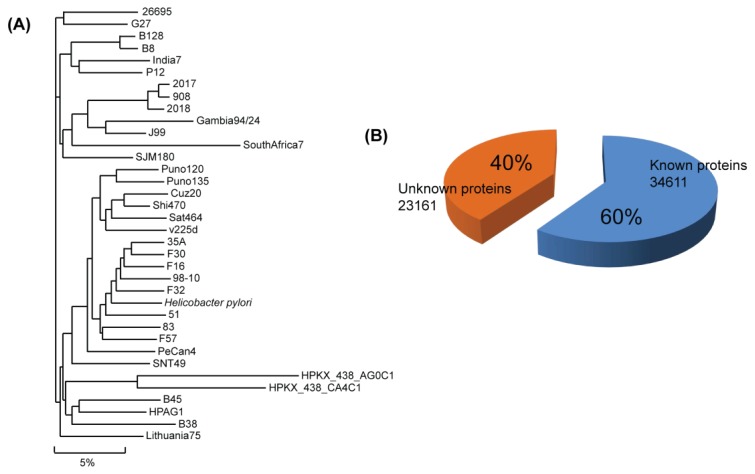
Figure 1
Figure 1
Genome sequence and proteins of H. pylori. In the phylogenetic tree, a total of 36 sub-species are branched with a total of about 60,000 genes (A); and among the translated proteins, the biological functions of 40% of the proteins are unidentified (B).
Figure 2
Figure 2
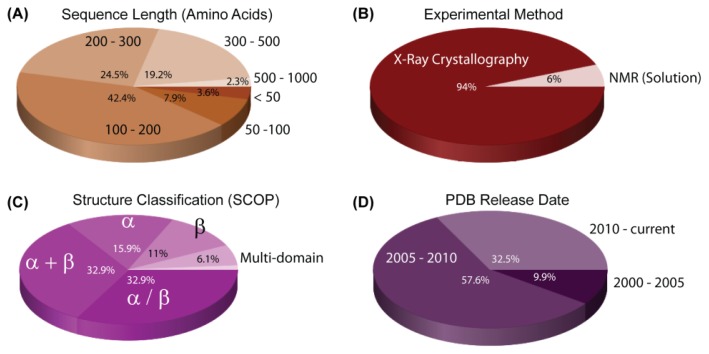
Statistics of protein structures from H. pylori. All data were collected and processed from PDB on 14 February 2012 [52]. The dominant properties of the presented data are 100–300 kDa in size, X-ray diffraction as the experimental method, alpha and beta structural motifs, and release date from 2005–2010.
Figure 3
Figure 3
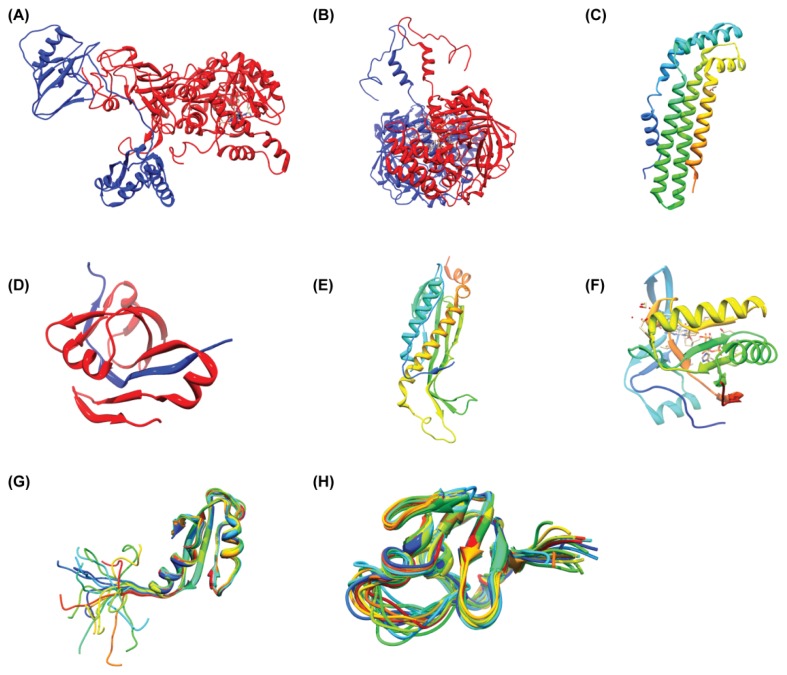
Several 3D structures from H. pylori. Urease subunit α and β (A, pdb code: 1E9Y), Kat catalase (B, pdb code: 1WQL) are multiple domain structures with multiple chains. Aspartate 1-decarboxylase adopts a dominant β structure (D, pdb code: 1UHD). The structures of unknown proteins are shown with different variations of their structural domains (C, pdb code 1S2X, all α; E, pdb code: 2I9I, α/β; F, pdb code: 2ATZ, α + β; G, pdb code: 2H9Z, α + β; H, pdb code: 2K6P, RNA binding motif). Structures of G and H are solved by NMR. All structures were displayed using UCSF Chimera with ribbon presentation method [55].
Figure 4
Figure 4
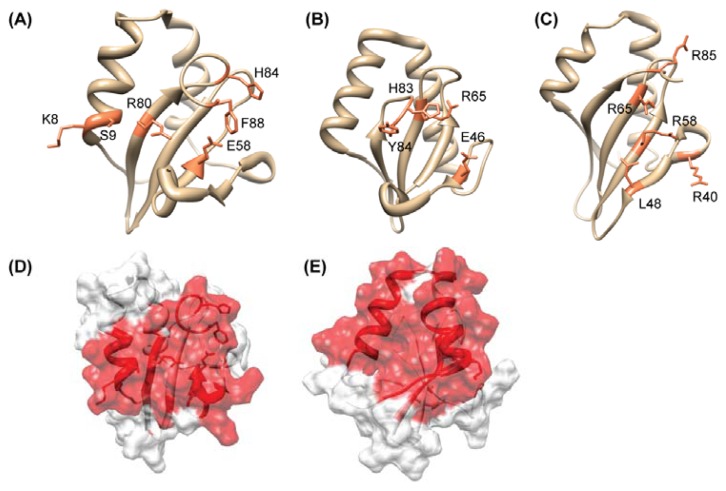
Comparison of the structural and catalytic residues of HP0894 with those of its structural homologues. AC, ribbon displays of the representative conformer of HP0894; (A) E. coli YoeB (PDB ID: 2A6R); (B) P. horikoshii RelE (PDB ID: 1WMI); (C) labeled functional or predicted key residues are colored coral. The RelE monomer structure was extracted from the aRelE-aRelB complex structure; (D) Chemical shift perturbation mapping of the C-terminal peptide of HP0895-binding region on HP0894 (1:1 molar ratio). Ribbon and surface displays of HP0894 structure colored according to chemical shift perturbations. The changes of the residues in obvious slow or fast exchange modes are colored in red. (E) Chemical shift perturbation mapping of the ssDNA-U [d(ACACUAAGAA)]-binding region on HP0894 (1:4 molar ratio). Residues showing significant chemical shift changes are colored in red.
Figure 5
Figure 5
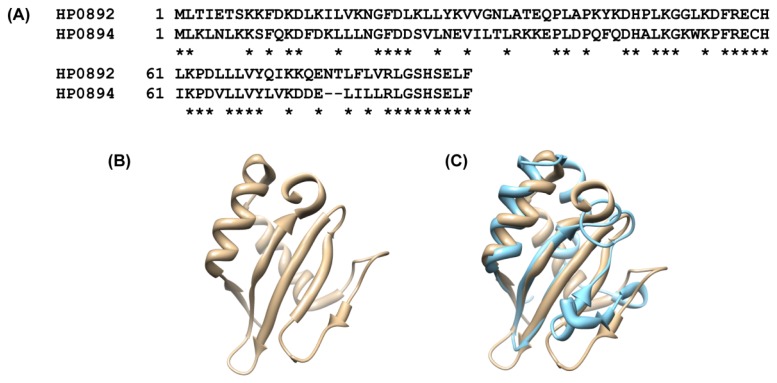
Comparison between HP0892 and HP0894. (A) Sequence homology between HP0892 and HP0894. Stars represent identical residues (53.3% identity in 90 residues); (B) Ribbon drawing of the representative conformer of HP0892 (PDB ID:2OTR); (C) Superposition of HP0892 (tan) and HP0894 (sky blue). The pairwise RMSD between two proteins was 0.712 Å. The topology of the two molecules is slightly different, especially in the loop regions.
Figure 6
Figure 6
Structure of HP0315 from H. pylori. (A) Cartoon representation of the dimer of HP0315 (α-helices, β-strands and loops are cyan, magenta and yellow, respectively). Dotted circle represents the putative catalytic region located at the deep cavity region. (B) Surface representation of HP0315 showing positive and negative electrostatic potential in blue and red, respectively. The dotted circle represents the putative RNA-binding region. This region would be related to initial binding with RNA, and then a second catalytic reaction would occur around the deep cavity region. (C,D) Structural comparison between HP0315 (C); and the homologue, SSO1404 (PDB code:2ivy) (D). β-Strands are colored in “yellow” and α-helices in “red”. Both of the structures possess a ferredoxin-like fold. (E) Diagrams of the hp0315 (hp0894) and hp0316 (hp0895) encoding region from the chromosome of H. pylori.
Figure 7
Figure 7
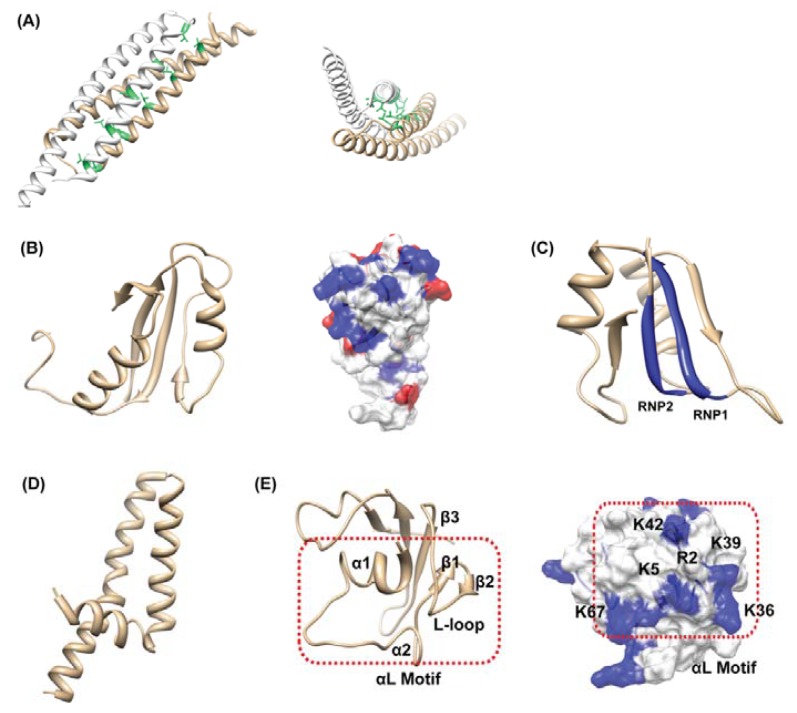
(A) Ribbon diagram of the HP0062 dimer is shown. Side and top views of the HP0062, showing the leucine zipper (green); (B) Ribbon drawing of the representative conformer of HP0495. Distribution of the surface charges on two distinct faces of HP0495 is shown. Positively-charged residues are blue, negatively-charged residues are red; (C) Ribbon drawing of the representative conformer of HP0827. Blue colors represent conserved RNP motifs lying side by side; (D) Ribbon drawing of the representative conformer of HP1242; (E) Ribbon drawing of the representative conformer of HP1423. The αL motif consists of two α-helices and the loop between β2 and β3. Electrostatic potential surface diagrams of HP1423 shows a strong concentration of positive charge in the proposed RNA-binding αL motif facing outwards.
Figure 8
Figure 8
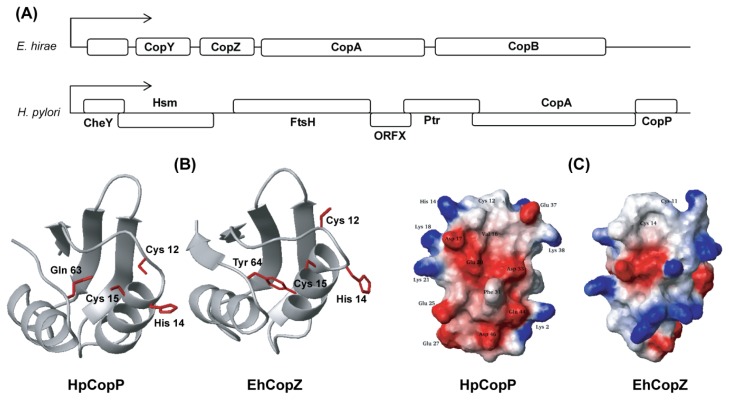
Structural comparison between apo-HpCopP and apo-CopZ. (A) The composition of cop ORFs of H. pylori and E. hirae; (B) The orientation of the two cysteines and one histidine in the CXXC motif of HpCopP is compared with that of EhCopZ. The hydrophobic protection by Tyr 64 in loop V stabilizes the Cu(I)-coordination in EhCopZ. This residue is highly conserved in bacterial proteins, but is replaced with Gln 63 in HpCopP. The side-chain of Gln 63 is not fully exposed to the solvent and points toward the metal binding site in apo-HpCopP. The structures of EhCopZ (PDB ID: 1CPZ) were obtained from the PDB; (C) The electrostatic potential surfaces of HpCopP and EhCopZ are compared to each other. The positively and negatively charged residues are represented in blue and red, respectively.
Figure 9
Figure 9
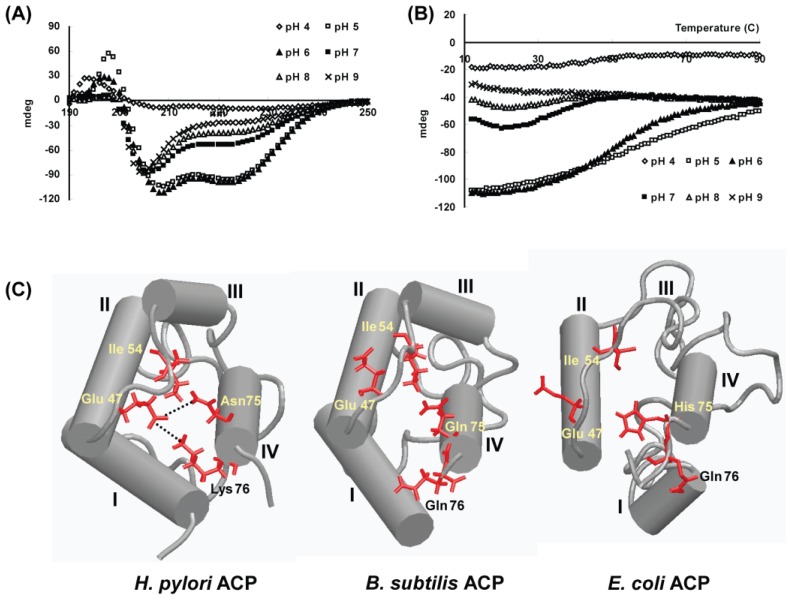
Comparison of the H. pylori ACP structure with the B. subtilis ACP and E. coli ACP structures. (A) CD spectra of HpACP recorded at various pHs. At neutral and alkaline pH, the conformational transition of HpACP occurred; (B) Tm curves of HpACP. At acidic pH 6, the temperature curves of the HpACP showed a distinct melting temperature around 50 °C. The unfolding process above neutral pH proceeded through multi-phasic changes, showing at least three stages exist; (C) Schematic representation showing the buried hydrophilic residues Glu 47, Asn 75 and Lys 76 in the energy minimized average structure of HpACP. Putative hydrogen-bonding interactions are indicated by dotted lines. The corresponding residues are compared to those of B. subtilis ACP and E. coli ACP.

References

    1. Rothenbacher D., Brenner H. Burden of Helicobacter pylori and H. pylori-related diseases in developed countries: Recent developments and future implications. Microbes Infect. 2003;5:693–703. - PubMed
    1. Wotherspoon A.C., Doglioni C., Diss T.C., Pan L., Moschini A., de Boni M., Isaacson P.G. Regression of primary low-grade B-cell gastric lymphoma of mucosa-associated lymphoid tissue type after eradication of Helicobacter pylori. Lancet. 1993;342:575–577. - PubMed
    1. Peek R.M., Jr, Blaser M.J. Helicobacter pylori and gastrointestinal tract adenocarcinomas. Nat. Rev. Cancer. 2002;2:28–37. - PubMed
    1. Parsonnet J., Friedman G.D., Vandersteen D.P., Chang Y., Vogelman J.H., Orentreich N., Sibley R.K. Helicobacter pylori infection and the risk of gastric carcinoma. N. Engl. J. Med. 1991;325:1127–1131. - PubMed
    1. Ferreira A.C., Isomoto H., Moriyama M., Fujioka T., Machado J.C., Yamaoka Y. Helicobacter and gastric malignancies. Helicobacter. 2008;13:28–34. - PMC - PubMed

Publication types

Substances

LinkOut - more resources