Review
. 2012 Oct;69(19):3245-57.
doi: 10.1007/s00018-012-1092-4. Epub 2012 Jul 28.

ROS homeostasis during development: an evolutionary conserved strategy

Affiliations
Review

ROS homeostasis during development: an evolutionary conserved strategy

Jos H M Schippers et al. Cell Mol Life Sci. 2012 Oct.

Abstract

The balance between cellular proliferation and differentiation is a key aspect of development in multicellular organisms. Recent studies on Arabidopsis roots revealed distinct roles for different reactive oxygen species (ROS) in these processes. Modulation of the balance between ROS in proliferating cells and elongating cells is controlled at least in part at the transcriptional level. The effect of ROS on proliferation and differentiation is not specific for plants but appears to be conserved between prokaryotic and eukaryotic life forms. The ways in which ROS is received and how it affects cellular functioning is discussed from an evolutionary point of view. The different redox-sensing mechanisms that evolved ultimately result in the activation of gene regulatory networks that control cellular fate and decision-making. This review highlights the potential common origin of ROS sensing, indicating that organisms evolved similar strategies for utilizing ROS during development, and discusses ROS as an ancient universal developmental regulator.


Figures
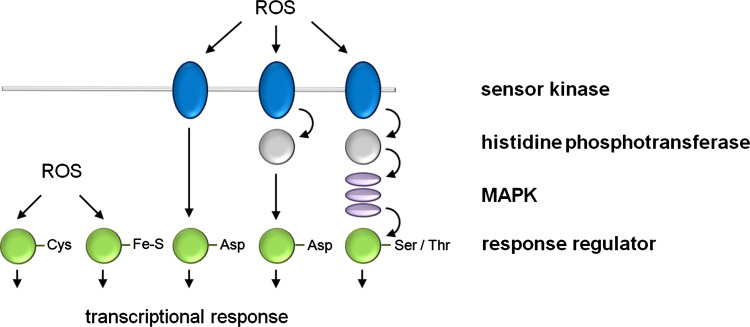
Fig. 1
Fig. 1
Schematic overview of the one-component and two-component signal transduction paradigm. The simplest transduction system is the one-component system (left) which is mainly found in unicellular organisms and, e.g., includes the OxyR and SoxR TFs, depicted as response regulators (RR) whose cysteine residue or Fe–S cluster, respectively, is oxidized by ROS. In the classical two-component pathway (left), the HK domain of the sensor kinase autophosphorylates and subsequently transfers a phosphoryl group to the aspartate residue of the RR. The sensory domain connected to the HK domain varies widely to allow receiving the various signals. Phosphorelay systems (second from right) are a common extension of the minimal two-component signaling cascade which in plants is involved in cytokinin signaling. Perception of a stimulus activates autophosphorylation and the phosphoryl group is intramolecularly passed to a C-terminal receiver domain. Subsequently, an additional histidine phosphotransferase (HPT) shuttles the phosphoryl group from the hybrid kinase to a soluble RR protein. Alternatively, as in plant-specific ethylene signaling or in some other higher eukaryotic organisms (rats), the phosphorelay feeds forward onto the MAPK cascade (right), which subsequently activates an RR protein via Ser/Thr residues. Taken together, one- and two-component pathways enable cells to sense and respond to stimuli by inducing changes in transcription
Fig. 2
Fig. 2
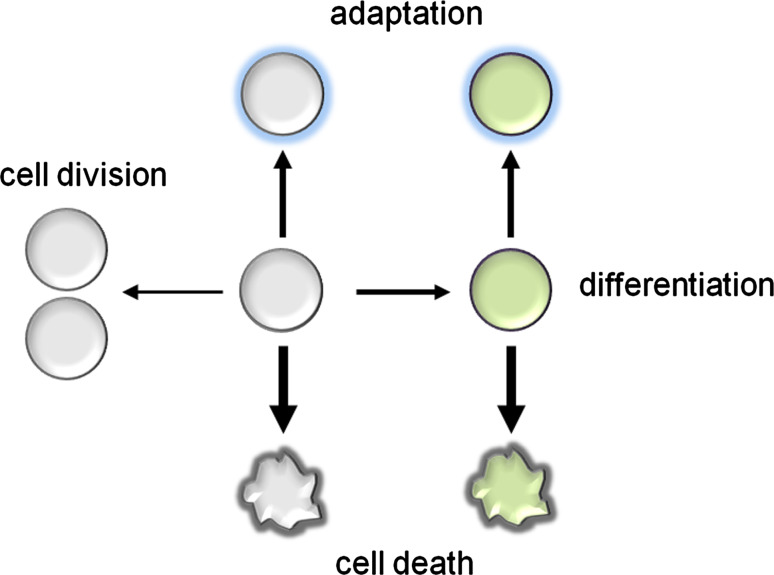
Output of ROS on cellular proliferation and differentiation, depending on the strength and type of the signal. A transient increase in ROS levels stimulates cell division, while a higher level can result in cell differentiation. Even higher levels, as experienced during cellular stress, will result in growth inhibition and subsequent adaptation. However, when ROS levels further increase and cells can no longer adapt, they either go into a state resembling cellular replicative senescence or die in an organized manner resulting in cell death. The strength of the ROS signal is indicated by the weight of the arrow
Fig. 3
Fig. 3
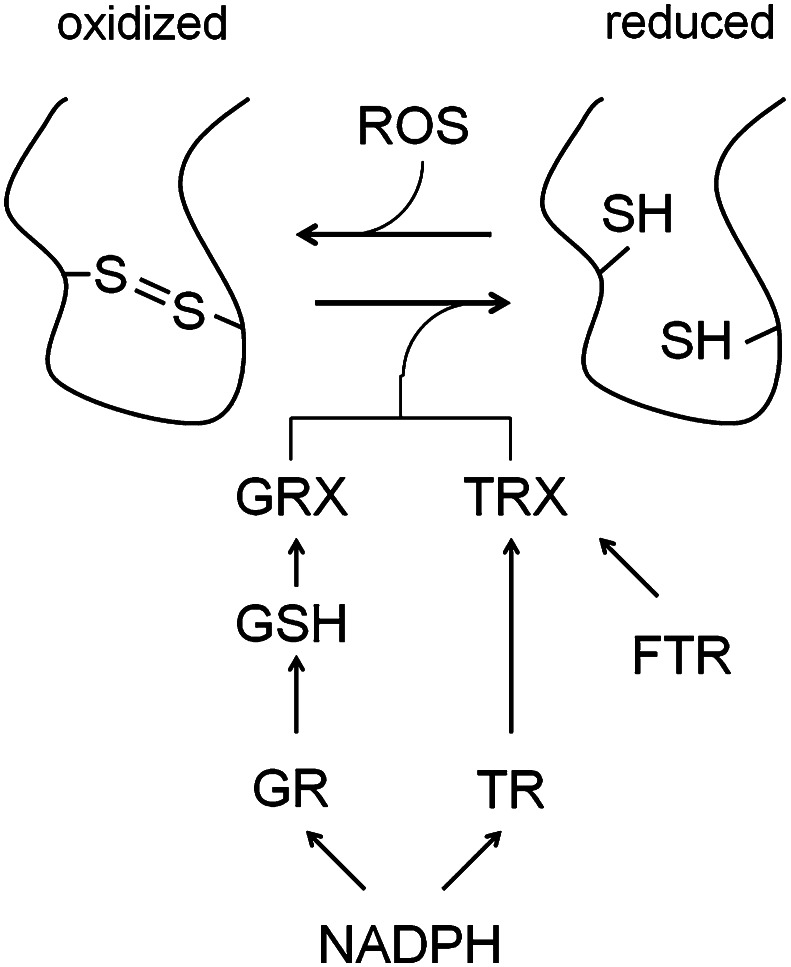
Two common thiol redox pathways that set redox homeostasis in cells. Under oxidative conditions, disulfide bonds are formed within proteins that can either activate or inactivate them. The major pathways for reducing the disulfide bonds in proteins rely on thioredoxins (TRX) or glutaredoxins (GRX). GRXs are reduced non-enzymatically by glutathione (GSH), whereas TRXs are reduced enzymatically by TRX reductase (TR). Oxidized GSH is recycled by glutathione reductase (GR). Both, TR and GR use NADPH as a substrate during the reduction reactions, except for the plastidial TR proteins which rely on ferredoxin (FTR) instead of NADPH for reduction

References

    1. Halliwell B. Reactive species and antioxidants. Redox biology is a fundamental theme of aerobic life. Plant Physiol. 2006;141:312–322. - PMC - PubMed
    1. Halliwell B, Whiteman M. Measuring reactive species and oxidative damage in vivo and in cell culture: how should you do it and what do the results mean? Br J Pharmacol. 2004;142:231–255. - PMC - PubMed
    1. Hedges SB, Blair JE, Venturi ML, Shoe JL. A molecular timescale of eukaryote evolution and the rise of complex multicellular life. BMC Evol Biol. 2004;4:2. - PMC - PubMed
    1. Dismukes GC, Klimov VV, Baranov SV, Kozlov YN, DasGupta J, Tyryshkin A. The origin of atmospheric oxygen on earth: the innovation of oxygenic photosynthesis. Proc Natl Acad Sci USA. 2001;98:2170–2175. - PMC - PubMed
    1. Falkowski PG. Evolution: tracing oxygen’s imprint on earth’s metabolic evolution. Science. 2006;311:1724–1725. - PubMed

LinkOut - more resources