


Self-regulatory depletion increases emotional reactivity in the amygdala
- PMID: 22842815
- PMCID: PMC3624961
- DOI: 10.1093/scan/nss082
Self-regulatory depletion increases emotional reactivity in the amygdala
Abstract
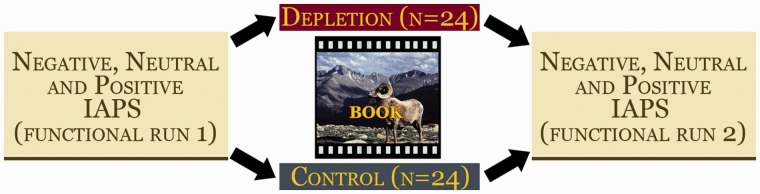
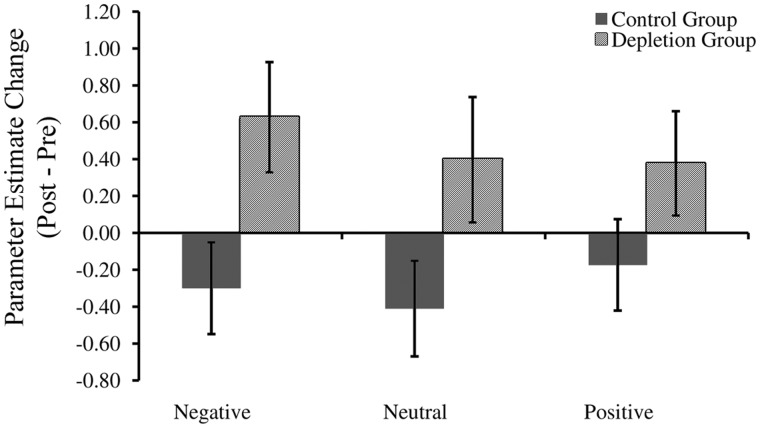
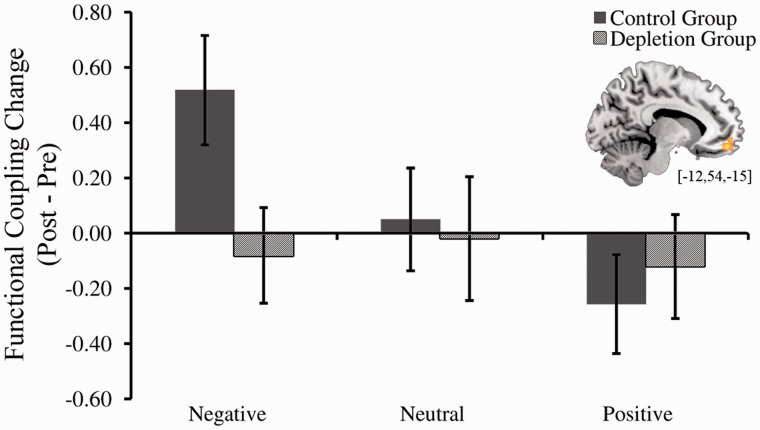
The ability to self-regulate can become impaired when people are required to engage in successive acts of effortful self-control, even when self-control occurs in different domains. Here, we used functional neuroimaging to test whether engaging in effortful inhibition in the cognitive domain would lead to putative dysfunction in the emotional domain. Forty-eight participants viewed images of emotional scenes during functional magnetic resonance imaging in two sessions that were separated by a challenging attention control task that required effortful inhibition (depletion group) or not (control group). Compared to the control group, depleted participants showed increased activity in the left amygdala to negative but not to positive or neutral scenes. Moreover, whereas the control group showed reduced amygdala activity to all scene types (i.e. habituation), the depletion group showed increased amygdala activity relative to their pre-depletion baseline; however this was only significant for negative scenes. Finally, depleted participants showed reduced functional connectivity between the left amygdala and ventromedial prefrontal cortex during negative scene processing. These findings demonstrate that consuming self-regulatory resources leads to an exaggerated neural response to emotional material that appears specific to negatively valenced stimuli and further suggests a failure to recruit top-down prefrontal regions involved in emotion regulation.
Figures

Comment in
-
Imaging depletion: fMRI provides new insights into the processes underlying ego depletion*.Soc Cogn Affect Neurosci. 2013 Apr;8(4):359-61. doi: 10.1093/scan/nss111. Epub 2012 Sep 20. Soc Cogn Affect Neurosci. 2013. PMID: 22997053 Free PMC article.
References
-
- Baumeister RF, Bratslavsky E, Muraven M, Tice DM. Ego depletion: is the active self a limited resource? Journal of Personality and Social Psychology. 1998;74(5):1252–65. - PubMed
-
- Baumeister R, Heatherton T. Self-regulation failure: an overview. Psychological Inquiry. 1996;7(1):1–15.
-
- Breiter HC, Etcoff NL, Whalen PJ, et al. Response and habituation of the human amygdala during visual processing of facial expression. Neuron. 1996;17(5):875–87. - PubMed
-
- Brind W, Schmalz B. Bighorn [VHS] Canada: National Film Board of Canada; 1970.
