


A comparison of tau and 14-3-3 protein in the diagnosis of Creutzfeldt-Jakob disease
- PMID: 22843257
- PMCID: PMC4098812
- DOI: 10.1212/WNL.0b013e318263565f
A comparison of tau and 14-3-3 protein in the diagnosis of Creutzfeldt-Jakob disease
Abstract
Objective: To compare the respective efficiency of CSF tau (quantitative) and CSF 14-3-3 protein (qualitative) in the diagnosis of prion disease.
Methods: We made measurements on 420 live subjects, who subsequently underwent a postmortem neuropathology examination, including protein chemistry, immunohistochemistry, and histology. We performed tau by ELISA. We detected 14-3-3 protein by Western blot. Both assays were optimized for maximum efficiency (accuracy).
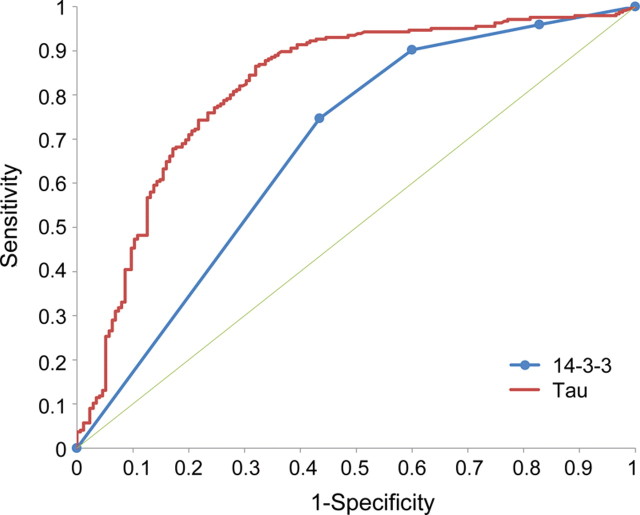
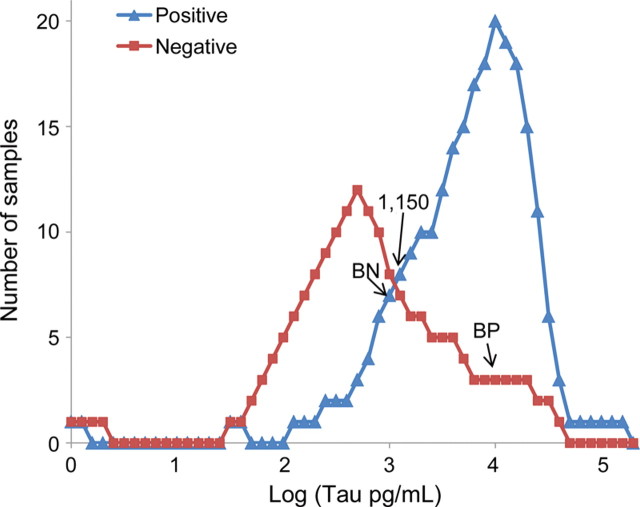
Results: We found tau and 14-3-3 proteins to be closely correlated, but tau had a significantly better ability to predict disease status than 14-3-3 protein. Also, tau distinguished disease status at least as well as when both assays' results are combined in a variety of ways. Importantly, the area under the receiver operating characteristic curve for tau (0.82) was significantly larger than that for 14-3-3 protein (0.68) (p < 0.001). Diagnostic test statistics are provided for the study subjects with 58.3% prevalence, and for a more typical, nonselected, 7.5% prevalence as received by our center.
Conclusion: In this study, tau is superior to 14-3-3 protein as a marker in the diagnosis of Creutzfeldt-Jakob disease, and is as efficient singly compared to a variety of combinations with 14-3-3 protein. This is the first study of this magnitude to examine prion disease diagnostic tests in a carefully characterized patient population with detailed statistical evaluation.
Figures
Comment in
-
Comment: Tau vs 14-3-3 protein--adjuncts for the diagnosis of CJD.Neurology. 2012 Aug 7;79(6):551. doi: 10.1212/WNL.0b013e3182635834. Epub 2012 Jul 25. Neurology. 2012. PMID: 22843263 No abstract available.
-
A comparison of tau and 14-3-3 protein in the diagnosis of Creutzfeldt-Jakob disease.Neurology. 2013 May 28;80(22):2081. doi: 10.1212/01.wnl.0000431029.13491.59c. Neurology. 2013. PMID: 23713090 No abstract available.
References
-
- Schapira AH, Tolosa E.Molecular and clinical prodrome of Parkinson disease: implications for treatment.Nat Rev Neurol 2010;6:309–317 - PubMed
-
- Hampel H, Frank R, Broich K, et al. Biomarkers for Alzheimer's disease: academic, industry and regulatory perspectives.Nat Rev Drug Discov 2010;9:560–574 - PubMed
-
- Hsich G, Kenney K, Gibbs CJ, Lee KH, Harrington MG.The 14-3-3 brain protein in cerebrospinal fluid as a marker for transmissible spongiform encephalopathies.N Engl J Med 1996;335:924–930 - PubMed
-
- Collins J, Sanchez-Juan P, Masters CL, et al. Determinants of diagnostic investigation sensitivities across the clinical spectrum of sporadic Creutzfeldt-Jakob disease.Brain 2006;129:2278–2287 - PubMed
Publication types
MeSH terms
Substances
Grants and funding
LinkOut - more resources
Full Text Sources
Medical
Molecular Biology Databases
