


doi: 10.1007/s12170-012-0241-5.
Exercise-induced Signals for Vascular Endothelial Adaptations: Implications for Cardiovascular Disease
Affiliations
- PMID: 22844545
- PMCID: PMC3404842
- DOI: 10.1007/s12170-012-0241-5
Item in Clipboard
Exercise-induced Signals for Vascular Endothelial Adaptations: Implications for Cardiovascular Disease
Curr Cardiovasc Risk Rep.
.
Abstract
This article reviews recent advances in our understanding of hemodynamic signals, external/compressive forces, and circulating factors that mediate exercise training-induced vascular adaptations, with particular attention to the roles of these signals in prevention and treatment of endothelial dysfunction and cardiovascular (CV) diseases.
Conflict of interest statement
Figures
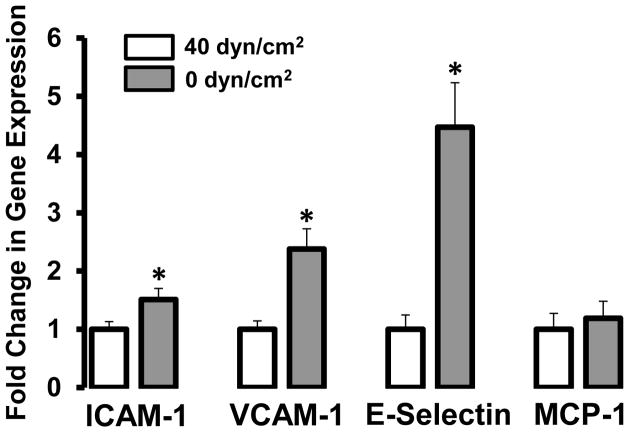
Effect of shear (40 dyn/cm2) vs. no shear (0 dyn/cm2) on expression of intercellular adhesion molecule-1 (ICAM-1), vascular adhesion molecule-1 (VCAM-1), E-selectin, and monocyte chemoattractant protein-1 (MCP-1) gene expression in rat carotid arteries. * P < 0.05 vs. no shear.

Proposed “inverted-U” shaped relationship between circulating insulin concentrations and endothelial function.
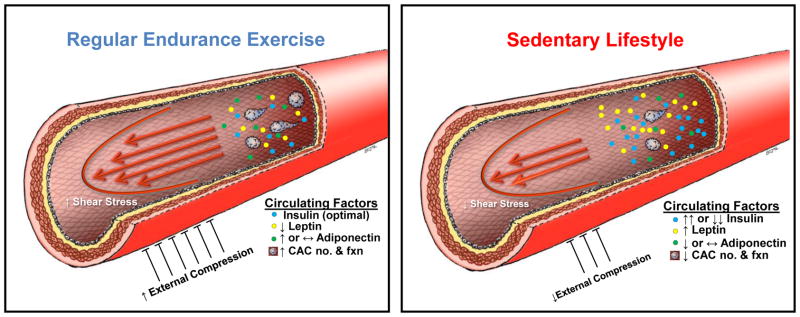
Summary of hemodynamic signals, compressive forces, and circulating factors involved in exercise training-induced endothelial adaptations, illustrated by contrasting the effect of regular endurance exercise (high mean shear stress and external compression, optimal levels of insulin [see Fig 2], low leptin levels, increased adiponectin levels, and increased number and function of CACs; left side) vs. that of a sedentary lifestyle (for simplicity, depicted as opposite of regular endurance exercise; right side).
References
-
- Blair SN, Kohl HW, 3rd, Paffenbarger RS, Jr, Clark DG, Cooper KH, Gibbons LW. Physical fitness and all-cause mortality. A prospective study of healthy men and women. JAMA. 1989;262:2395–401. - PubMed
-
- Lees SJ, Booth FW. Sedentary death syndrome. Can J Appl Physiol. 2004;29:447. - PubMed
-
- Green DJ, Walsh JH, Maiorana A, Best MJ, Taylor RR, O’Driscoll JG. Exercise-induced improvement in endothelial dysfunction is not mediated by changes in CV risk factors: pooled analysis of diverse patient populations. Am J Physiol Heart Circ Physiol. 2003;285:H2679–87. - PubMed
Grants and funding
LinkOut - more resources
Full Text Sources