. 2012:2012:207958.
doi: 10.1155/2012/207958. Epub 2012 Jul 15.

Why chromosome palindromes?

Affiliations

Why chromosome palindromes?

Esther Betrán et al. Int J Evol Biol. 2012.

Abstract

We look at sex-limited chromosome (Y or W) evolution with particular emphasis on the importance of palindromes. Y chromosome palindromes consist of inverted duplicates that allow for local recombination in an otherwise nonrecombining chromosome. Since palindromes enable intrachromosomal gene conversion that can help eliminate deleterious mutations, they are often highlighted as mechanisms to protect against Y degeneration. However, the adaptive significance of recombination resides in its ability to decouple the evolutionary fates of linked mutations, leading to both a decrease in degeneration rate and an increase in adaptation rate. Our paper emphasizes the latter, that palindromes may exist to accelerate adaptation by increasing the potential targets and fixation rates of incoming beneficial mutations. This hypothesis helps reconcile two enigmatic features of the "palindromes as protectors" view: (1) genes that are not located in palindromes have been retained under purifying selection for tens of millions of years, and (2) under models that only consider deleterious mutations, gene conversion benefits duplicate gene maintenance but not initial fixation. We conclude by looking at ways to test the hypothesis that palindromes enhance the rate of adaptive evolution of Y-linked genes and whether this effect can be extended to palindromes on other chromosomes.


Figures
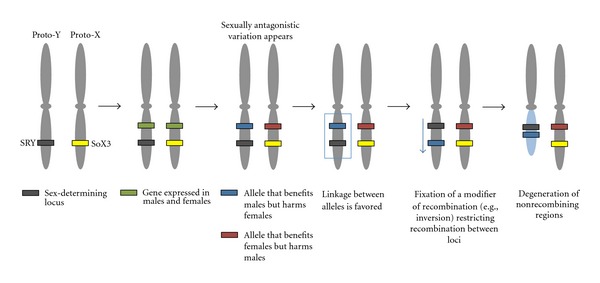
Figure 1
Figure 1
The model of sex chromosome evolution. Close linkage between sexually antagonistic variation and the sex-determining gene has been proposed to start Y chromosome morphological differentiation from the X chromosome.
Figure 2
Figure 2
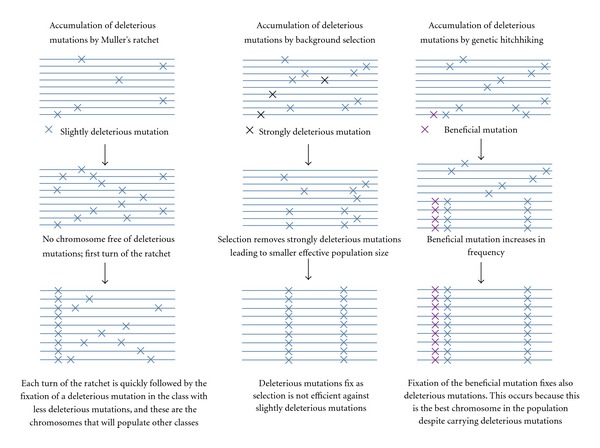
(a) The three processes that lead to degeneration of the Y chromosome: Muller's ratchet (see [109] for details of how every turn of the ratchet is followed by fixation of a deleterious allele), background selection, and genetic hitchhiking. Only in the case of genetic hitchhiking, the fitness of the Y chromosome increases through time.
Figure 3
Figure 3
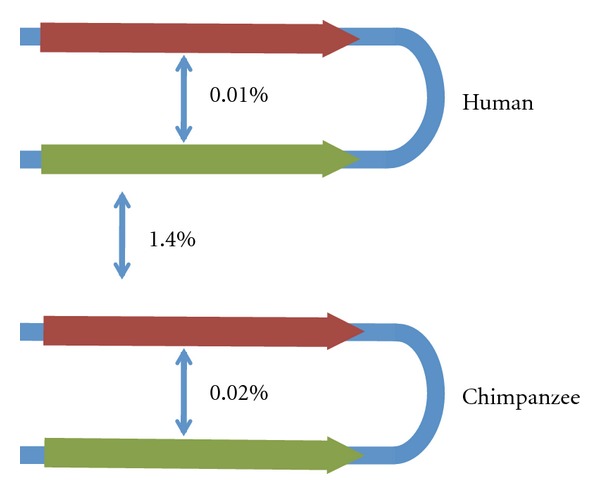
Concerted evolution by gene conversion in primate palindrome 6 [77]: low divergence between paralogs within a lineage but “normal” divergence between orthologs between lineages.
Figure 4
Figure 4
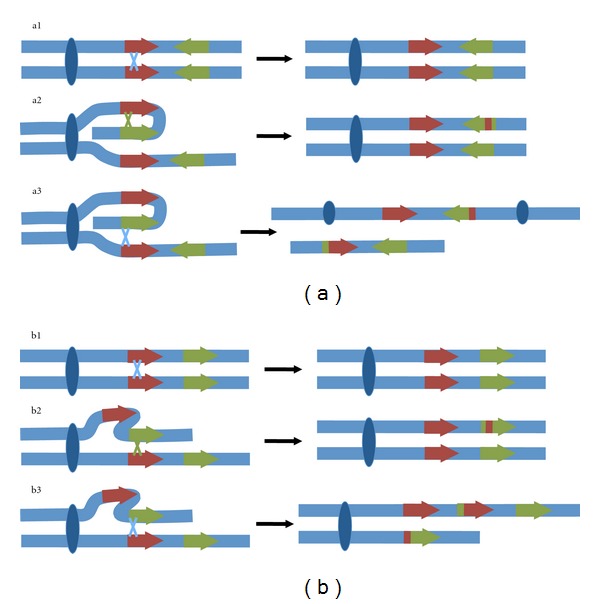
Effects of crossovers (blue lines) and gene conversion (green lines) in Y(W) palindromes (a) and tandem arrays (b). No effect of a crossover is observed if it occurs within the same gene between sister chromatids (a1 and b2). Gene conversion (nonreciprocal transfer of information) is observed if it occurs between different genes within the same palindrome or between tandem duplicates (a2 and b2). Acentric and dicentric chromosomes are produced from a crossover between different genes in palindromes located in sister chromatids (a3). Acentric chromosomes will not segregate properly, and dicentric chromosomes will likely break and lose information when they are pulled to opposite cell poles [78]. Gene gains and losses are produced from a crossover between different duplicates within array located in sister chromatids (b3).
Figure 5
Figure 5
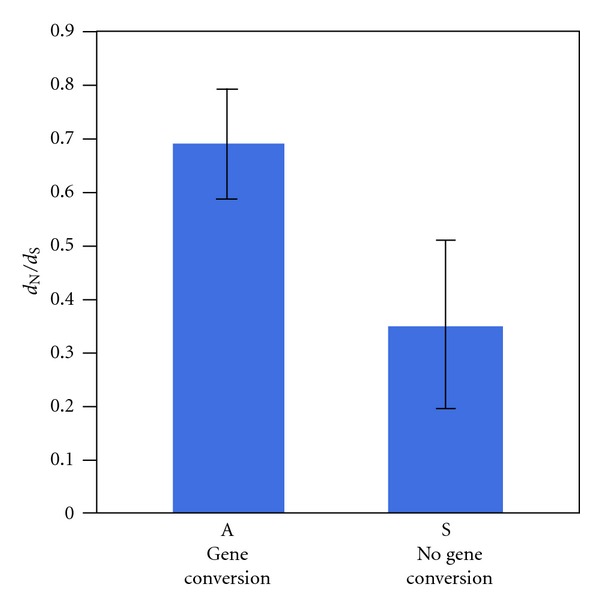
d N/d S comparison between ampliconic (A) and single-copy (S) genes in the human-rhesus Y chromosome ([26]; Mann-Whitney test, Z = 3.75, P = 0.0002). If a gene is ampliconic in one species and not in another, it was counted as ampliconic in this comparison. Error bars indicate 95% confidence interval.
Figure 6
Figure 6
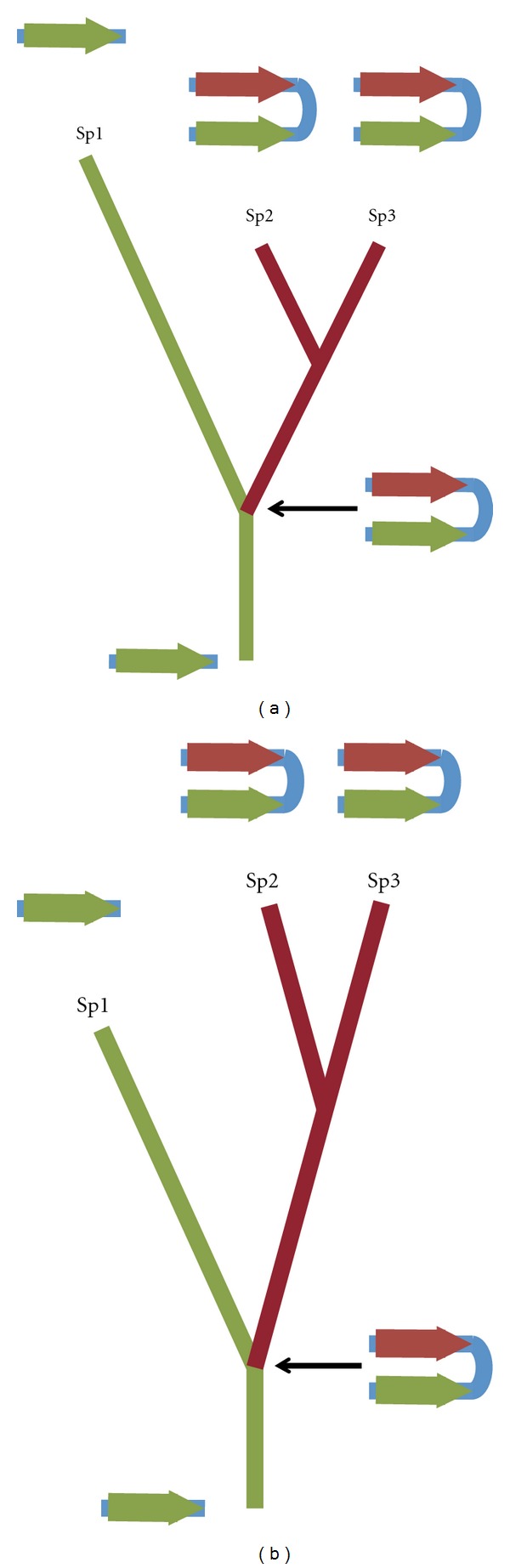
Two models of the evolution of gene families on the Y chromosome under concerted evolution. The length of the branches shown is proportional to d N/d S ratio. (a) When gene conversion does not increase the fixation rate of beneficial mutations in multigene families, the rate of evolution is reduced compared to that of single-copy gene because gene conversion is expected to reduce the fixation rate of deleterious mutations. (b) When gene conversion increases the fixation rate of beneficial mutations in multigene families, the rate of evolution is higher compared to single-copy genes.

References

    1. Charlesworth D. Plant sex determination and sex chromosomes. Heredity. 2002;88(2):94–101. - PubMed
    1. Charlesworth D. Plant sex chromosomes. Genome Dynamics. 2008;4:83–94. - PubMed
    1. Schartl M. Sex chromosome evolution in non-mammalian vertebrates. Current Opinion in Genetics and Development. 2004;14(6):634–641. - PubMed
    1. Marshall Graves JA. Weird animal genomes and the evolution of vertebrate sex and sex chromosomes. Annual Review of Genetics. 2008;42:565–586. - PubMed
    1. Vallender EJ, Lahn BT. How mammalian sex chromosomes acquired their peculiar gene content. BioEssays. 2004;26(2):159–169. - PubMed

LinkOut - more resources