Seoul National University Bundang Hospital's Electronic System for Total Care
- PMID: 22844650
- PMCID: PMC3402557
- DOI: 10.4258/hir.2012.18.2.145
Seoul National University Bundang Hospital's Electronic System for Total Care
Abstract
Objectives: Seoul National University Bundang Hospital, which is the first Stage 7 hospital outside of North America, has adopted and utilized an innovative and emerging information technology system to improve the efficiency and quality of patient care. The objective of this paper is to briefly introduce the major components of the SNUBH information system and to describe our progress toward a next-generation hospital information system (HIS).
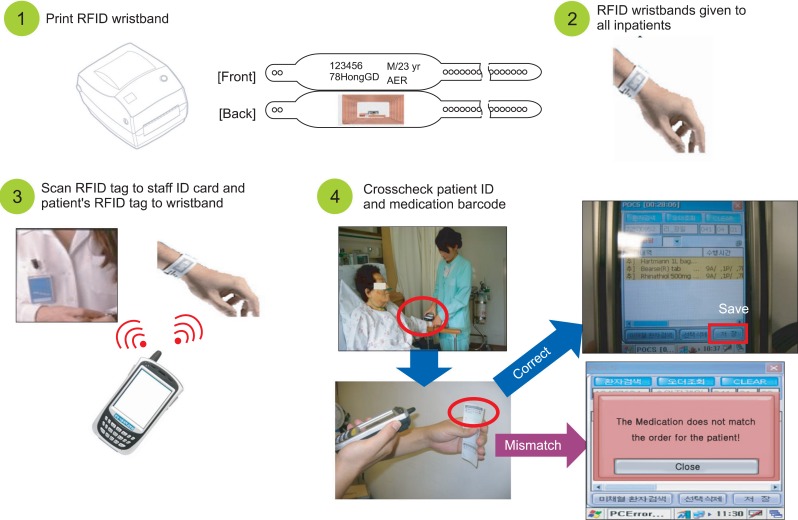
Methods: SNUBH opened in 2003 as a fully digital hospital by successfully launching a new HIS named BESTCare, "Bundang hospital Electronic System for Total Care". Subsequently, the system has been continuously improved with new applications, including close-loop medication administration (CLMA), clinical data warehouse (CDW), health information exchange (HIE), and disaster recovery (DR), which have resulted in the achievement of Stage 7 status.
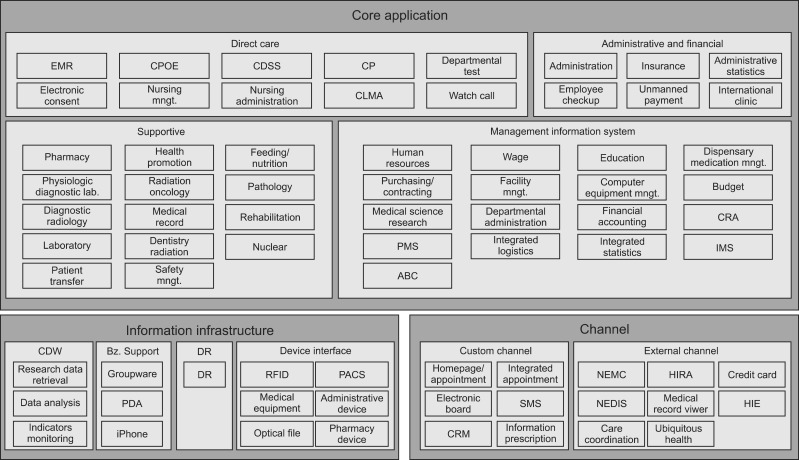
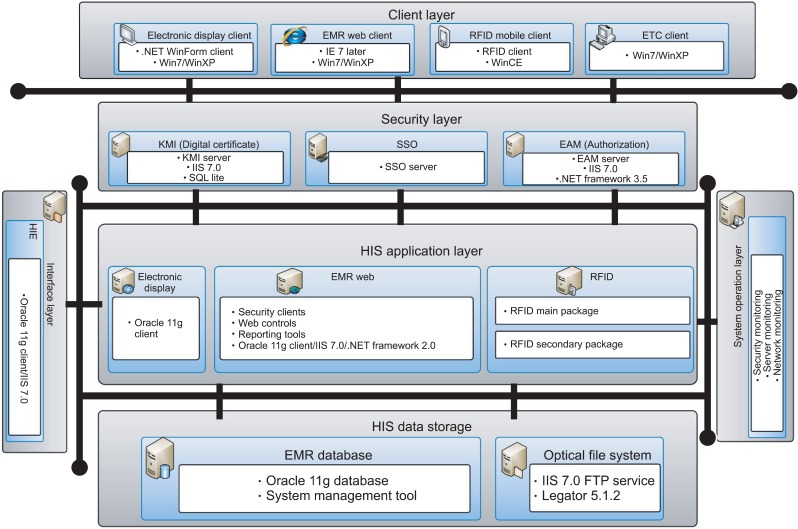
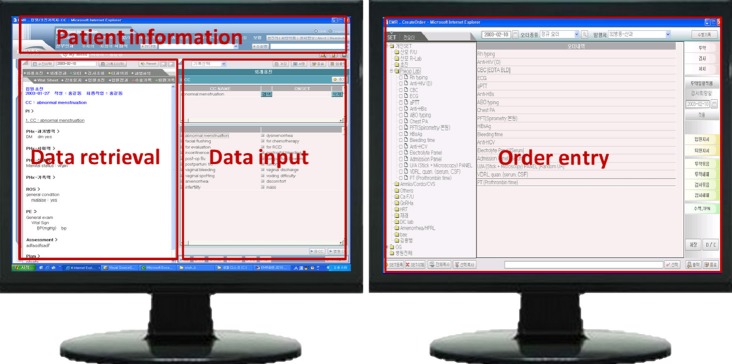
Results: The BESTCare system is an integrated system for a university hospital setting. BESTCare is mainly composed of three application domains: the core applications, an information infrastructure, and channel domains. The most critical and unique applications of the system, such as the electronic medical record (EMR), computerized physician order entry (CPOE), clinical decision support system (CDSS), CLMA, CDW, HIE, and DR applications, are described in detail.
Conclusions: Beyond our achievement of Stage 7 hospital status, we are currently developing a next-generation HIS with new goals of implementing infrastructure that is flexible and innovative, implementing a patient-centered system, and strengthening the IT capability to maximize the hospital value.
Keywords: Electronic Health Records; Hospital Information Systems; Patient Safety; Quality of Health Care.
Conflict of interest statement
No potential conflict of interest relevant to this article was reported.
Figures
References
-
- Palacio C, Harrison JP, Garets D. Benchmarking electronic medical records initiatives in the US: a conceptual model. J Med Syst. 2010;34:273–279. - PubMed
-
- Hillestad R, Bigelow J, Bower A, Girosi F, Meili R, Scoville R, Taylor R. Can electronic medical record systems transform health care? Potential health benefits, savings, and costs. Health Aff (Millwood) 2005;24:1103–1117. - PubMed
-
- Gartee R. Essentials of electronic health records. Upper Saddle River, NJ: Prentice Hall; 2012.
-
- Choi J, Kim JW, Seo JW, Chung CK, Kim KH, Kim JH, Kim JH, Chie EK, Cho HJ, Goo JM, Lee HJ, Wee WR, Nam SM, Lim MS, Kim YA, Yang SH, Jo EM, Hwang MA, Kim WS, Lee EH, Choi SH. Implementation of Consolidated HIS: Improving Quality and Efficiency of Healthcare. Healthc Inform Res. 2010;16:299–304. - PMC - PubMed
-
- Healthcare Information and Management System Society (HIMSS) Analytics. Stage 7 hospitals [Internet] Chicago, IL: HIMSS; 2012. [cited at 2012 May 21]. Available from: http://www.himssanalyticsasia.org/emradoptionmodel-stage7hospitals.asp.
Publication types
LinkOut - more resources
Full Text Sources