


Targeting the PI3K/AKT/mTOR signaling axis in children with hematologic malignancies
- PMID: 22845486
- PMCID: PMC4214862
- DOI: 10.2165/11594740-000000000-00000
Targeting the PI3K/AKT/mTOR signaling axis in children with hematologic malignancies
Abstract
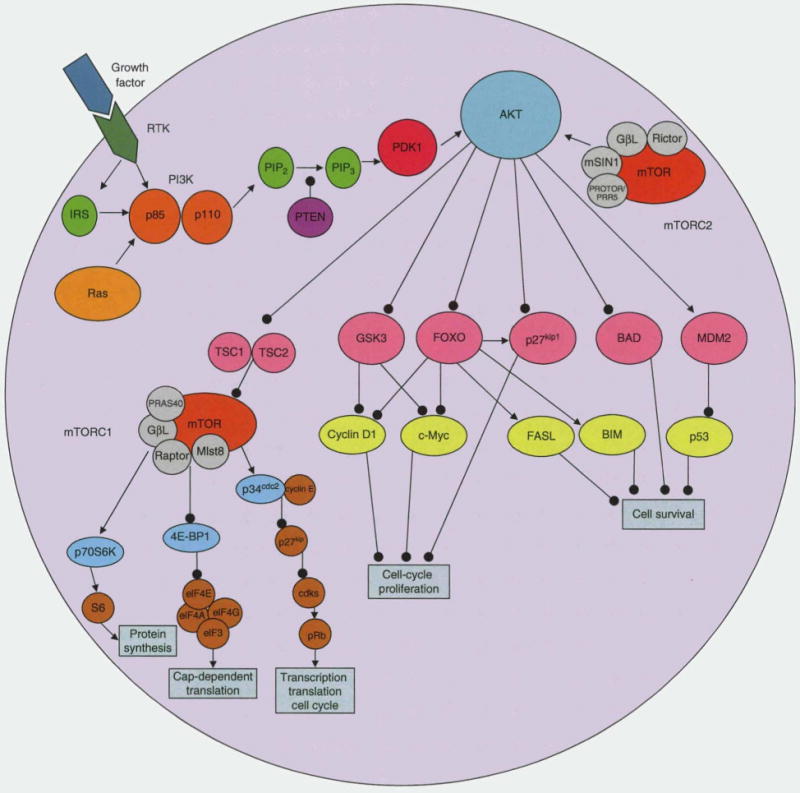
The phosphatidylinositiol 3-kinase (PI3K), AKT, mammalian target of rapamycin (mTOR) signaling pathway (PI3K/AKT/mTOR) is frequently dysregulated in disorders of cell growth and survival, including a number of pediatric hematologic malignancies. The pathway can be abnormally activated in childhood acute lymphoblastic leukemia (ALL), acute myelogenous leukemia (AML), and chronic myelogenous leukemia (CML), as well as in some pediatric lymphomas and lymphoproliferative disorders. Most commonly, this abnormal activation occurs as a consequence of constitutive activation of AKT, providing a compelling rationale to target this pathway in many of these conditions. A variety of agents, beginning with the rapamycin analogue (rapalog) sirolimus, have been used successfully to target this pathway in a number of pediatric hematologic malignancies. Rapalogs demonstrate significant preclinical activity against ALL, which has led to a number of clinical trials. Moreover, rapalogs can synergize with a number of conventional cytotoxic agents and overcome pathways of chemotherapeutic resistance for drugs commonly used in ALL treatment, including methotrexate and corticosteroids. Based on preclinical data, rapalogs are also being studied in AML, CML, and non-Hodgkin's lymphoma. Recently, significant progress has been made using rapalogs to treat pre-malignant lymphoproliferative disorders, including the autoimmune lymphoproliferative syndrome (ALPS); complete remissions in children with otherwise therapy-resistant disease have been seen. Rapalogs only block one component of the pathway (mTORC1), and newer agents are under preclinical and clinical development that can target different and often multiple protein kinases in the PI3K/AKT/mTOR pathway. Most of these agents have been tolerated in early-phase clinical trials. A number of PI3K inhibitors are under investigation. Of note, most of these also target other protein kinases. Newer agents are under development that target both mTORC1 and mTORC2, mTORC1 and PI3K, and the triad of PI3K, mTORC1, and mTORC2. Preclinical data suggest these dual- and multi-kinase inhibitors are more potent than rapalogs against many of the aforementioned hematologic malignancies. Two classes of AKT inhibitors are under development, the alkyl-lysophospholipids (APLs) and small molecule AKT inhibitors. Both classes have agents currently in clinical trials. A number of drugs are in development that target other components of the pathway, including eukaryotic translation initiation factor (eIF) 4E (eIF4E) and phosphoinositide-dependent protein kinase 1 (PDK1). Finally, a number of other key signaling pathways interact with PI3K/AKT/mTOR, including Notch, MNK, Syk, MAPK, and aurora kinase. These alternative pathways are being targeted alone and in combination with PI3K/AKT/mTOR inhibitors with promising preclinical results in pediatric hematologic malignancies. This review provides a comprehensive overview of the abnormalities in the PI3K/AKT/mTOR signaling pathway in pediatric hematologic malignancies, the agents that are used to target this pathway, and the results of preclinical and clinical trials, using those agents in childhood hematologic cancers.
Figures
References
-
- Druker BJ, Talpaz M, Resta DJ, et al. Efficacy and safety of a specific inhibitor of the BCR-ABL tyrosine kinase in chronic myeloid leukemia. N Engl J Med. 2001 Apr 5;344(14):1031–7. - PubMed
-
- Yap TA, Garrett MD, Walton MI, et al. Targeting the PI3K-AKT-mTOR pathway: progress, pitfalls, and promises. Curr Opin Pharmacol. 2008;8(4):393–412. - PubMed
Publication types
MeSH terms
Substances
Grants and funding
LinkOut - more resources
Full Text Sources
Other Literature Sources
Medical
Miscellaneous
