Childhood attention-deficit/hyperactivity disorder (ADHD) and growth in adolescent alcohol use: the roles of functional impairments, ADHD symptom persistence, and parental knowledge
- PMID: 22845650
- PMCID: PMC4128089
- DOI: 10.1037/a0028260
Childhood attention-deficit/hyperactivity disorder (ADHD) and growth in adolescent alcohol use: the roles of functional impairments, ADHD symptom persistence, and parental knowledge
Abstract
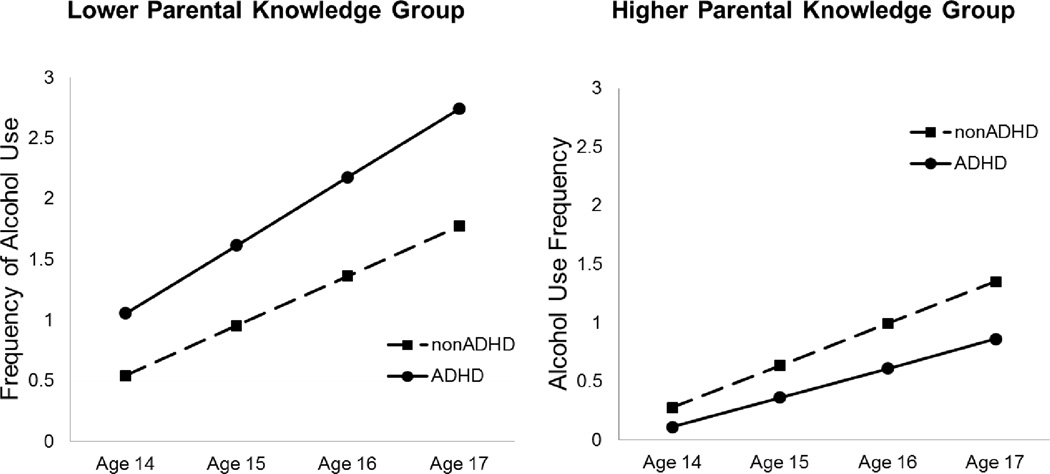
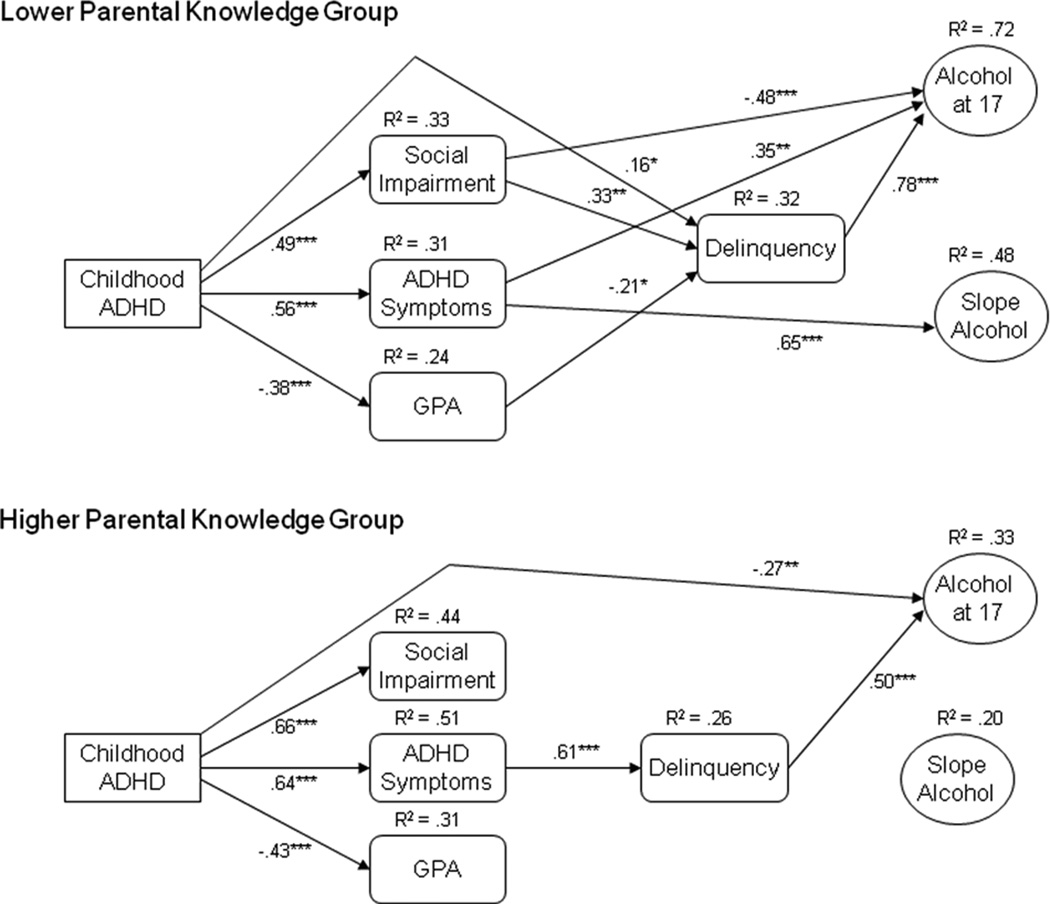
Research on the relation between childhood attention-deficit/hyperactivity disorder (ADHD) and adolescent alcohol use has found mixed results. Studies are needed that operationalize alcohol use in developmentally appropriate ways and that test theoretically plausible moderators and mediators in a longitudinal framework. The current study tested childhood ADHD as a predictor of alcohol use frequency at age 17 and age-related increases in alcohol use frequency, through adolescence for 163 adolescents with ADHD diagnosed in childhood and 120 adolescents without ADHD histories. Childhood ADHD did not predict either alcohol outcome. However, parental knowledge of the teen's friendships, activities, and whereabouts moderated the association such that childhood ADHD predicted alcohol use frequency at age 17 when parental knowledge was below median levels for the sample. Mediational pathways that explained this risk included social impairment, persistence of ADHD symptoms, grade point average, and delinquency. Social impairment was positively associated with alcohol use frequency through delinquency; it was negatively associated with alcohol use frequency as a direct effect independent of delinquency. These nuanced moderated-mediation findings help to explain previously inconsistent results for the ADHD-adolescent alcohol use association. The findings also imply that future research and intervention efforts should focus on ADHD-related social and academic impairments as well as symptom persistence and parenting efforts. (PsycINFO Database Record (c) 2012 APA, all rights reserved).
Figures
References
-
- Barkley RA. Attention-Deficit Hyperactivity Disorder. Third ed. New York: The Guilford Press; 2006.
-
- Barkley RA, Fischer M, Edelbrock CS, Smallish L. The adolescent outcome of hyperactive children diagnosed by research criteria: I. An 8-year prospective follow-up study. Journal of the American Academy of Child and Adolescent Psychiatry. 1990;29:546–557. - PubMed
-
- Barkley RA, Fischer M, Edelbrock CS, Smallish L. The adolescent outcome of hyperactive children diagnosed by research criteria, III: Mother-child interactions, family conflicts, and maternal psychopathology. Journal of Child Psychology and Psychiatry. 1991;32:233–256. - PubMed
-
- Barkley RA, Fischer M, Smallish L, Fletcher KE. Does the treatment of Attention-Deficit/Hyperactivity Disorder with stimulants contribute to drug use/abuse? A 13-year prospective study. Pediatrics. 2003;111(1):97–109. - PubMed
-
- Barkley RA, Murphy KR, Fischer M. ADHD in adults: What the science says. New York, NY: Guilford Press; 2008.
Publication types
MeSH terms
Grants and funding
- DA016631/DA/NIDA NIH HHS/United States
- N01 DA085553/DA/NIDA NIH HHS/United States
- R01 MH077676/MH/NIMH NIH HHS/United States
- K21 AA000202/AA/NIAAA NIH HHS/United States
- R01 MH053554/MH/NIMH NIH HHS/United States
- AA011873/AA/NIAAA NIH HHS/United States
- R01 MH069614/MH/NIMH NIH HHS/United States
- R01 AA012342/AA/NIAAA NIH HHS/United States
- MH077676/MH/NIMH NIH HHS/United States
- R01 MH062946/MH/NIMH NIH HHS/United States
- R21 DA016631/DA/NIDA NIH HHS/United States
- N01 MH012010/MH/NIMH NIH HHS/United States
- R01 MH065899/MH/NIMH NIH HHS/United States
- DA12414/DA/NIDA NIH HHS/United States
- R01 DA012414/DA/NIDA NIH HHS/United States
- MH069434/MH/NIMH NIH HHS/United States
- R01 MH069434/MH/NIMH NIH HHS/United States
- MH065899/MH/NIMH NIH HHS/United States
- R01 AA011873/AA/NIAAA NIH HHS/United States
- MH62946/MH/NIMH NIH HHS/United States
- MH53554/MH/NIMH NIH HHS/United States
- AA12342/AA/NIAAA NIH HHS/United States
- R01 NS039087/NS/NINDS NIH HHS/United States
- NS39087/NS/NINDS NIH HHS/United States
- R56 AA011873/AA/NIAAA NIH HHS/United States
- ESO5015/PHS HHS/United States
- R37 AA011873/AA/NIAAA NIH HHS/United States
- MH069614/MH/NIMH NIH HHS/United States