


Permissive role of endothelin receptors in tumor metastasis
- PMID: 22846215
- PMCID: PMC11207194
- DOI: 10.1016/j.lfs.2012.03.040
Permissive role of endothelin receptors in tumor metastasis
Abstract
Metastasis remains the major driver of mortality in patients with cancer. The multistep metastatic process requires the concerted actions of several genes and involves tumor cell invasion, epithelial mesenchymal transition (EMT), shedding from primary tumor, intravasation, arrest, extravasation and colonization at a preferential site. Understanding this complex process would provide the basis for the development of molecularly targeted therapeutics aimed at the tumor cell or its interaction with the host microenvironment. The neuropeptide hormones endothelins (specially, ET-1) have been correlated with invasiveness and metastasis of several cancers and high ET-1 levels are associated with decreased disease-specific survival. The mechanism(s) by which ET-1 promotes metastasis are being gradually unraveled. Through preferential binding to cognate receptors (ET(A)R or ET(B)R), ET-1 triggers autocrine and paracrine signaling cascades in tumor, immune and stromal cells, at both primary and distant sites, supporting cancer progression and metastasis. In this review, we will summarize the role of the ET axis in metastasis of different cancers and potential targeting of ET receptors in the therapeutic setting.
Copyright © 2012 Elsevier Inc. All rights reserved.
Conflict of interest statement
Conflict of interest statement
The authors declare that there are no conflicts of interest.
Figures
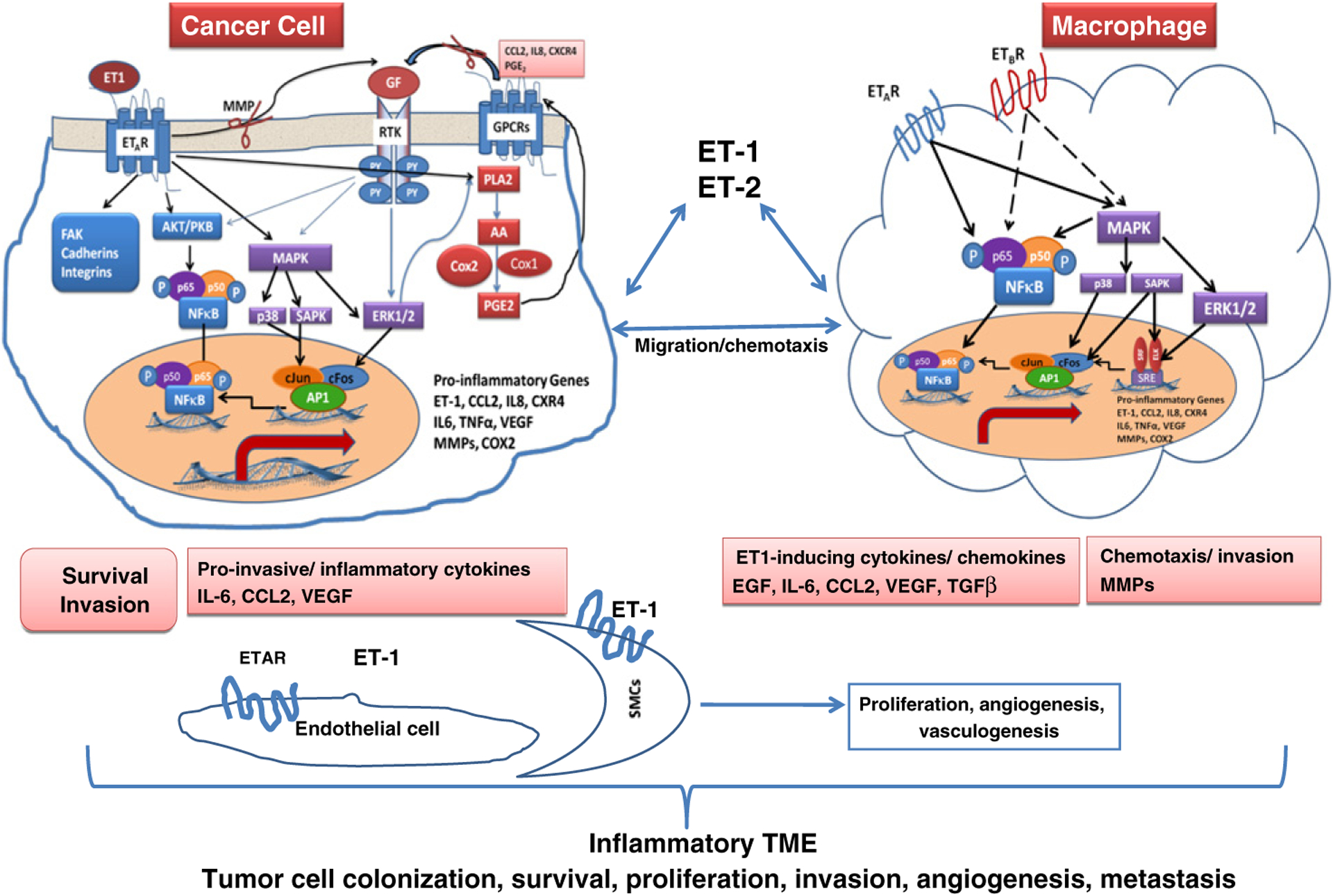
In tumor cells: Binding of ET-1 to the ETAR triggers multiple signal-transduction pathways, leading to cell survival and invasion. ET-1 increases its own secretion as well as the secretion of cytokines and growth factors IL-6, CCL2 (MCP-1), and VEGF as well as inflammatory mediators COX2 and prostaglandins-E2 (PGE-2).
In macrophages: ET-1 induces macrophage chemotaxis through ETAR and ETBR. Binding of ET-1 to both receptors in macrophages triggers signaling pathways converging in NFκB and AP-1 activation with subsequent induction of IL-6, CCL2, VEGF, EGF, TGFβ, MMPs and COX2, subsequently, stimulating tumor cell invasiveness, recruitment and colonization in preferential metastatic sites.
In endothelial cells and vascular smooth muscle cells: ET-1 stimulates endothelial and VSMCs proliferation, angiogenesis and vasculogenesis through interaction with ETAR receptor.
References
-
- Arun C, London NJ, Hemingway DM. Prognostic significance of elevated endothelin-1 levels in patients with colorectal cancer. Int J Biol Markers 2004;19:32–7. - PubMed
-
- Arun C, Swift B, Porter KE, West KP, London NJ, Hemingway DM. The role of big endothelin-1 in colorectal cancer. Int J Biol Markers 2002;17:268–74. - PubMed
-
- Awano S, Dawson LA, Hunter AR, Turner AJ, Usmani BA. Endothelin system in oral squamous carcinoma cells: specific siRNA targeting of ECE-1 blocks cell proliferation. Int J Cancer 2006;118:1645–52. - PubMed
Publication types
MeSH terms
Substances
Grants and funding
LinkOut - more resources
Full Text Sources
Molecular Biology Databases
